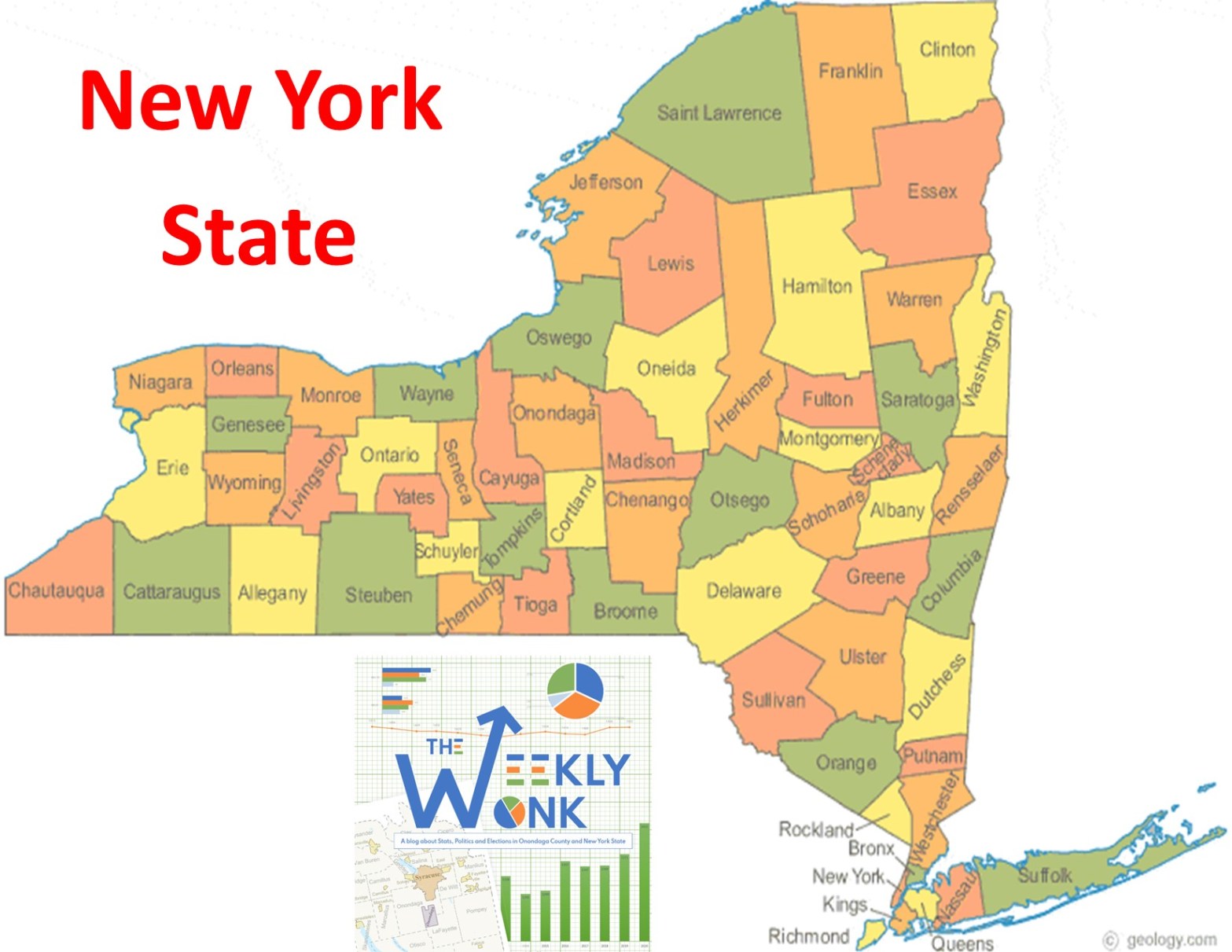
Welcome back to the #weeklywonk. In this space I try to shed some light on the forces that make up the body politic in New York and Onondaga County. Each week I will look at electoral and registration data that make up a political subdivision or an election event. This week I start my look at political subdivisions that will make up the General Election 2024. I start off with a look at New York State as we are electing a US Senator statewide in 2024.

It comes as no surprise that New York is an overwhelmingly Democratic state. When looking at the active voter registration compiled by the New York State Board of Elections in late February 2024 Democrats dominate the active voter rolls. There are 5,778,841 Democrats (49%) in New York. The GOP made up 2,695,185 voters (23%) which is actually third to the non-enrolled at 2,879,809 (24%). The Conservatives have 154,128 voters (1%) and Working Families have 50,048 voters (<1%) and 366,132 voters are enrolled in other various parties (3%). New York is generally thought of in three separate regions. New York City which has 4,519,781 voters (38%), the immediate suburbs consisting of Rockland, Westchester, Nassau, and Suffolk which has 2,835,419 voters (24%, and for lack of a better term upstate New York which has 4,568,943 voters (38%).
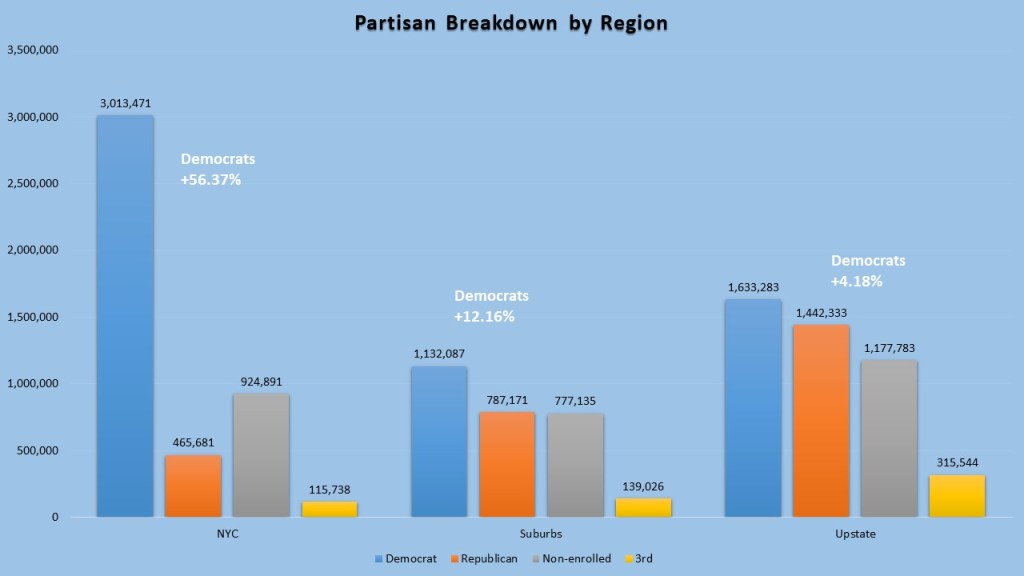
When looking at the partisan breakdown by region Democrats actually are in the lead in all three regions. In NYC Democrats dominate the enrollment there and the GOP are a distant third. Democrats have 3,013,471 voters, non-enrolled 924,891, GOP 465.681 and 115,738 in third parties. That is a +56.37% partisan enrollment advantage for Democrats. In the suburbs of Westchester, Rockland, Nassau, and Suffolk Democrats also have a significant advantage with 1,132,087 Democrats to 787,171, GOP, 777,135 Non-enrolled and 139,026 third parties. That is a Small +4.18% enrollment advantage for Democrats.
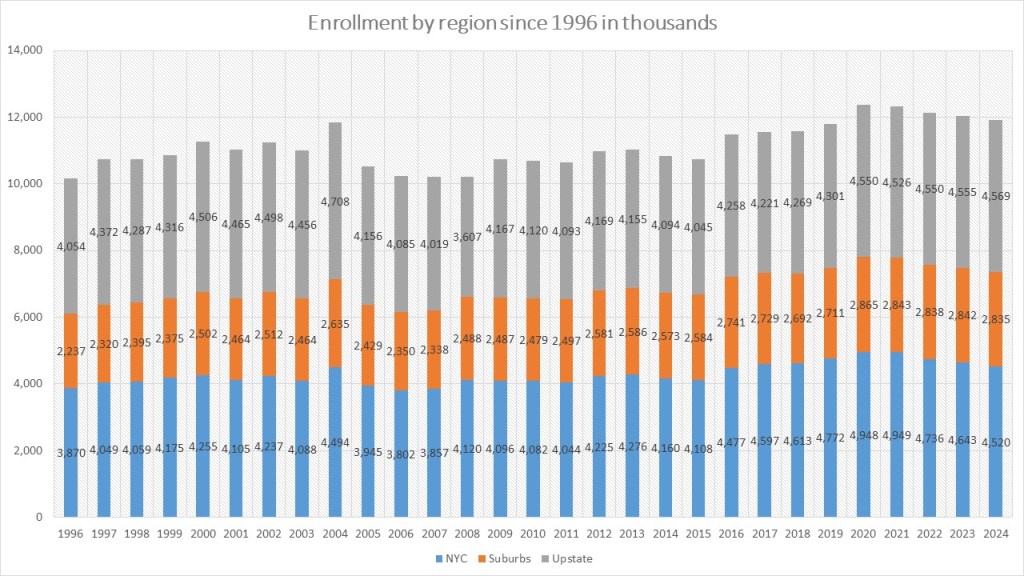
One of the more surprising reveals in this analysis is the upstate region has the most active registered voters, outnumbering New York City. In fact, looking back in registrations going back to 1996, tis is the first 2011 that has been the case. We have seen a steady three-year decline in voter registrations in NYC since 2021 while upstate has gained in that same time period. The suburbs during that time stayed relatively stable. This is not that surprising as urban areas in between presidential elections tend to lose voter registrations and gain in the Presidential year and year after. We will have to check in on the data in November.
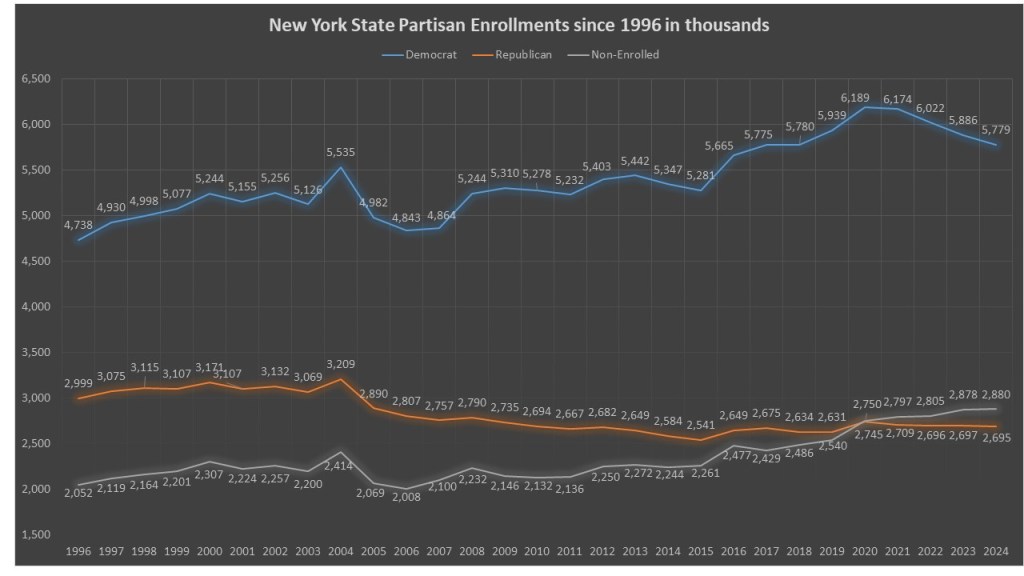
Another surprising data point is a decrease in Democratic enrollment over the last four years. The Trump presidency supercharged Democratic enrollment in New York, reaching a high of 6.189 million in 2020. Since then, the Democratic enrollment has dropped steadily each year down to 5.779 million in February of 2024. Republicans have not been the main beneficiary though. Their 2.695 million is also part of a steady but smaller decline since 2020. The main benefit seems to be the non-enrolments that have gained second place status in New York climbing to their highest point ever at 2,88 million. Again, the caveat here is the 2024 data is from February and we will have to see if the Presidential election year generates a large enrollment bump. Also, the Trump years of constant voter registration is an anomaly, looking back at four-year patterns there is usually a drop in between presidential years for major parties and then an increase in enrollment in the presidential year. We could be seeing a natural dip that will be erased by the end of the year.

When looking at how New York votes in common elections I have decided to look at 5 different statewide elections. The first of course in Gillibrand’s 2018 re-election bid since she is up for re-election again. She crashed in that election winning 64.90%. Since it is a presidential election, I take a look at the 2020 US Presidential result. President Joe Biden carried New York with 60.35%. Most statewide elections happen in mid-term years. In 2022 We elected an all-Democratic slate for statewide office which has happened each midterm since 2006. However, it was one of the years the GOP did the best. Senator Schumer (55.66%) won by double digits. However. Attorney General Letitia James had just 53.14% of the vote and Hochul just 52.67% of the vote.
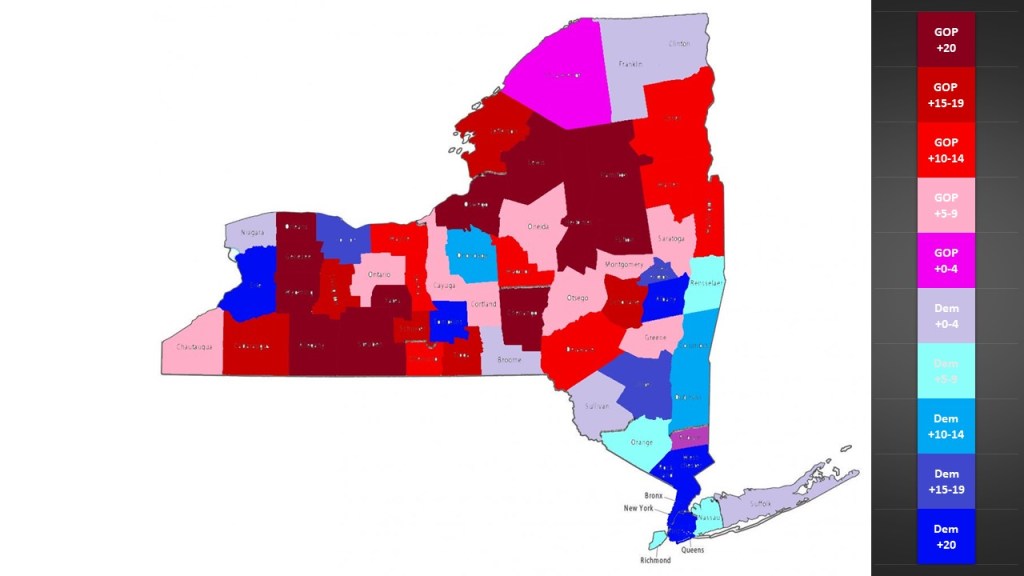
Finally, it is the return of the heat map. While for efficiency sakes I broke the whole of New York into three regions, we can see by the heat map that individual counties that make up those regions show the vast diversity of New York as a whole. NYC is a dominant blue, but Richmond County (Staten Island) is a standout of slightly less Democratic enrollment. The suburbs are truly broken into two different regions of the northern suburbs of Rockland and Westchester which are heavily Democratic and Long Island counties of Nassau and Suffolk that are borderline Democratic at best. Upstate sees the most diversity of any region. The Hudson valley region of Ulster, Orange, Dutchess, Sullivan, Putnam, and Columbia counties have either borderline to solid Democratic counties. The Capital region of Albany, Schenectady and Rensselaer also show strong Democratic enrollment. Counties with large urban cores such as Onondaga (Syracuse), Monroe (Rochester) and Erie & (Buffalo) also show solid to large Democratic advantages. Finally, some smaller counties with large college populations like Tompkins, Broome, Franklin, and Clinton show areas that have borderline to strong Democratic leanings.
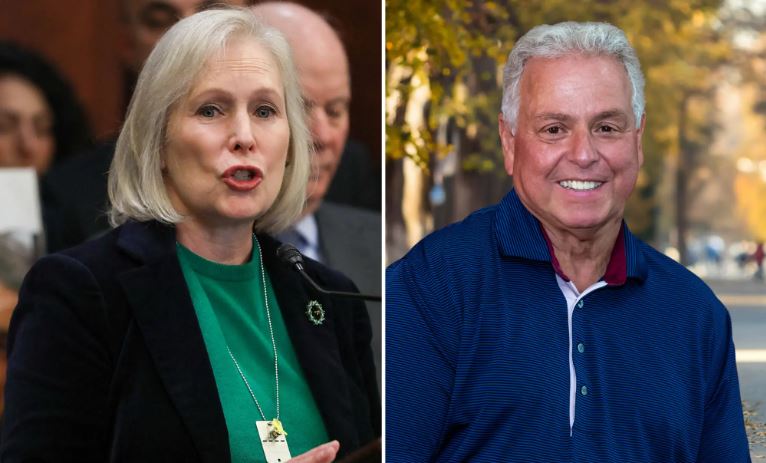
As mentioned at the top of the article, we do have a choice for US Senate this year in New York. Senator Kristen Gillibrand is running for re-election. She became Senator in 2009 appointed by Governor Patterson to fill the term of Hillary Clinton. She won a special election in 2010 to fill out the remainder of the term and re-election bids in 2012 and 2018. She is facing Republican and Conservative Michael Sapraicone. As of this article there are several candidates who filed petitions to create primaries on the Democrat and GOP side for US Senate, but they have all been preliminarily ruled invalid by the NYS Board of Elections and will need to go to court to preserve their right to challenge but that is considered unlikely.
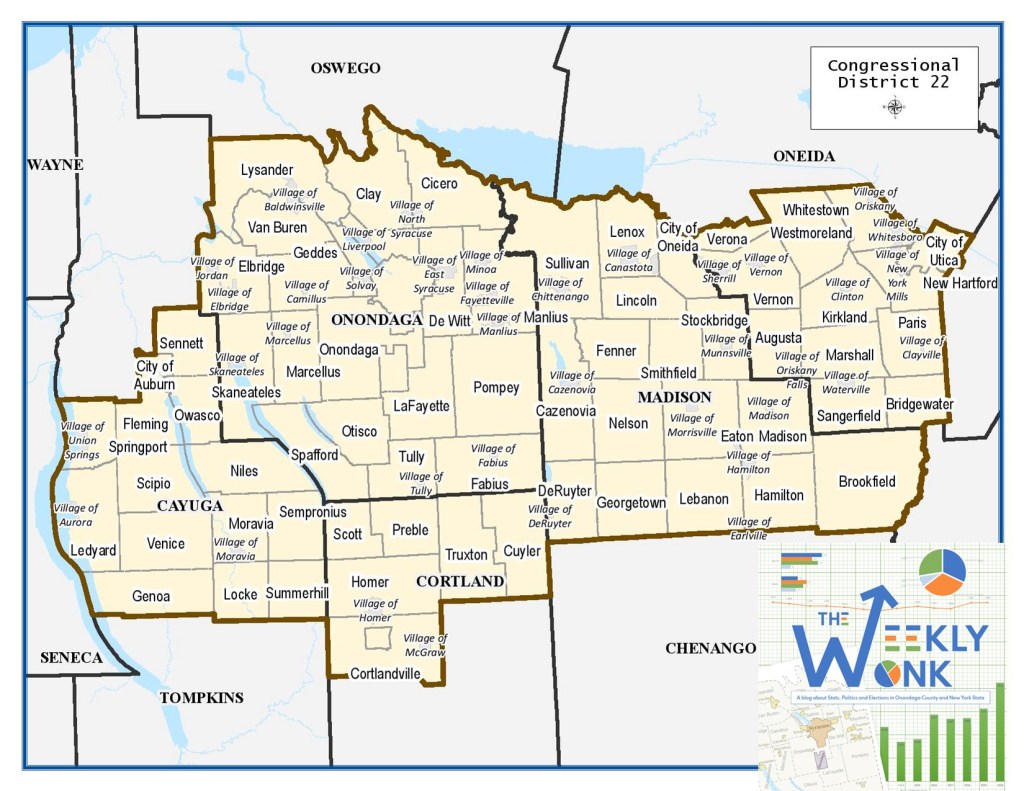
That is, it for this week’s edition of the #weeklywonk. Next week I will take a look at the newly drawn New York 22nd Congressional district. I will look at the changes in this district since the last election and redistricting’s effect in the district. As always you can subscribe to dustinczarny.com to get all content and election news updates.
 Dustin M. Czarny