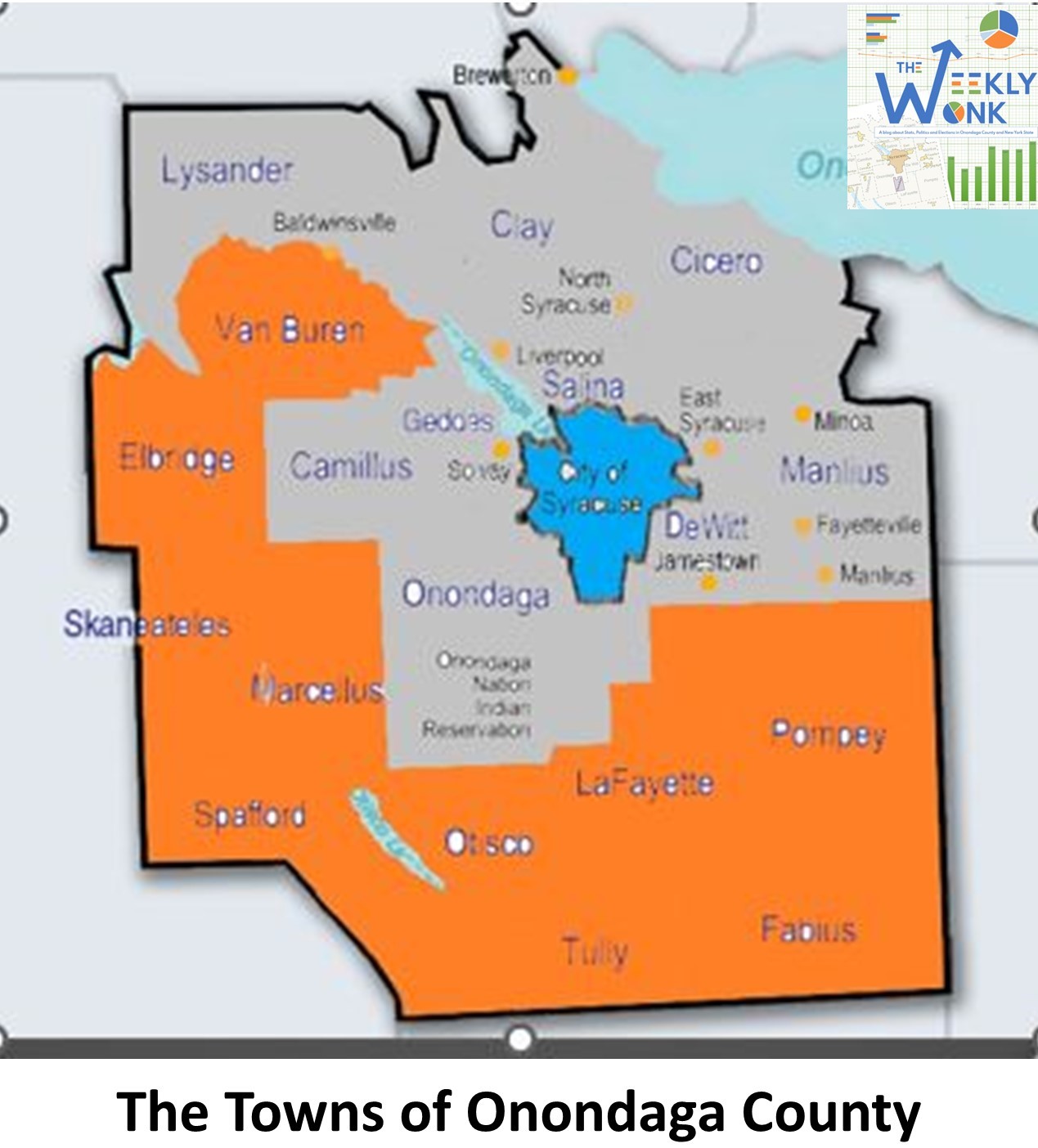
Welcome back to the #weeklywonk. This is my weekly article on election statistics and related topics. These articles give insight into the data and statistics that make up our home, Onondaga County and New York State. Each week I investigate a different election event or political subdivision that can give us clues into our rich and diverse electoral tapestry. Now that the June primary has been certified we turn our attention to the General Election. We continue our look at Onondaga County with a focus on the suburbs. We look at the seventeen towns that surround the City of Syracuse.

We have 234,608 active registered voters in the suburbs of Onondaga County as of the close of July 2024. Democrats make up 76,474 (33%), Republicans 73,034 (31%) non-enrolled 69,192 (29%), Conservatives 4,407 (2%) Working Families 830 (<1%) and 10,671 are in various other not recognized parties (5%). The City of Syracuse only makes up 23% (71,098 voters) of the active voters of Onondaga County. The rest belongs to the suburbs. The suburbs can essentially be broken into two distinct types of towns. We have large suburban towns and small agrarian towns. The large suburban towns make up 64% (194,273 voters) of Onondaga County. The small agrarian towns make up just 13% (40,335 voters despite being roughly equal in acreage.
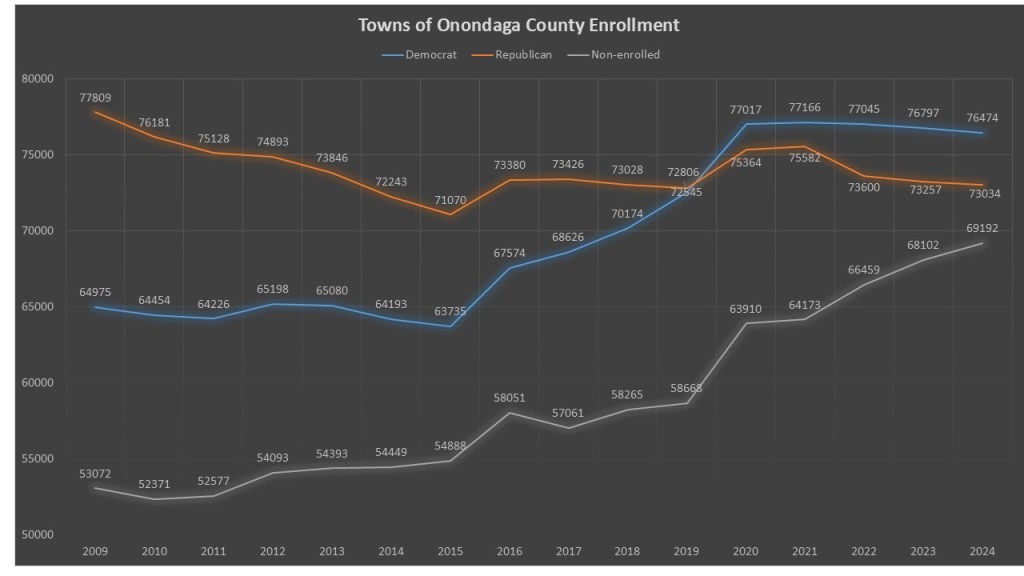
When we look at the partisan trends in Onondaga county, we see now familiar term trends since 1996 and also short-term trends since the last presidential election. Since 1996 Democrats in the suburbs have added 11,499 voters, & the non-enrolled have added 16,120 voters. The GOP though has lost 4,775 voters. However, since the 2020 election we are seeing a new trend. Democrats have lost 543 voters, and the GOP have lost 2,330 voters. However, the non-enrolled has exploded, adding 5,282 voters. It will be interesting to see whether this trend changes at all as registrations come in for the fall Presidential election.
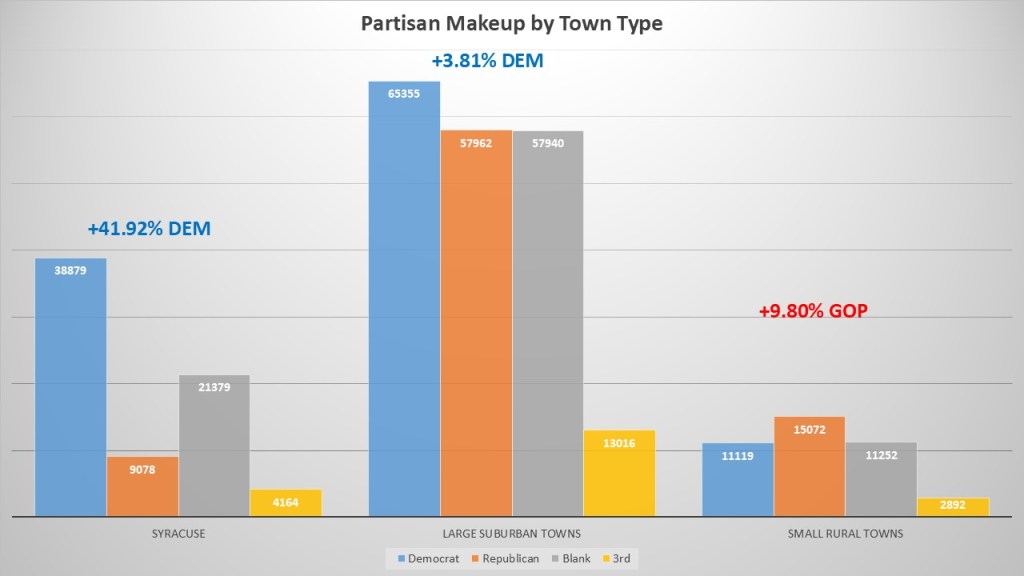
Taking a look at the partisan makeup of the suburban regions of Onondaga County we can see why a pretty strong polarization. The City of Syracuse is the most Democratic with Democrats having a +41.92% enrollment advantage. The large suburban towns end up having a borderline Democratic advantage of 3.81%. The rural towns have a moderate GOP lean of 9.80%. The heavy Democratic lean of Syracuse and small lean of the large suburban towns is what is driving the partisan lean of Onondaga County as the shear numbers overwhelm the small agrarian towns to give Onondaga County its slight blue lean. In fact, the sheer numbers of the suburban towns alone allot the Democrats to have a small advantage even outside of the City of Syracuse.
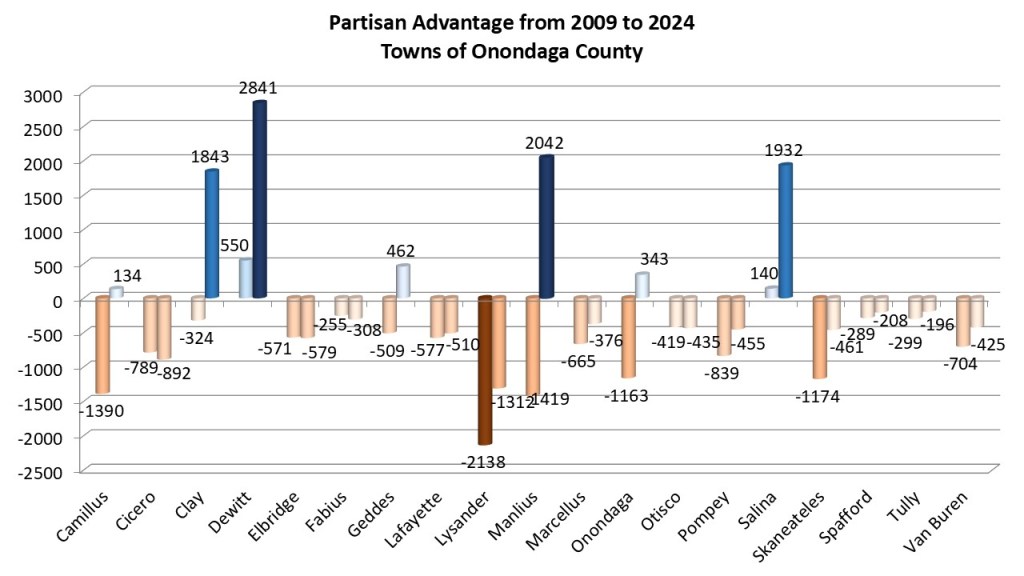
We will take a look at most of these towns individually throughout the rest of the year, especially if they are having competitive races. However, this graph shows how towns have changed since 2009. Almost every town has gotten more Democratic over time. Since 2009 2 towns were slightly Democratic (Dewitt and Salina) and expanded their Democratic advantage. % towns (Camillus, Clay, Geddes, Manlius, & Onondaga) flipped from Republican advantage to Democrat, with Manlius being the biggest swing. We have had eight towns (Lafayette, Lysander, Marcellus, Pompey, Skaneateles, Spafford, Tully, & Van Buren) reduce their GOP advantage though remain Republican. Finally, four towns (Cicero, Elbridge, Fabius, & Otisco) have increased the GOP advantage over the last 15 years.

With that we check in on the heat map for Onondaga County. This has essentially remained unchanged since 2020. You have your bright blue dominant City of Syracuse in the middle of the county. You then see the easter direct suburbs with the dark solid democratic lean of Dewitt, followed by the slight leans of Manlius & Salina. The borderline Democratic towns of Clay sit to the north, and Camillus, Geddes, and Onondaga County to the direct west of Syracuse. Borderline GOP towns of Van Buen sit in the northwest and Cicero in the northeast. Slight GOP towns in Lysander, Marcellus, Skaneateles, Pompey, and Tully are scattered as we get farther out from Syracuse. Moderate GOP towns like Elbridge and Lafayette make up the next group. Spafford is in the next group with a strong GOP lean. Finally, you have the dominant GOP towns of Otisco and Fabius in the dark red.

An analysis of the suburbs cannot be complete without a look at how third parties affect the towns. While Conservatives are small county wide, they are mostly existing outside the City of Syracuse. With the Working Families having such a small number, this means every town shifts a bit to the right. This represents about a 2-3% shift per town. This is most evidently in play in the borderline towns from the heat map. Cicero and Van Buren become slight right ward leaning instead of borderline. Camillus flips from a borderline Democratic town to a borderline right lean. Onondaga Geddes, and Clay get remarkably close to evenly registered towns when you take the conservative effect on their enrollment.
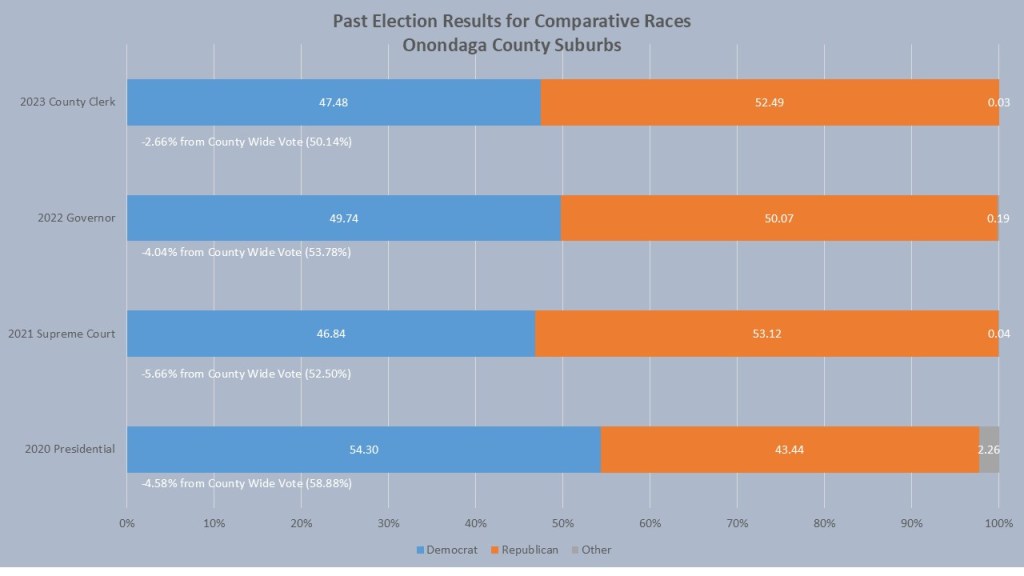
Finally, we look at the comparative races and how they perform in the suburbs vs. the county overall. In general, the suburbs react about 4-5% more republican than the county as a whole. In 2022 Governor Kathy Hochul lost the suburbs and was only able to get 4.974% of the suburban vote which is 4.04% less than her win in Onondaga County. In the 2021 Supreme Court race Anthony Brindisi only got 46.84% of the suburban vote, 5.66% less than his Onondaga County total. President Biden’s 2024 race was the only comparative race that won the suburbs with 54.30% of the vote but that still trailed his county wide total by 4.58%. Finally last year Emily Essi was one of the closest races in Onondaga County but bucked the trend in the suburbs somewhat. Though she lost the suburbs with just 47.48% but that was only 2.66% lower than her Onondaga County total.
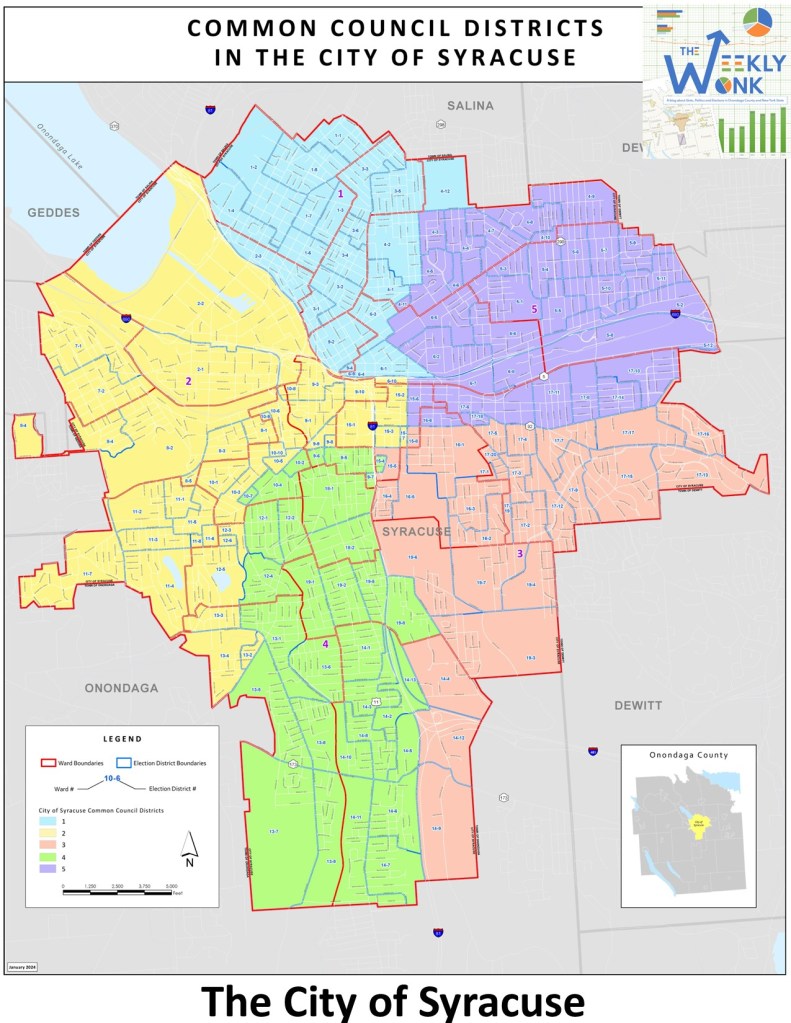
That is, it for this edition of the #weeklywonk. Nest week we will continue to look at the political subdivisions in our county holding elections. We will investigate the city of Syracuse which not only has two City Court races this year, but it will also play a vital part in the Congressional and Family Court races this fall. As always you can subscribe to dustinczarny.com to get all my content and election news updates.
 Dustin M. Czarny