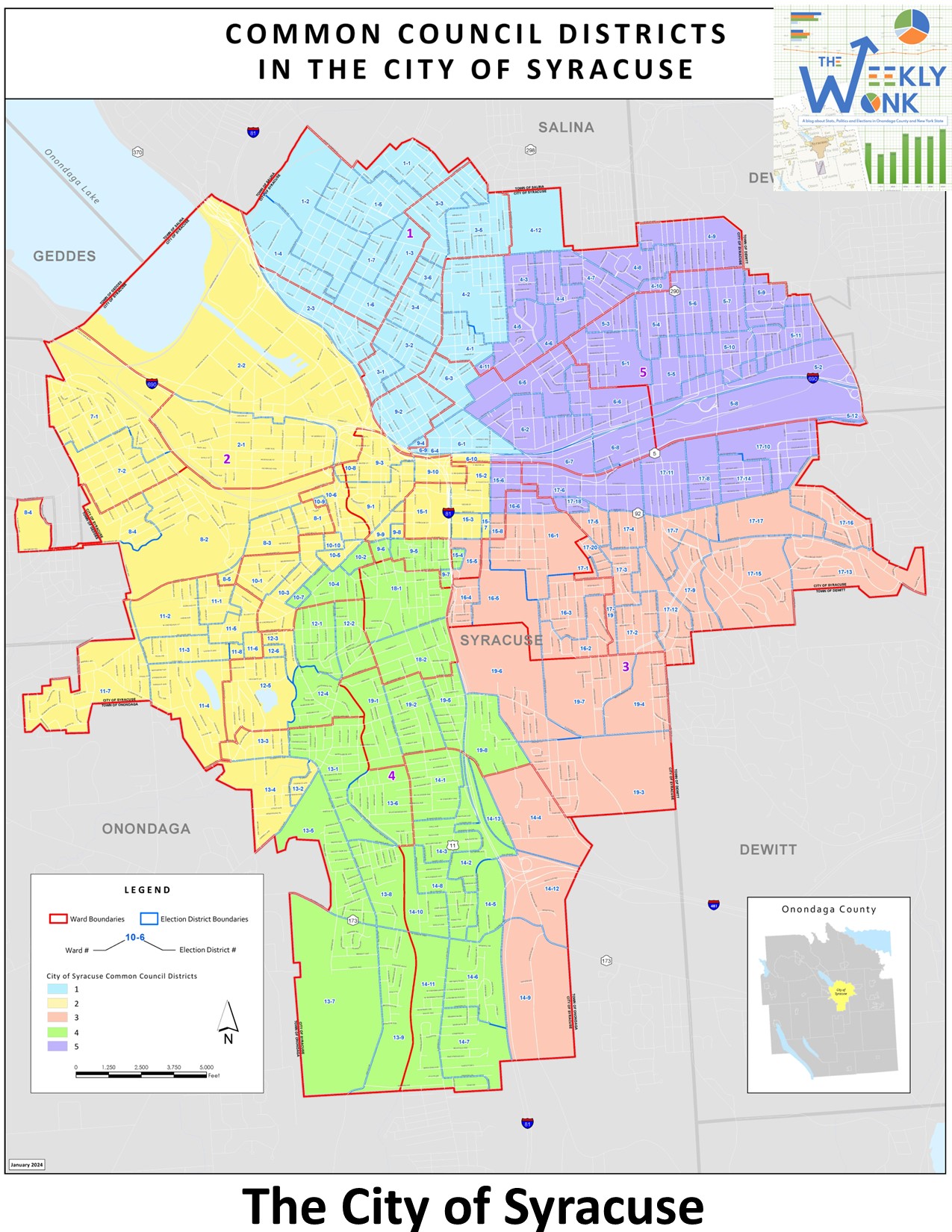
Welcome back to the #weeklywonk. This is my weekly article on election statistics and related topics. These articles give insight into the data and statistics that make up our home, Onondaga County and New York State. Each week I investigate a different election event or political subdivision that can give us clues into our rich and diverse electoral tapestry. Now that the June primary has been certified we turn our attention to the General Election. We continue our look at Onondaga County overall with our final piece of the puzzle, the City of Syracuse. Today we will look at the 19 Wards and 5 Common Council districts that make up the center of Onondaga County.

The City of Syracuse has 71,574 active registered as of August 2024. Democrats make up 39,181 (55%), Republicans 9,113 (13%) non-enrolled 19,437 (27%), Conservatives 658 (1%) Working Families 593 (1%) and 2,594 (3%) are in various other not recognized parties. The City of Syracuse has 5 Common Council districts that divide the city. The city radically redrew the maps following the 2020 census and now these districts tend to fall along neighborhood lines. Since they are drawn on population numbers, the active voters can vary. The smallest is the 1st Common Council makes up 16% of the active voters (11,670). The 3rd Common Council has 18% (12,4880 of the voters. The 2nd Common Council has 21% (15,164) of the voters. The 4th Common Council has 22% (15,864) of the voters. Finally, the 5th Common Council has 23% (16,343) of the voters.

When we look at the partisan trends in City of Syracuse the story is the atrophy of the Republican party and rise of the non-enrolled. The Democrats have remained surprisingly stable. Since 2009 the Democrats have just added 109 voters. In the same time period, the non-enrolled have added an outstanding 2,853 voters. The big loser here is the GOP. Echoing trends, we have seen across the nation that the GOP has lost 3,871 voters since 2009. One of the things I am tracking this year is how subdivisions have changed since the last Presidential election. Democrats have lost 2143 voters in the City of Syracuse and Republicans have lost 558. The non-enrolled continued to gain, adding 1476 voters. While this is a bit of an alarming trend, there is a caveat. There is a long trend of falling registrations in between Presidential years with a massive rally in the Presidential year itself. A good deal of that comes in the last few months of the year. We will follow up on those 2020 numbers right before the November 2024 general election.

Taking a look at the partisan makeup of the common council districts we can see why all Democrats now represent the Syracuse Common Council. The last common council district to be represented by the GOP is the 1st Common Council, which flipped to Democrat in 2021 though it was redrawn as all districts were for the 2023 elections. The 1st Common Council is now a solidly northside district and has a +30.27 Democratic lean. The 2nd Common Council district representing the west side has a +37.94% Democratic lean. The 3rd Common Council district representing the University and east side has a +51.95% Democratic lean. The 4th Common Council district representing the southside and valley has a +53.47% lean. Finally, the 5th Common Council representing Eastwood and Sedgewick neighborhoods has a +35.44% lean. These overwhelming Democratic numbers not only lead to the representation we see, but the more frequent primaries inside the city.

With that we check in on the heat map for City of Syracuse. For the heat map we look at the nineteen wards inside the City of Syracuse. The City of Syracuse presents a special challenge for our heat map. In the past we identify a top level of Democratic advantage of over 205. Every Ward in the City would have fallen into that category to make a very boring heat map. There is value though to show the intensity of the Democratic advantage inside the city. To that end I have added three more categories of Democratic advantage to this heat map. The 1st, 3rd, 5th, and 7th Wards fall into the 2029% Level. The next level of 30-40% Dem advantage exists in the 2nd, 4th, 6th. Eighth, and 11th wards. The 9th, 13th, 14, 15th, and 16th wards fall into the 40%-50% range. Finally, the biggest Democratic advantage in the city of over 50% Dem advantage belongs to the 10th, 12th, 17th, 18th, and 19th wards.

The domination of the Democrats inside the City is reflected even when we look at the effect of third parties on the enrollment advantages. One of the analyses I have added this year is how the Conservative and Working Families parties affect the ideological tilt of a political subdivision. Usually, the conservatives outnumber the working families by 3 to 1 or more and thus shift the subdivision to the right. They are virtually tied in the. y of Syracuse registration wise and that is reflected in the individual wards as well. This chart shows percentage of each ward when we add enrolled Democratic and Working Families voters together and compare it to Republicans and Conservatives added together. The colored totals above the advantages show the shift when adding in Conservative and Working Families numbers. This may be the only place inside the county where there are actually shifts to the left. Eight wards represented with blue numbers, shift to the left. Nine wards represented with red numbers shift to the right. Two wards represented with white numbers stay exactly the same. In general, though no shifts are less than 1% and in general.

Finally, we look at the comparative races and how they perform in the City of Syracuse vs. the county overall. In general, the city of Syracuse in general reacts around 20% more Democratic than the county as a whole. In 2022 Governor Kathy Hochul win the County due to her 7.51% performance inside the City, +19.72% from her county wide vote (53.78%). In the 2021 Supreme Court race Anthony Brindisi got 73.78% of the city of Syracuse vote +21.28% than his Onondaga County total (52.50%). President Biden’s 2024 race performed the best of our comparative race inside the City of Syracuse with 76.96% of the vote but that +18.08% better than his Onondaga County total (58.88%). County Clerk Emily Essi’s win in 2023 was largely propelled by her performance inside the City of Syracuse winning 72.50% of the vote which was +22.36% better than her narrow county win total of 50.14%. Finally, I added the 2021 Mayoral race results into the mix as a preview for next year’s Mayoral race. Mayor Ben Walsh, an independent, won 6052% of the vote, compared to Democrat Khalid Bey’s 27.68% and 11.80% for Republican Janet Burman.
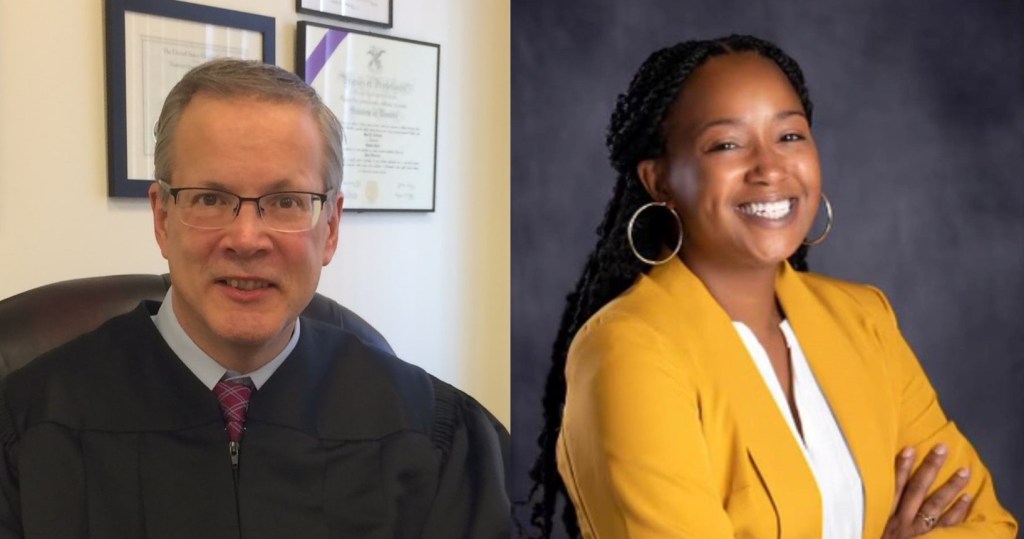
The only races inside the City of Syracuse this year are City Court judges. Judge Ross Andrews is running for re-election and newcomer Staci Dennis-Taylor is running for the second seat caused by the retirement of Judge Vanessa Bogan. There are no other declared candidates for these seats. They are running on the Democratic line. The City of Syracuse though will play a large part in potential victories for Democrats running for Congress, State Senate, Assembly, and Family Court.

That is, it for this edition of the #weeklywonk. Nest week I will look at the first political subdivision that is having a competitive election this fall. The Town of Clay, the largest town in Onondaga County. As always you can subscribe to dustinczarny.com for all content and election news updates.
 Dustin M. Czarny