The #weeklywonk is back. My weekly column on election and registration data in Onondaga County and throughout New York State has been running since the middle of 2020. I took a hiatus for this column for the last part of 2024 and 2025 while I reevaluated what content I wanted to bring to dustinczarny.com. There were occasional columns around elections, but I am happy to say I Am back and doing this weekly for the rest of 2025 and 2026. I have found new ways to present data effectively. This week we continue my three parts look back at the 2025 General Election. Today I bring to you Part 2: How Voters Participated in the 2025 General Election.
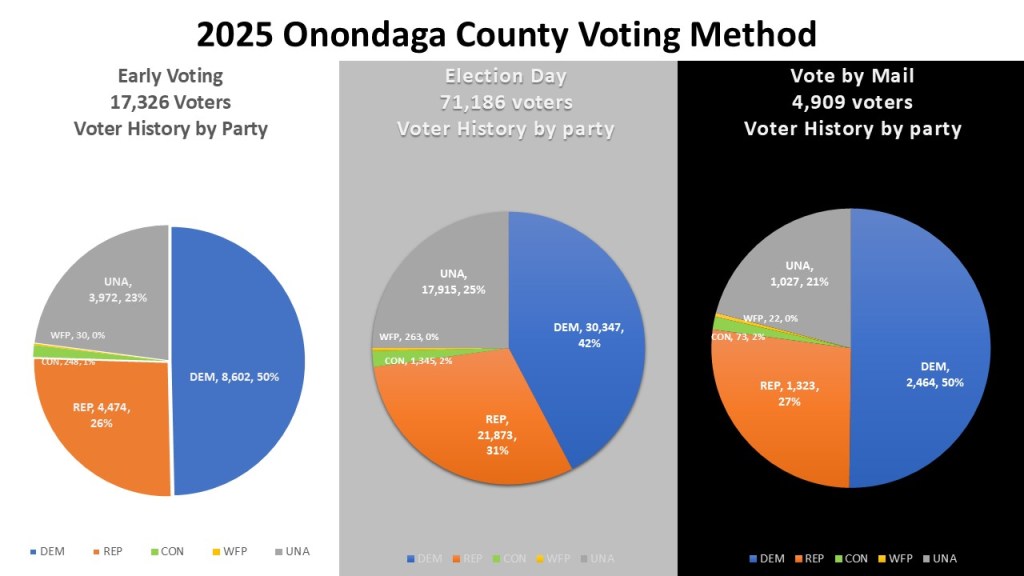
For this column I will focus on three main ways voters participated, Early in Person voting, Vote by Mail, and Voting on Election Day. This data brought to you by the official voter turnout starts at the Onondaga County board of Elections which lumps all voters outside of the four major parties with the unenrolled into the Unaffiliated category. Early In Person Voting includes voters who voted at our 10 Early Voting stations during the EV period including regular voters, court orders, and affidavits. 17,326 voters participated with 50% (8,602) who were Democrats, 26% (4,474) who were Republican, 23% (3,972) who were Unaffiliated, 1% (248) Conservative, and >1% (30) Working Families parties. Election Day also has regular voters, affidavit voters, and court orders and totals 71,186 voters. Forty-two percent (30,347) were Democrat, 31% (21,873) were Republican, 25% (17,915) were Unaffiliated. Two percent (1,345) were Conservative, and >1% (263) were Working Families. Vote by Mail voters include Absentee, Early Vote by Mail and UOCAVA/military voters. 4,909 voters participated by mail with 50% (2,464) Democrat. Twenty-seven percent (1,323) Republican, 21% (1,027) Unaffiliated, 2% (73) Conservative, and >1% (22) Working Families Party. Democrats were the plurality of every vote method but were more represented in Early and Vote by Mail voters.

Looking at Early Voting in 2025 we see that it is another example of #earlyvotingisgrowing. As I did last week, I am going to focus on just the local years: 2018, 2021, 2023, & 2025. With four years of Early Voting during off-year elections we really see significant progression. Furthermore, to compare apples to apples I am looking at check-in data here and excluding court orders and affidavits. The Early Voting totals in 2025 of 17,218 which is 18.43% of the overall vote in 2025. Both the raw number and percentage of vote is double what we saw in in the first local year (8,462 7.87%), Significant progress has been made each local year with 2021 (9,727 10.31%) and 2023 (12.680 13.96%) showing growth culminating in the record year we saw in 2025, Early Voting continues to grow in its popularity in local years even if it trails the percentages and numbers in even years.
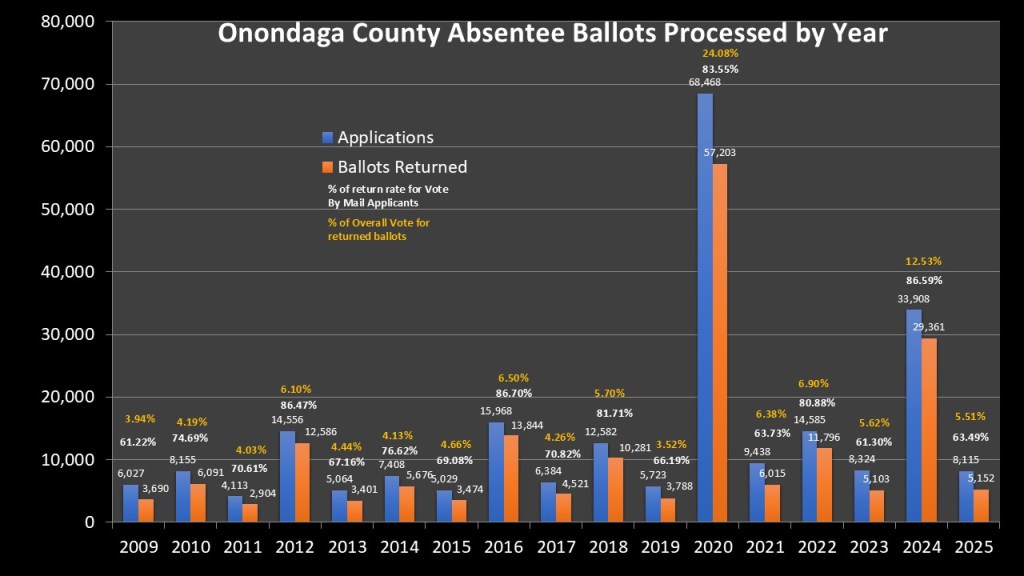
On the other side of the discussion is Vote by Mail. Unlike Early Voting, the vote by mail has not grown significantly during local years. This dataset analyzes returned ballots, including those rendered invalid because of unresolved technical problems. There were 5,152 ballots returned out of 8,115 ballot requests made in 2025. This resulted in a return rate of 63.49%. These ballots accounted for only 5.51% of the total votes cast. This is like 2023 (5103 out of 8324 61.30% return rate 5.62% of the vote) and significantly less than 2021 (6015 out of 9,438 63.73% return rate and 6.38% of overall vote). The 2021 data seem higher than usual because of the pandemic’s effects that year. In contrast, when EV debuted in 2019, its return rate stood at 66.19% (3,788 returned out of 5,723), and it made up just 3.52% of the total vote—both numbers falling below the projections for 2025. Voting by mail is more popular than when New York changed our Democracy to add more options, but it is not growing at the rate that EV is.
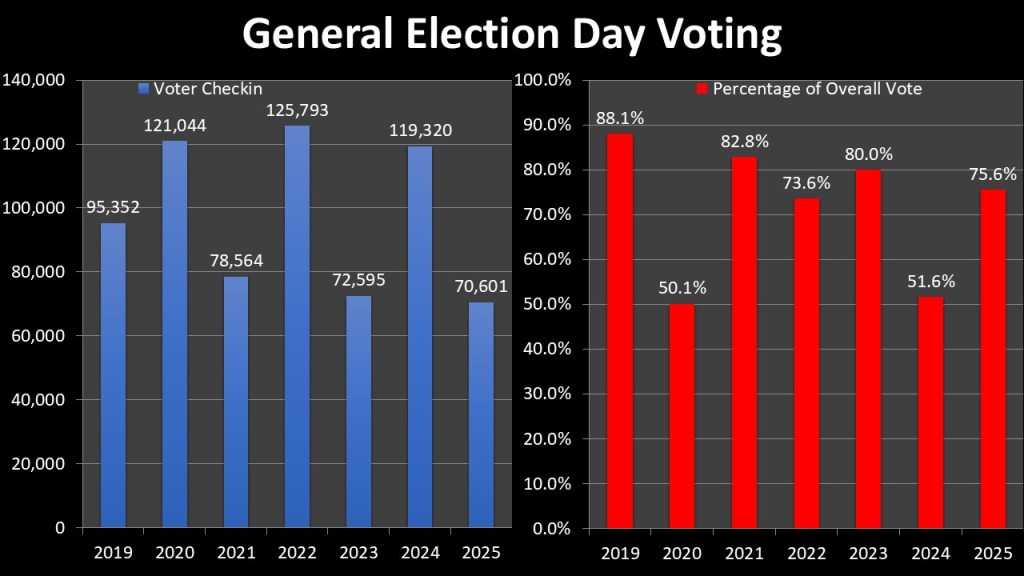
Election Day voters continue to be the most popular form of voting, but it is falling in both numbers and percentage of the vote for local years. Once again, we are looking at voter check-ins and not affidavit or court orders. On Election Day 2025 we had 70,601 voters and it represented 75.6% of the votes. This is the lowest of all four Election Day local years in the modern era. We see a downturn each year with 2023 (72,59*5 80.0%), 2021 (78,564 82.8%) and 2019 (95,352 88.1%) all lining up with a steady and downward progression. More Onondaga County voters are choosing alternative voting choices, specifically Early Voting, during local year elections.

When it comes to partisan choices, we can see that in 2025 how and why Democrats had such a good night last month. When comparing the methods of voting to overall voter registration, Democrats outkicked their coverage. Democrats represent 37.08% of the overall registration in Onondaga County and overshot that registration as they were 12.57% higher for Early Voting, 5.55% for Election Day, and 13.12% for Vote by Mail. The republicans have 26.76% of the registration and did overshoot their representation for Election day by 3.97% but Early voting (-0.93%) and Vote by Mail (+0.19%) were statistically the same as the voter registration rate., Unaffiliated represents 34.00% of the electorate but underperformed in all three voter methods (-11.07% Early Voting, -8.83% Election Day, -13.08% Vote by Mail). Looking at the partisan trends since 2019 we can see 2025 was a reversion back to the norm after a successful Early vote participation by the GOP in 2024. More of the Democratic vote (28.35%) chose Early Voting than the GOP (20.45%)/ With Vote by Mail Democrats (8.12%) were a larger share of their vote than the GOP (6.05%) but even for Democrats this was a bus drop from last year.

This year I am doing a bigger focus on age groups in the Weekly Wonks. As we saw last week the electorate was significantly older than the overall registration of Onondaga County. So, it is no surprise that the older the electorate gets, the more voters use each of the voting methods. However when we look at the percentage of the age groups vote and the method they choose there is one surprising detail The two oldest groups 71+ (87.16%), 61-70 (73.87%), 51-60 (81.06%) had the least percentage of their vote choosing Election Day. However, the youth vote 18-30 (82.67%) is lower than 41-50 (86.30%) and 31-40 (86.76%). This could prove a useful tool when trying to address the youth voter turnout issue, trying to steer to alternative forms of voting like Early or Vote by Mail. In fact, with vote by mail the youth vote is the second highest rate of participation only reaching 71+.
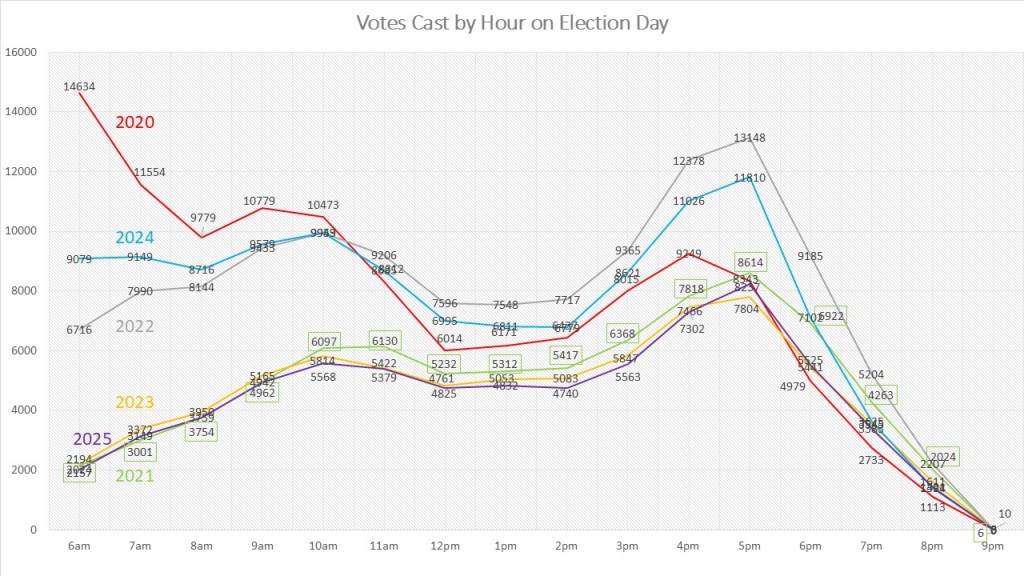
Finally, I like to look at the hourly data on Election Day. There is no statistical value to this other than to manage expectations for future years. Regrettably, access to the 2019 data is unavailable because it was not archived. However, 2025 mimics other local years on record, 2021 & 2023. The day starts of low and builds till about 11 am. There is a slight lull between noon and 3pm. Then there is a dramatic upturn with 4-6pm being the busiest times of the day. We then see a dramatic decrease in the evening hours. This is the same in the one midterm election of 2022 we have data for. The two Presidential elections of 2024 and 2020 acted so dramatically differently we need more data to determine how Presidential and midterm electorates act.
That is, it for this week’s edition of the #WeeklyWonk. Next week I conclude my look back at the 2025 election to look at how Democrats did when it came to elective office. We will analyze districts that have undergone changes in seat allocation, those with consistent seat distribution, as well as regions where both parties contested only a limited number of offices. As always you can subscribe to dustinczarny.com for all content and election news updates. Enjoy.
 Dustin M. Czarny