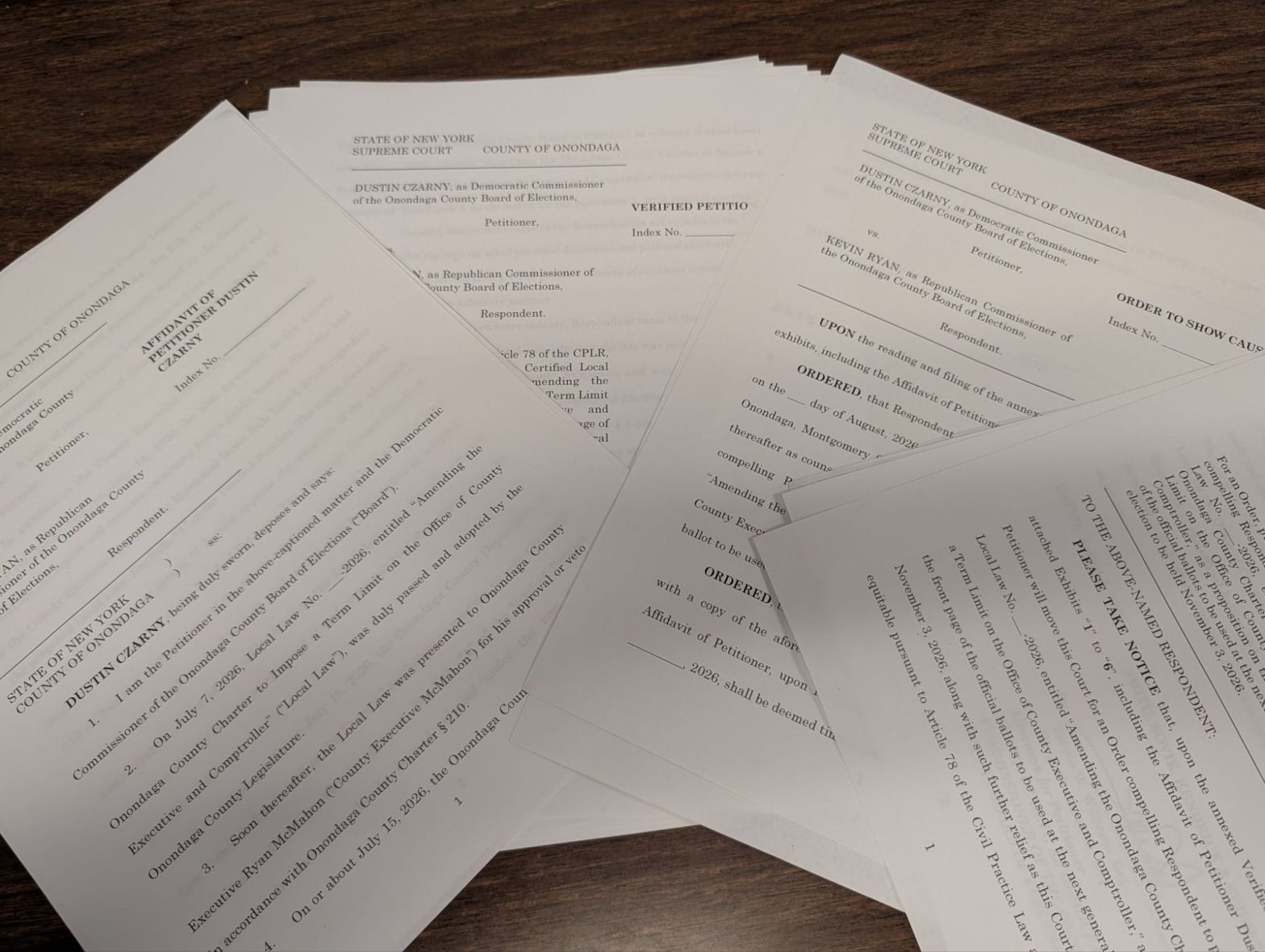
Today I filed a request for an Order to Show Cause asking the court to resolve whether the resolution establishing term limits for the Onondaga County Executive and County Comptroller should appear on the November ballot. I do not take this action lightly. This is an unprecedented situation, and after consulting with my legal counsel, I concluded that seeking a judicial ruling is the quickest, most appropriate, and perhaps only way to resolve this dispute before the statutory deadlines.
My position is straightforward: the Board of Elections’ responsibility is to place properly transmitted resolutions on the ballot—not to determine their legal validity. Questions regarding the validity of resolutions belong to the officials designated by law and, when disputes arise, to the courts. In my view, the resolution transmitted to the Board on July 17, 2026, should be placed before the voters this November unless a court determines otherwise.
While some may view this as a dispute over a single ballot question, the issue before us is much broader. At stake is the proper role of New York’s bipartisan Boards of Elections and the ministerial duties assigned to election commissioners under state law. Determining whether a resolution has been lawfully adopted is the responsibility of the appointed clerks of the Onondaga County Legislature, the Syracuse Common Council, and the elected town clerks throughout Onondaga County. Election commissioners are not empowered to independently determine the legal validity of resolutions beyond ensuring they are timely transmitted and in proper form as required by law.
If one commissioner can prevent a properly transmitted resolution from reaching the ballot based on legal grounds not assigned to election commissioners under state law, it establishes a precedent that fundamentally changes how bipartisan Boards of Elections function. That precedent extends far beyond this single resolution and raises significant questions about the balance of authority established by New York Election Law.
I recognize that my counterpart sincerely believes his position is the correct one, and I do not question his good faith. We simply disagree about the responsibilities assigned to election commissioners under the law. When bipartisan Boards of Elections reach an impasse on a matter of legal authority, the courts are the appropriate and only neutral arbiter.
I also understand the concerns of those who worry about the cost of litigation. Unfortunately, the deadlines for resolving this dispute administratively have passed, leaving judicial review as the only practical avenue to obtain a timely and definitive answer before ballots must be finalized.
This action is not about whether term limits are good policy or bad policy. It is about ensuring that each governmental body fulfills the responsibilities assigned to it under the law. My goal is to obtain clarity from the court regarding the proper role of the Board of Elections and, if the court determines the resolution belongs on the ballot, to ensure that the voters—not election administrators—have the opportunity to decide this question in November.
—
Dustin M. Czarny
Onondaga County Elections Commissioner (D)
Court Filings
For all updates on the court case please follow along at this link:
Subscribe to dustinczarny.com for all content and election news updates

