Today I sit down with Joe Nehme CNY Regional Director for Senator Chuck Schumer. We talk about what a regional office for a Senator does, how working through a pandemic has meant for him, and the ambitious legislative agenda for the Majority leader in the Senate, including the American Rescue Plan, American Jobs Plan, American Family Act and S1 and John Lewis Voting Rights Act. I hope you enjoy.
Wonky Wednesday: Town of Otisco

Welcome back to Wonky Wednesday. Each week I do a deep dive into the election and registration data that makes up the electoral landscape of our home, Onondaga County. I hope by looking into this data we can glean that this everchanging county is not monolithic as once thought and competition for Democrats, and all registrations, can be found everywhere. This week I investigate the Town of Otisco.
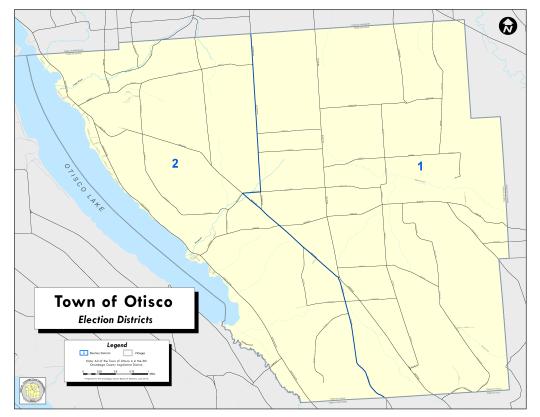
The Town of Otisco sits just south of the Town of Onondaga near the center bottom of our County. There are no established villages in Otisco nor are there any defined suburban areas. This is mostly an agricultural rural town with some clusters of housing along Otisco Lake which may not necessarily be full time residential properties. It is also one of the few towns that are wholly located in a County Legislative District (6) which is currently represented by Julie Abbott-Keenan (R). There are two election districts that basically split the town into western and eastern halves
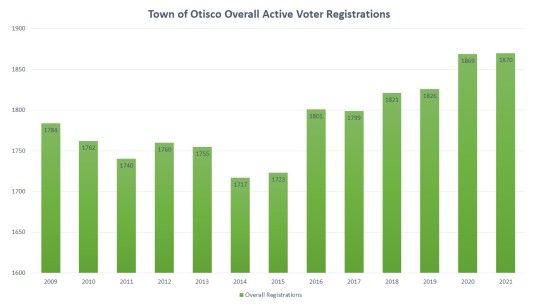
The overall population of the town of Otisco is very small. It is the second smallest town in terms of voter population in our County. How small is it? It is smaller than 16 of the 19 Wards inside the City of Syracuse in terms of registered voters. This makes it the 5th smallest political subdivision in Onondaga County. And it doesn’t look like the population is increasing either. Normal voter registration rises in the 2020 election appear but it is not likely a long term trend population trend. It is more likely a result of the normal registration rates rising during Presidential years.
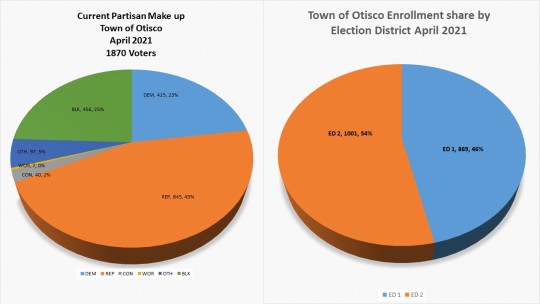
The current registration of the Town of Otisco shows a solidly GOP dominated town. Republicans make up 45% of the town with Democrats at 23%. Non-enrolled (BLK) voters outnumber Democrats with 25%. The two Election Districts are not quite equal in size. ED 2 is smaller in area but has more of the housing developments as it is the western portion of the town near the lake. ED 1 is the more agrarian eastern portion of town.

The partisan population in this small town has been relatively stable since 2009. The GOP has remained at the same level nearly doubling the Democratic enrollment. Democrats have had a mini surge since 2016 but it is not even enough to overtake the Non-enrolled. Finally the non-enrolled has also remained stable just outnumbering the GOP.
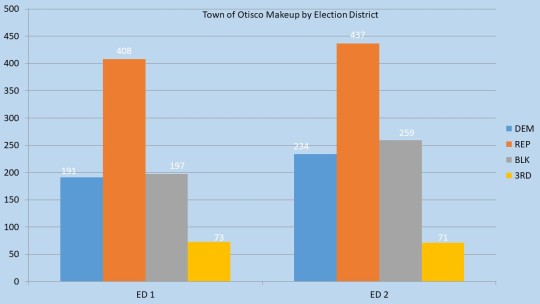
The election districts in Otisco are relatively similar in terms of partisan enrollment as well. ED 1 the GOP doubles the Democrat enrollment. ED 2 is a little less GOP dominant but not by much. However what little difference there is doesn’t really matter as every elected office in this town runs town wide. In fact if the election district sizes were ever to be raised Otisco might be a town where we consider only having one election district in it.
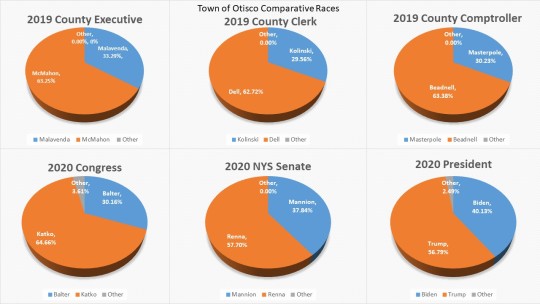
The significant six races we are looking at really drives home the fact that this is as strong a GOP town as it gets. In 2019 all three races, County Executive, County Clerk, and County Comptroller the GOP candidate crushed the opposition. In fact Beadnell and Dell doubled up their opponents while McMahon failed to do that, barely. In 2020 in a heavy Democratic year the GOP candidates had double digit wins in each race. Only Joe Biden could crack 40% in this town. Democrats only hope of winning in this area is to connect with non-enrolled voters, form a coalition, and hope for a local issue to rally around.
The Town of Otisco Democrats nominates their candidates by caucus. For such a small town Otisco actually has a good deal of races up this year. They will elect Supervisor, Clerk, three Town Councilors, Highway Superintendent, and tax assessors. If you are interested in any of these positions contact Otisco Democratic Town Chair Toby Shelley at toby_shelley@yahoo.com
Commissioner in a Car: Election Inspector classes begin
Today I talk about Election Inspector classes starting at OCBOE and how to apply. I also talk about my recent oped to syracuse.com on funding elections in Onondaga County. https://www.syracuse.com/opinion/2021/04/to-preserve-fair-elections-onondaga-county-needs-to-invest-more-money-commentary.html
To preserve fair elections, Onondaga County needs to invest more money (Commentary)

This originally was published by syraucse.com on April 26, 2021 https://www.syracuse.com/opinion/2021/04/to-preserve-fair-elections-onondaga-county-needs-to-invest-more-money-commentary.html
I am reporting it here to add to my essays on my Tumblr blog on elections.
It was welcome news that the American Rescue Plan had direct aid to local governments as part of its overall relief package passed into law in early March. This aide was meant to help restore vital services that were drastically cut during the COVID-19 crisis. In this revolutionary package, $89 million was given to Onondaga County with very few strings attached to it. The decision on how to spend this money resides with Onondaga County Executive Ryan McMahon and the Onondaga County Legislature. I believe it is vital that they reserve some of these funds to restore and enhance Democracy in Onondaga County.
Unlike previous packages there is no delineation for local Election Boards to receive any of the money assigned to Onondaga County. COVID-19 upended the 2020 Election season and the Onondaga County Board of Elections had to adjust. Comparing to 2016, our registration forms increased 250%; our absentee ballot applications increased 500%. We hired extra inspectors, temporary help, and worked 12 hour days in the weeks leading up to the General Election and after to meet our obligations to the voters of Onondaga County. The Onondaga County Board of Elections relied on CARES grant funding, existing federal Shoebox and HAVA grants, as well as a private Grant from the Center for Tech and Civic Life to meet those needs and limit the impact on local dollars.
As we head into 2021, we will continue to require additional resources to cover these costs. The COVID-19 epidemic continues in our community and nearly all of the mitigation factors put in place in 2020 will be needed in 2021. Our workload on absentees and registration forms will continue to grow. Extra staff will be needed for cleaning and securing polling places. Unlike 2020 though there are no federal grants we can rely on to cover those costs. It is up to Onondaga County to utilize some of the $89 million from the American Rescue Plan and the unexpected budget surplus of over $20 million to provide resources to the Onondaga County Board of Elections so we can continue to meet our mission. It is my recommendation we do the following:
Restore the budget cuts for 2021. While much was made of the attempted salary cuts of both commissioners, this hid another more egregious issue. The Onondaga County Legislature reduced the proposed budget for the OCBOE by over $200k. This bi-partisan budget for 2021 was proposed by both me and my GOP counter-part and agreed to by the County Executive. We were told at the time this cut was because of the dire budget outlook for the County but given no specific reason for the reduction. With the unexpected County surplus, it is imperative that the Legislature restore these funds so we can hire the temporary staff and prepare for the anticipated needs of another election season under COVID-19.
Invest in Early Voting Expansion for 2021. The 2020 election season was a success in almost every way for Onondaga County. However, the unwillingness to expand Early Voting centers beyond the bare minimum was an abject failure. Two hour waits as well as massive traffic congestion plagued our sites as voters flocked to take advantage of this new reform. I give a great deal of credit to my colleague who agreed to expand hours in the face of this challenge in 2021. However, it is nearly impossible to address the demand in the Early Voting period adequately with so few locations. This is not a one-time event and we must plan for at least the same level of participation in the future. In fact, all evidence from other states continues show Early Voting usage grows over time.
I will propose at our May organizational meeting at the Onondaga County Board of Elections to increase to 10 Early Voting sites adding Onondaga Community College, Lysander Town Hall, Cicero Town Hall, and downtown in the Civic Center complex. Adding sites in Lysander, Onondaga and Cicero will ease the burdens on our three largest suburban sites, Camillus Fire Station, Clay Town Hall, and Dewitt Town Hall. Adding sites at OCC and downtown will also take advantage of the thousands of Onondaga County residents that either commute to work downtown or work, attend classes or events at OCC. Putting sites where people congregate will reduce the burden on all sites throughout the County and accommodate the growing need of our electorate.
New York State has once again included money in the 2021 budget to compensate for Early Voting Operations. To qualify for this money we must agree to expansion in May. In 2019 Onondaga County passed up on these funds which Syracuse.com said was “penny-wise, pound-foolish”. Failing to take advantage of this opportunity a second time would be compounding this initial mistake. If we act in May, we can expand with no further cost to the county. Even without this funding source we can do this without much additional resources. More sites will mean reduced traffic at each site, decreasing the need for additional staffing. We can always surge staffing to meet increased need in certain locations as we monitor usage throughout the Early Voting period.
Add Four Permanent Positions to the Onondaga County BOE roster for 2022. This last week the Onondaga County Board of Elections released our Annual Report. Detailed in its pages is not only the massive additional workload we are experiencing each year but the inequities our Board has had to face in terms of resources. The Onondaga County Board of Elections operates with just 16 full time staff including the two commissioners. For a county of over 307,000 voters that means we have just 1 full time staffer to every approximate 19,000 voters. This is the worst ration in the 57 County Board of Elections State of New York. Furthermore, our average dollar spent per voter annually ($9.28) is the 5th most austere budget as well. We are incredibly efficient and utilize technology and modernization to achieve our required duties. However, over the last few years our tiny staff has routinely had to work 12 hour days for weeks on end to be able to properly run elections. The human toll on this type of workload has caused turnover and burnout. Election work is specialized and must have bi-partisan checks and consistency. Temporary workers are not a proper way to address this tidal wave of work on the horizon. Even if we add 4 full time workers, an increase of 25% of our workforce, we still will be the worst ratio of full time workers to voters in the state.
Lack of resources is the leading cause of Election Day failures at Board of Elections. We saw this in Oneida and #NY22 just this past cycle. We have avoided this in Onondaga County because our staff is dedicated to the ideals of free and fair elections. We desperately need the additional resources to continue that excellence and accommodate the growing needs of our community. The amount for preparing for and fixing our inequities pales in compare to the price we will pay if our election process falters. We need to invest in our Right to Vote for it is the right that makes all other rights possible.
Dustin M. Czarny
Onondaga County Elections Commissioner (D)
Zoom with Czarny: Joe Driscoll 5th District Councilor
In today’s Zoom with Czarny I sit down with Joe Driscoll – 5th District Councilor. We talk about his work on lead paint, permits for live music, Fair Maps CNY, and Flip the County Legislature. I hope you enjoy.
Wonky Wednesday: Highlights from the 2020 Annual Report
Welcome back to Wonky Wednesday. Each week I do a deep dive into the election and registration data that makes up the electoral landscape of our home, Onondaga County. I hope by looking into this data we can glean that this everchanging county is not monolithic as once thought and competition for Democrats, and all registrations, can be found everywhere. This week I take a break from the march through our towns to look at the Onondaga County Board of Elections Annual Report released last week.
Every year Election Law requires each Board of Election in New York State to prepare a written Annual Report. This report is distributed to each County Legislator, the County Executive, the County Comptroller, and posted on our website at onvote.net (under Election Regulations). We prepare the report in April of each year after the County closes its fiscal year. The report touches on just about every part of our mission to serve the voters of Onondaga County. In its pages you will have data on staffing Budgets, and election statistics.
Today’s Wonky Wednesday I will dive into a few highlights from the report that was not covered earlier this year with my post 2020 wrap up series. Previously I did Wonky Wednesday posts on Early Voting, Absentee, Affidavit and Court Orders, as well as 2020 Turnout. Today I will be highlighting some statistics from our Budget Performance, Staffing Levels, Workload, and I will be providing some stats not included in the Annual Report on Commissioner Salaries in Onondaga County.
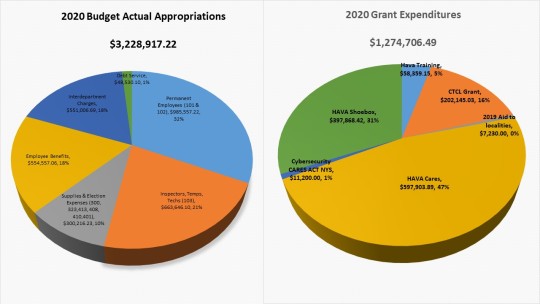
The 2020 local Budget for Onondaga County consisted of $3,228,917.22. This is the total impact of dollars on Onondaga County residents. The major expenditure categories are Permanent Staff (the 14 full time employees and 2 Commissioners) at 32%, Temporary and Season Employees (Techs and Inspectors that work the poll sites) at 21%, Employee Benefits for the Permanent staff at 18%, Interdepartmental Charges (charges from other county departments) at 18%, And Supplies at 10%. The OCBOE Commissioners submit budget requests for everything but the Benefits and Interdepartmental charges. Those portions of our budget are controlled directly by the Office of Budget and Management.
In addition to the local budget Onondaga County Board of Elections spent $1,274,706.49 in Grant Expenditures. This is where the OCBOE found State, Federal, or private Grants to offset local dollars. This effort to utilize grant money by the OCBOE kept our Department from going over budget in a year where COVID-19 created tremendous burdens on county budgets and Board of Elections throughout the nation.
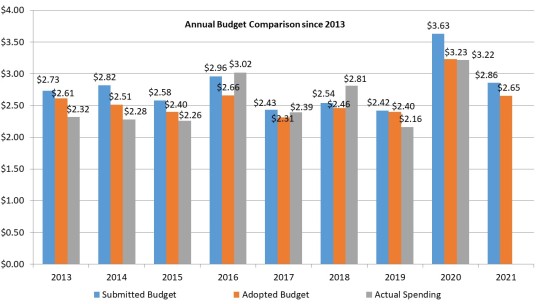
The overall budget is looked at in three stages. The OCBOE submits a budget to the County Executive and County Legislature based on our experience in what we need to spend in an Election Year. The County Executive and Legislature then alters the budget and finally adopts it. Finally, the OCBOE tries to expend local dollars below both the Adopted and Submitted budgets. However, we have a mandate at the Board to spend what is needed to cover state and federal mandates to service the voters for an election.
In 2019 then County Comptroller began a year long attack on the OCBOE for being irresponsible and “blowing our budgets”. This led me to start compiling historical data on our budgets going back to my first year as Commissioner. There were only two years where the OCBOE failed to keep expenditures below our submitted budget 2016 & 2018. The historic nature of the turnout in those elections is the direct cause for those discrepancies. In both years, the turnout broke expected levels. In 2017 we were under our submitted budget but over the cuts made by the County Executive and Legislature. In that year we also had historic turnout for a mayoral election which helped drive up costs. However, in all three years the much of the reason for going over budget was beyond the OCBOE control.
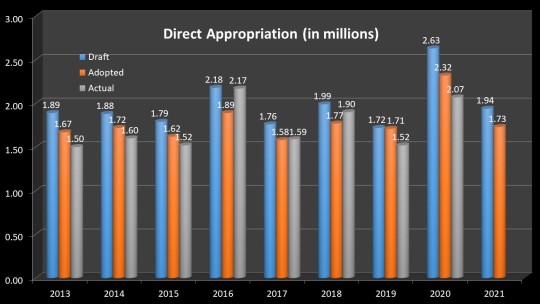
In these two slides you see the Direct Appropriation Spending as well as the Interdepartmental spending. As I noted earlier the OCBOE only has control of certain portions of our budget. This is all under the Direct Appropriation label. In the three years we went “over-budget (2016, 2017, 2018) our direct appropriation, the spending controlled by the BOE, was under our submitted budget amounts, though over the cuts made at the legislature. In fact, at my time at the BOE we have never spent more than our submitted budget request.
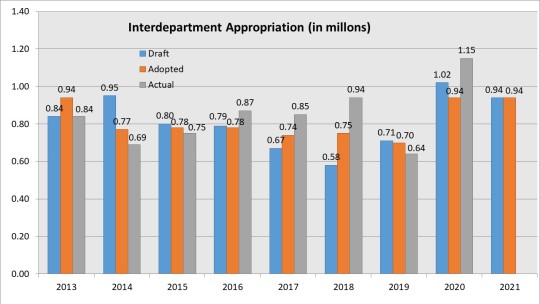
Where the budgets went over was in the direct appropriations. Again, this portion of our budget is created and controlled by the Office of Management and Budget. We have no control over the spending or creation of this budget. None of this nuance was shared by then Comptroller Beadnell in his many public attacks on our department.
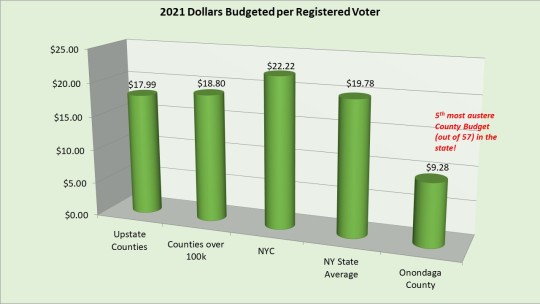
The austerity of the Onondaga County budgets is most noticed when comparing to the other counties. In 2021 that austerity continues. Our adopted budget of 2.8 million is 10th highest of upstate counties, but we have the 6th highest registered voter population. The proportional proposed spending of $9.28 per voter is the 5th worst in the entire state and way below the average of $17.99 per voter for all Upstate Counties and $18.80 per voter for counties over 100k.
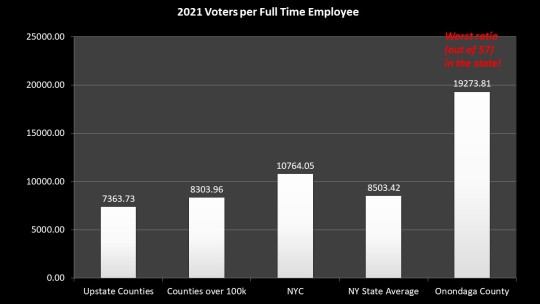
The main source of this inequity comes from the refusal to add permanent staff to our department. Despite all the Election Reforms passed and the dramatic increase in workload we are at the same staffing levels that we had when we started in 2013. The 14 full time permanent staff represent 1 full time staffer to every $19.2k voters. Throughout Upstate New York the Boards of Elections average 1 full time staffer for every 7.3k voters, Again Counties over 100k voters average 1 for every 8.3k voters. Even if the County adopts my proposal for 2021 to add 4 full time permanent staff, an increase of over 25%, we still will have the worst ratio in the state.
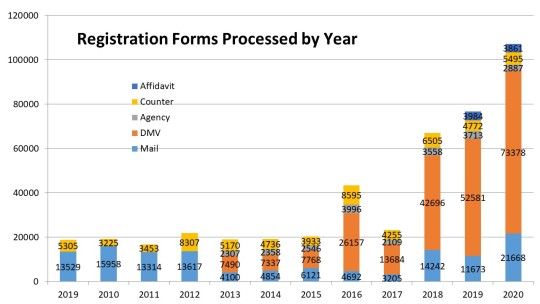
The workload has dramatically increased over the last 4 years. In addition to the 500% increase in absentee ballots in 2020 we saw a record-breaking registration level. New York State reforms that make it easier to register and update registrations through DMV have been vital to our increased turnout, but that fallout is an ever-increasing workload. We processed over 100k registration forms in 2020 with 73k from DMV. This is part of an ever-increasing traffic that we have seen since 2016 when the DMV started allowing online registration changes. This added workload along with no additional staffing has resulted in weeks of 12-hour days to avoid issues like we saw in Oneida County last year. The human cost of this is starting to show as we are getting some burnout and turnover each election now.
Finally, I wish to address the controversy last year with the attempted reduction in my fellow commissioners and my salary. I feel honored to be one of your Elections Commissioner and I recognize that to many in our community our salaries of $99,973 annually would be a blessing, and it is for me as well. I hope that you can see from the amount of personal time and effort I put into this job that it is not a 40 hour a week 9-5 job for me. Commissioners do not receive overtime and often work 50-60 hour weeks during Election Time and as you can see from the workload and new calendar throughout the year. However, the attempted reduction in our salaries was justified both on the floor and in a release by the GOP legislators with faulty math to justify their hasty and last-minute decision.
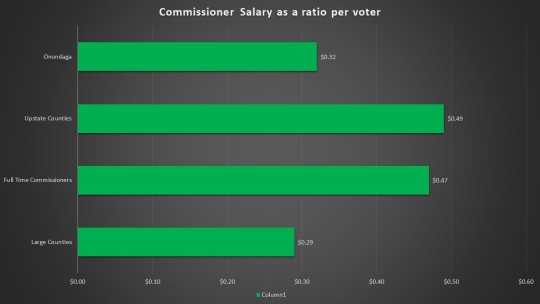
Onondaga County is the 6th most populous county in New York outside of NYC. Our salaries are the 7th highest. In all the counties the state average I the Commissioner makes about $.49 per voter, we in Onondaga County only make $.32 per voter. 41 of the 57 counties have full time commissioners, they average $.42 per voter. Commissioners of Larger counties usually make less per voter since they have additional staffing to compensate to spread out the workload. As we saw in the last section Onondaga County is the least staffed County in the state per voter. Even so Onondaga County’s rate is comparable to the $.29 average. This ratio will get worse over time now that the County Legislature has exempted us from annual cost of living pay raises, something every other Department Head in the County benefit from, including themselves. It is up to others to speculate on the motivation, but the math doesn’t add up.
I hope this analysis shows you the hard work and dedication of all our staff at the Onondaga County Board of Elections. Despite the inequities placed on us the staff is committed to not only providing basic services but are a leader in Election Administration throughout the state. I could not be prouder of them and I will continue to work to make sure these inequities are highlighted, and hopefully resolved, in the future.
Zoom with Czarny: Assemblywoman Pamela Hunter
Today I sit down with Assemblywoman Pamela Hunter – 128th District. We talk about her role as representative but also Majority Conference Chair in the Assembly. We touch on the Budget, some of her legislative accomplishments, and what she hopes will get done by the end of session. We also talk about her hopes for the Onondaga County Democratic Committee this fall. I hope you enjoy.
Commissioner in a Car: Court Cases and Mail Cards
Today I talk about how court cases may effect the upcoming Primary. I also talk about the upcoming mail check cards. Enjoy.
Wonky Wednesday: The Town of Onondaga
Welcome back to Wonky Wednesday. Each week I do a deep dive into the election and registration data that makes up the electoral landscape of our home, Onondaga County. I hope by looking into this data we can glean that this everchanging county is not monolithic as once thought and competition for Democrats, and all registrations, can be found everywhere. This week I investigate the Town of Onondaga.
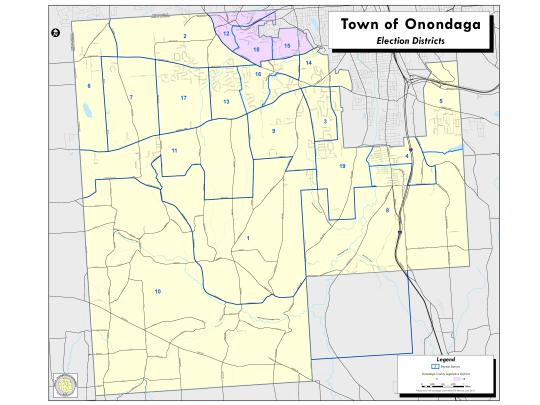
The Town of Onondaga sits just South west of the City of Syracuse. There are no established villages in Onondaga which is a rarity for the large towns of our county. The areas in the north of the town that border Syracuse more resemble the suburban portions of our county but as you travel south it becomes more rural and agrarian. The county’s only community college, Onondaga Community College, in many way ridges both sides of this town sitting in between these contrasting portions of this town. There are 2 county legislative districts that cuts through this town, but one just barely.
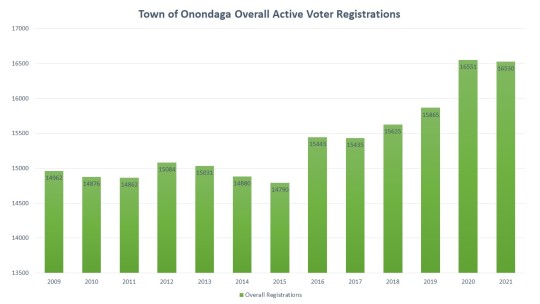
Onondaga like many suburban towns have seen a steady growth of enrolled voters over the last few years. This is not just the normal growth all areas received in 2020 because of increased registration during the Presidential contest. Increased rental and housing subdivisions seems to be driving the population increase. We will get more data later this year when the census is released as well.
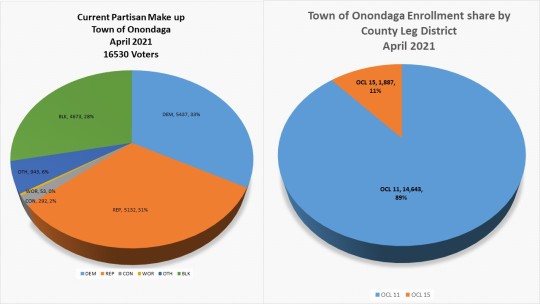
The current registration of the Town of Onondaga shows a Town equally divided. Democrats have a small plurality over the GOP. Conservative enrollment though makes up that gap, for now. A large portion of the town enrollment is not enrolled in a party. There are two county legislative districts in this town. County Legislative district 11 represented by John McBride makes up a large portion of the town and goes over into Camillus. County legislative district 15 represented by Bill Kinne represents a few northern election districts.
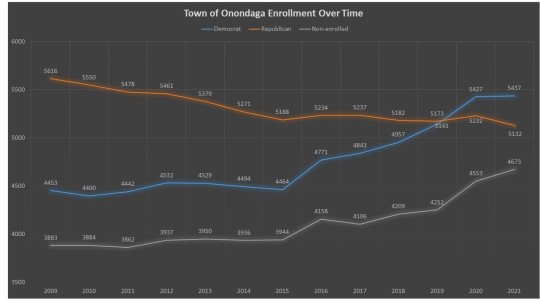
Since 2009 the GOP has had a steady slow decline in this town. This mirrors the declines we have seen in other large suburban towns across the county and our country. Democrats on the other hand started a rapid increase in registration since 2015. These opposite dynamics increased through the 2020 election and into 2021. Non-enrolled voters have also increased in this town made up ox-pat Republicans and younger voters that tend to shed party labels when they first register.

The two county legislative district portions of this town also represent its division. OCL 11 is basically an even district and makes up most of the town. The northern districts in OCL 15 tend to be more Democratic. Though the OCL 11 district looks mostly drawn in a congruent shape it was an interesting decision to carve out a more Democratic piece in the north and replace it with a more moderate portion of Camillus.
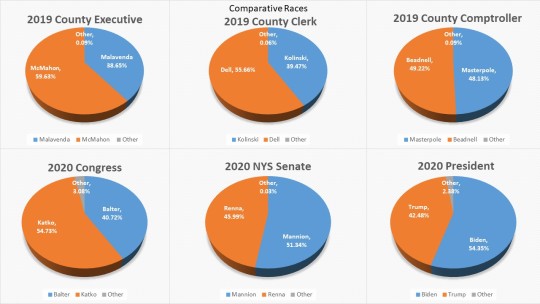
The significant six races we are looking at to get a glimpse of how a town reacts electorally show promise for Democrats looking to run in this town. In the local year elections in 2019 we saw the typical results. County Executive McMahon Had a commanding lead over his opponent. County Clerk Dell’s race was closer. However most surprising was the closeness of the County Comptroller race. Masterpole came within just a point of Beadnell which contributed greatly to his win county wide. In 2020 Katko dominated Balter but not as much as McMahon a year earlier. The NYS Senate Race Mannion outperformed the GOP Renna and Joe Biden won this town by double digits.
The Town of Onondaga Democrats have chosen to nominate candidates by caucus in 2021 due to the COVID-19 pandemic making petitioning problematic. Supervisor, Clerk, Justice, 2 Town Councilors, Highway superintendent, and the receiver of taxes are all up for election in 2021. If you wish to get involved with the Onondaga Democratic Committee contact chair Irene Workman at iworkman@twcny.rr.com and the Town of Onondaga Democratic Committee can be found on Facebook at https://www.facebook.com/Town-of-Onondaga-Democrats-176112497354667.
Sunday Seminar: How to Become an Election Inspector 2021
This month’s Sunday Seminar I go over How to Become an Election Inspector at Onondaga County Board of Elections. I discuss training and what types of inspectors we use as well as eligibility and pay. I hope you enjoy.

