Welcome back to Wonky Wednesday. Each week I do a deep dive into the election and registration data that makes up the electoral landscape of our home, Onondaga County. I hope by looking into this data we can glean that this everchanging county is not monolithic as once thought and competition for Democrats, and all registrations, can be found everywhere. This week I investigate the Town of Skaneateles.
The Town of Skaneateles sits in the Southwestern corner of our county wrapping around the northern half of Skaneateles Lake. While many people think of the village of Skaneateles when talking about the town, it is worth noting that it has a wide diversity of geography. In addition to the bustling village there are large mansions on the lake as well as many rural agricultural areas of the town.
The overall population of the town of Skaneateles is definitely in the smaller side but it is growing. General population shifts and more housing could be part of the growth. Just as likely are the easier voter registration tools since 2016 allowing some of the population to stay registered and active. 2020 saw a huge registration surge in this town as well which is typical for a Presidential year.
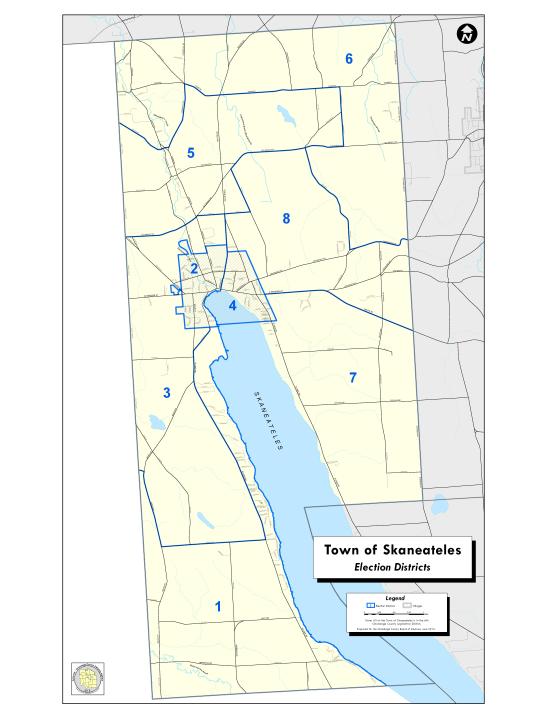
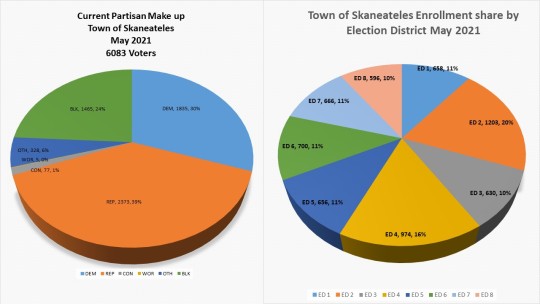
The current registration of the Town of Skaneateles shows a solid GOP town. Republicans make up 39% of the town with Democrats at 30%. Non-enrolled (BLK) voters makeup 24% of the town. Skaneateles is all contained within the 6th County Legislative district so we will be looking at the 8 Election Districts that divide the town. The two largest Election Districts, 2 & 4, make up the village of Skaneateles while the rest of the town is in less populous but larger area Election Districts.
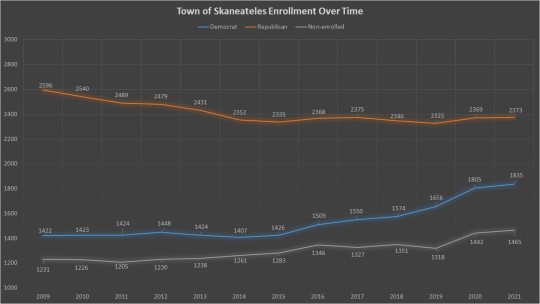
Democrats have been making solid gains on the GOP. A steady increase in Democratic enrollment is starting to change the makeup of this town. Combine that with a slight decrease in GOP enrollment that really cuts into the lead the GOP has seen in this town. Rising numbers in the non-enrolled registrants provides an opportunity for Democrats. IF they can piece together a coalition of non-enrolled voters they could on occasion compete in town wide races.
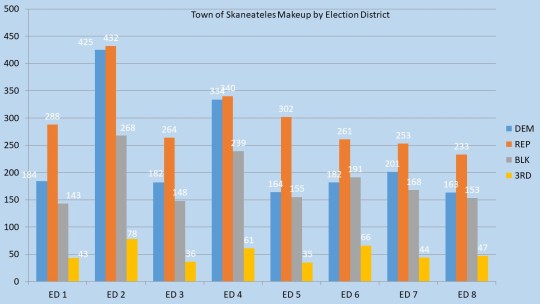
The election districts in Skaneateles provide an example of the dichotomy of this changing town. EDs 2 & 4 makeup the village of Skaneateles where Democrats have seen the most gains. In the village Democrats have drawn near even with Republicans. The other election districts either represent more affluent areas or rural communities. There Democrats still trail by quite a bit.
The significant six races provide some surprises in this reliably red town. In 2019 the GOP candidates for County Executive, County Clerk, and County Comptroller had solid margins of victory in this town. The same dynamic happened in 2020 with Congress with Katko winning a sizable share. However the State Senate race was under 1.5% difference, virtually tied, in the town of Skaneateles. Most surprising is that Biden won by over 13 points. While there is a conservative lean to this town they will reject more Trumpian candidates if there is a coalition of Democrats and Non-enrolled working together.
The Town of Skaneateles Democrats nominates their candidates by caucus. They will elect their Supervisor, Clerk, two town councilors, highway superintendent, and Tax Collector in 2021. If you are interested in getting involved or running for office contact Skaneateles Town Democratic Chair Alan Johnson at alanartjohnson310@gmail.com.
Today I sit down with the Town of Dewitt Democratic Town candidates. This blue town has been a progressive leader in our community and I was happy to talk to those making it happen: Re-Elect Ed Michalenko for DeWitt Supervisor Angela Epolito for DeWitt Town Clerk Sam Young for DeWitt Town Judge Joseph Chiarenza for the People Elect Sarah Klee Hood Max Ruckdeschel for DeWitt Town Board
Welcome back to Wonky Wednesday. Each week I do a deep dive into the election and registration data that makes up the electoral landscape of our home, Onondaga County. I hope by looking into this data we can glean that this everchanging county is not monolithic as once thought and competition for Democrats, and all registrations, can be found everywhere. This week I investigate the Town of Salina.
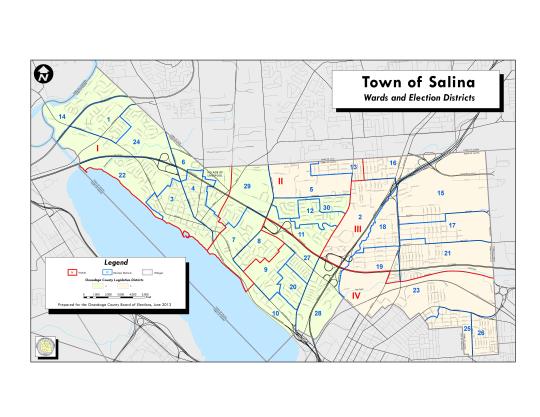
The Town of Salina is the direct northern suburb of Syracuse nestled between it and the Town of Clay. It occupies the eastern shores of Onondaga Lake and stretches west until it hits Dewitt. It is the last large suburban town in my 2021 series looking at all the Towns of Onondaga. Inside of Salina are many different neighborhoods. The Village of Liverpool is one of the most distinct villages in Onondaga County. Mattydale and Lyncourt are other non-formal neighborhoods incorporated into the town. The town is split into two different Legislative districts OCL 4 represented by Judy Tassone who is retiring and OCL 5 represented by Deborah Cody, the executive director of the Onondaga County GOP. It is also one of two towns separated into ward systems with 4 wards that make up representation on the Town Board instead of at-large positions.
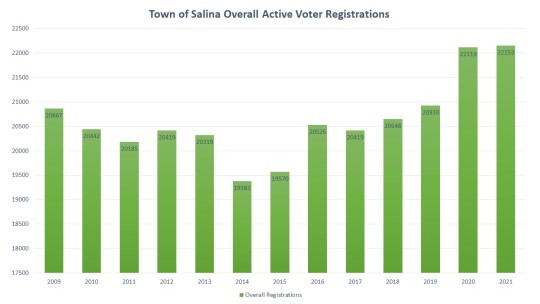
Salina is one of the more popular towns in Onondaga County. At just over 22k voters it is the 4th most populous town. It is a suburban town with housing subdivisions villages, and apartment complexes that is driving growth. Like with other areas of Onondaga County we see steady growth in voter registration since 2015. This is likely due to population increases as well as better voter registration tools in New York. We also aw the typical large jump in enrollment we saw during the 2020 Presidential Election.
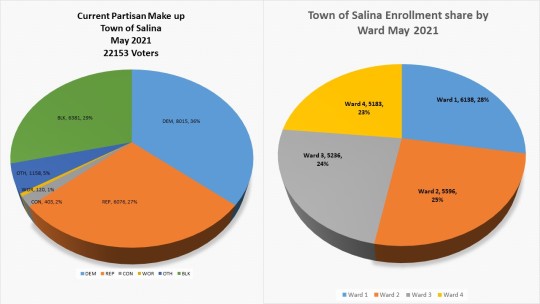
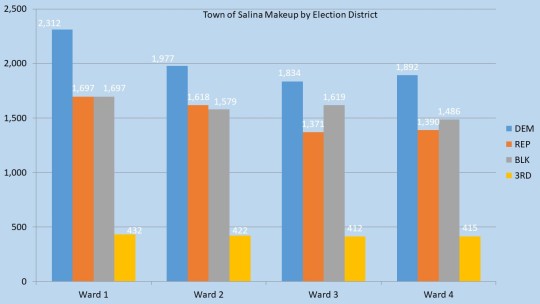
The Town of Salina is a solid Democratic town in registration. Democrats have 36% plurality and GOP 27%. However non-enrolled voters have now surpassed GOP with 29% enrollment. Only two other political subdivisions have this dynamic, Syracuse and Dewitt which are Democrat dominated areas. It is surprising however that the GOP dominates elected office in this town. The 4 wards in Salina seem to be slightly out of balance and when census data comes in there could be a chance for changes in structure next year.
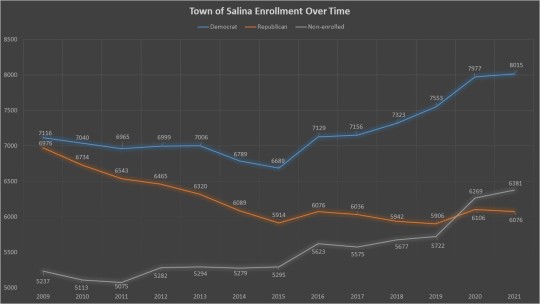
Salina is following the trend of suburban areas over the last few years. Since 2009 it has gone from a basically even enrolled town to large split between Democrats and GOP. Democrats have steadily and consistently grown in registration in Salina. At the same time the GOP registration has decreased substantially. Democrats have added 899 voters since October of 2009 while the GOP has lost 900 voters. The inverse correlation is dramatic and interesting to observe. The Non-enrolled has grown the most however adding 1144 voters. This is where the opportunity lies for Democrats, reaching the new portion of their electorate who may not have voted in local elections as well as convincing the growing non-enrolled voters to embrace their candidates.
The ward system in Salina separates the town board into 4 different sections. It may surprise some to see that Democrats dominate the registration even inside the wards. The only elected Democrat on the Town Board has been in Ward 2, which represents the middle part of Salina between the village of Liverpool and Mattydale. With retiring Town Board member James Maganarelli Democrats will have to defend this open seat. However, in terms of registration Ward 1 is, in terms of registration, the most Democratic. Traditionally Democrats were thought to be at a disadvantage in Liverpool, but the numbers are showing this can, and should, be an opportunity. Ward 4 (Mattydale) and Ward 3 Lyncourt have moderate Democratic advantages as well. In the past Democrats have not put-up full field of candidates, but that is changing this year. It will be interesting to see if they can take advantage of this growing registration advantage.
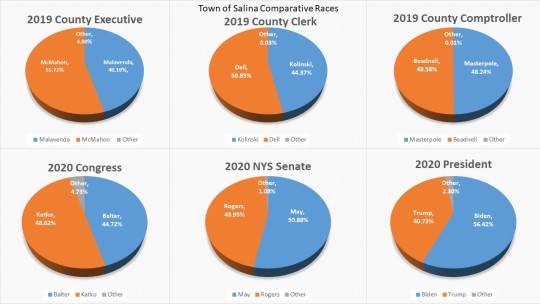
The significant six races provide some evidence that Democrats in the town are embracing Democratic candidates when given a choice. In 2019 Ryan McMahon dominated the County Executive race as he did in most towns. However, the County Clerk race was in single digits. Also, the race between Beadnell and Masterpole for County Comptroller was tantalizing close with just .34% difference. In 2020 with higher turnout, we can see Democrats in the town did much better. Balter did come in second to Katko, though she did much better here than most Towns losing by just 3.9%. However, if we add the 4.73% of vote cast for Steve Williamson the WFP line more people voted for Democratic candidate for congress than GOP. Rachel May solidly beat her opponent by nearly 7 points and President Biden dominated Trump winning by almost 16 points.
The Town of Salina Democrats have nominated a full slate of candidates for the 2021 election. Kathy Zabinski is running for Town Supervisor, Aaron Buchta is running for 1st Ward, Leesa Paul is running for 2nd District, Tina Fitzgerald is running for 3rd District, and Duane Main for 4th District. The Democrats have also nominated Anthony Lavalle for Town Judge. Finally, the two County Legislative seats Democrats have nominated Stephon Williams in OCL 4 and Jana Rogers in OCL 5. If you are interested in helping or joining the Town of Salina Democrats contact Town Chair Chris Shepard at syrvmguy@hotmail.com
Today I talk about the start of absentees in Onondaga County for the June 22, 2021 election. If you want to apply for or track your absentee ballot go to onvote.net.
Note: Early this month I formally submitted this proposal to expand Early Voting in Onondaga County. When we the OCBOE formally met on Monday May 3rd, 2021 my counterpart refused to discuss expansion this year and opted to stick with just 6 sites. This makes Onondaga County the largest county doing the bare minimum of Early Voting sites in new York State. I believe the facts for expansion speak for themselves so I am releasing the plan I formally submitted In April making the case for Early Voting expansion THIS year. Below is my proposal.
Expanding Early Voting in Onondaga County
Background
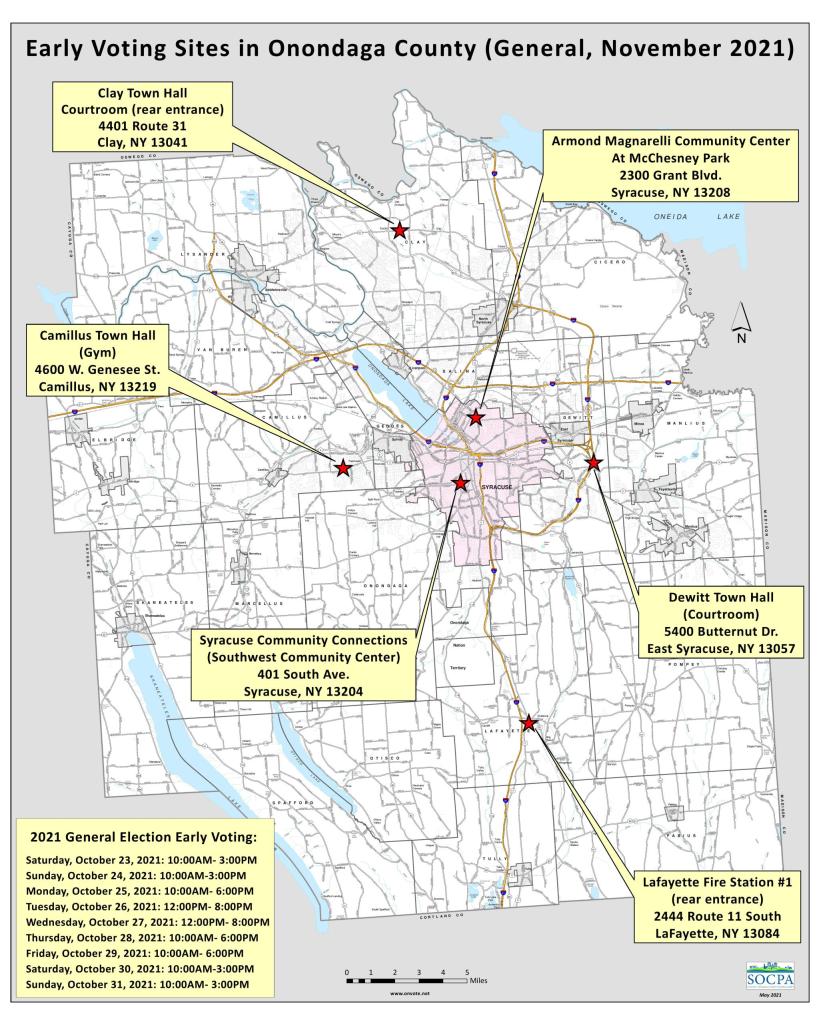
On May 2, 2021 at our monthly organizational meeting we will vote on our Early Voting sites as required by NYS Election Law. NYS requires us to have in 2019 and 2020 we elected to do the minimum number of sites 6 for over 300k voters. In 2019 the sites were Van Buren Town Hall, Clay Town Hall, Dewitt Town Hall, Lafayette Station #1, Armond Magnarelli Center, and Syracuse Connections at South West Community Center. In the infancy of the program 8k voters, or 8% of the overall turnout, chose to participate in Early Voting. The numbers were almost triple the absentee ballot universe. There were little lines though some minor traffic issues at Clay Town Hall and Dewitt Town Hall our most populous voting centers. There were complaints from those populations in the southwest corner of our county they did not have accessible location.
In 2020 in the middle of a pandemic we once again chose to keep the 6 minimum sites. However we made an important adjustment moving from Van Buren Town Hall to Camillus Fire Station. The COVID 19 crisis drove almost half of our electorate to find alternate voting methods. One of the highest turnout elections in our history we saw nearly 50% of the electorate chose not to vote on Election Day. That portion was equally divided between Early and absentee voting. Those fearing COVID-19 chose to stay at home and vote by mail while those wanting to vote by convenience chose Early Voting. The nearly 60k voters that flooded our sites caused major traffic and lines at all of our sites. The long lines and traffic issues put excess demands on the Towns and City to provide police and traffic control. Some voters waited well over 2 hours, beyond our mandate of a 30 minute wait, to cast their ballot.
Minimum sites for 2021
We agree on the six minimum sites for 2021. These are the same sites from 2020 with the exception of a temporary change moving from Camillus Fire Station to Camillus Town Hall for the General Election due to condemnation of the pedestrian bridge. We both agree that if we are to remain at 6 these sites are well spaced out and provide minimum needs for our voters. While some sites performed better than others the familiarity of these sites to the voters as well as coverage in North, South, East and West portions of the County and North and South west portions of the City of Syracuse spreads out the coverage as evenly as possible given the small number of sites.
Need for Expansion
While the unprecedented numbers in 2020 were hard to imagine earlier in the year, it was only logical that Early Voting would grow in popularity. As we saw in the 40+ states that came before us, the initial years were sparse but the growth happens over time. In many states usage of Early Voting exceeds 40% of the voting totals. In Onondaga County in 2020 we saw only 25% of our voting populace vote. There is plenty of room for growth. Despite the long lines the voters appreciated the ability to choose the hours in which they vote as well as the convenience of being able to choose polling places instead of being assigned just one.
I am grateful that facing the long lines last year we were able to reach agreement to extend hours on the final weekend of voting. This did help mitigate the wait times. However extending hours is not a significant way to deal with expected crowds. The lesson we should learn form 2020 is it would be better to disperse the voting populace by adding sites, reducing initial staffing, and then surging staff to areas that are experiencing longer waits.
Placing Expansion Sites
There are two main deficiencies in our 6 site structure. With a county as large and populace as ours it is difficult to serve all of our community’s geographic needs. The towns of Lysander, Cicero, Onondaga, and Manlius are some of our more populace communities yet do not have Early Voting sits inside their townships. Because these towns are located squarely between the current 6 site plans their populace has the farthest to go to take advantage of Early Voting. We have seen that the farther away from an Early Voting site you are the less likely to take advantage of Early Voting.
The current 6 site plan also is lacking in another quality that helps Early Voting, placing sites that are congregated by large amounts of citizens. Because Early Voting allows any voter to vote at any site, the concept of placing polling sites only near places of residence is limiting. Added value to any site would be a large amount of county residents that are expected to be in the vicinity of the site during the hours of operations 10 days before General Election Day. Places like the Civic Center and Onondaga Community College have large amounts of county residents that work or study in the immediate area. Not only would placement in these communities help the residents that live nearby, it will help all residents who frequent these areas easing the burden on all county sites.
No matter where we expand sites it is important we commit that the expansion has geographic and ideological balance as much as possible. Confidence in our integrity is important and fair placement should be tantamount to our deliberations.
Expansion Proposals
For your consideration I am offering three options regarding expansion in 2021, a modest expansion to 8 sites, a moderate expansion to 10 sites, and a robust expansion to 12 sites. While I am always for the most expansion possible I understand fiscal concerns and I am willing to accept that the most aggressive expansion may not be possible this year. However since there are bills in the NYS legislature which would double the amount of sites required I felt it is important to at least start the conversation. Across the state over the last two years many counties and most of the large counties, have gone beyond their mandated minimum. They have seen on average increased usage of Early Voting.
Expansion to 8 sites: Onondaga Community College and Cicero Town Hall. This option allows us to address our most glaring needs, access to Early Voting in the Southwest and Northeast corners of our counties. Cicero has over 23k voters and Onondaga has over 16k voters. In addition to the residence in the Town of Onondaga thousands of county residents from all walks of life attend school and work at Onondaga Community College. The college faculty and administration are willing to house
us in the facility and there is plenty of parking on campus as well as the ability to reserve spaces close to the arena for those who are elderly and have mobility issues. Placement at these sites will ease the burden on our three biggest suburban sites Clay, Camillus, and Dewitt as well as achieve a site with high public concentration. Ideologically Cicero is one of the most GOP leaning towns and though Onondaga is evenly split in registrations one could assume the college population leans towards the left. Pairing these two sites gives balance to this expansion. I would also be open to North Syracuse Village Hall instead of Cicero Town Hall.
Expansion to 10 sites: Lysander Town Hall & The Civic Center in Syracuse. This is my preferred option. Adding these sites in addition to the sites at OCC and Cicero adding sites in Lysander and Downtown Syracuse is the next logical choice. Lysander has over 17k residents and the residents there have flooded the Clay Town hall site as well as Camillus. Placing a site Downtown would serve a growing downtown population that has mobility issues, be close to the Centro bus transfer station, and serve the thousands of downtown residents. Lysander has decidedly a GOP lean its registration. Any site inside the city is bound to have an ideological left lean though the makeup of the thousands of downtown workers is undetermined. Pairing these sites also gives balance for this further expansion.
Expansion to 12 sites: Salina Town Hall and Manlius Town Hall. If we really want to invest in Early Voting doubling the amount of sites is the eventual choice. Expanding to Salina and Manlius will put sites in every town with over 15k voters. It will ease the burden on the Dewitt site as well as Clay and Armond Magnarelli Center. Manlius is our third largest town 23.5k voters and Salina has 22k voters. Both Manlius and Salina have Democratic leaning registrations but when we get to this level of expansion it is harder to find areas of large population that doesn’t have a Democratic lean. The sheer numbers of population in these towns calls for expansion into them if we go to the highest level. I would be open to adding Van Buren Town Hall and the NYS Fairgrounds to also add in sites at Geddes and Van Buren in addition to these for a super expansion in the future which will bring more moderate towns into the mix.
Fiscal Impact
Expanding Early Voting sites will require some expenditure of resources above the current budgeting levels. However the current budgeting levels may be inadequate even for the bare minimum 6 site plan. The main expenditure for Early Voting is the inspector totals. We already have enough Electronic Poll Books and Poll Print units to expand to even 14 sites with reasonable accommodations. We also have money in the Shoebox and upcoming Capital Grants if any small purchases are needed. The supplies spent on ballot paper and other consumables will be the same regardless of the number of sites as the population of the voters will not change drastically, only their convenience and time.
When we look at our normal 6 site plan we have staffing of 1 Poll Site Manager, 2 Voting System Specialists and 6 regular inspectors per day at each Early Voting site. This would normally cost us approximately $65,000 per nine day EV period. During the 2020 election because of the long lines we had to surge staff and increase hours. Our staff at each site went to 2 PSM, 2 VSS, and 8 inspectors and
with the added hours it cost Onondaga County over $156k. The extra staff dealt with crowd control and line maintenance as well as assisting voters with their ballots.
By expanding the sites we reduce the chances for long lines and crowded polling places requiring additional staff and hours. If we expanded sites we could reduce our staffing footprint to 1 PSM, 2 VSS, and 4 Inspectors. If needed we could surge staff to larger sites seeing more activity to reduce wait time, especially on closing weekend. Our cost ranges for the expansion would be as following: 8 sites 70k-86k, 10 sites 87k-107k, 12 sites 104k to 128k. I have attached a spreadsheet which details each scenario.
While expanding sites will add costs in some cases, it is actually less then what was spent in 2020 due to the long wait times. The more sites we add, the less likely we will have to surge staffing to deal with long lines as voters will have more options and can choose from a variety of sites. It is also worth noting that Early Voting, per voter, is less expensive to Onondaga County than absentee and mail in balloting. Expansion will encourage its use as oppose to voters who live farther away from designated sites deciding to request mail in ballots. The NYS Legislature in 2021 once again included money for early Voting Costs for the purpose of covering expansion of Early Voting. Onondaga County is set to receive between $40k and $50k. This will more than cover an expansion to the 10 site model.
Conclusion
I propose we expand to the 10 site model for Early Voting for 2021. We can reassess in 2022 whether this reduced wait times and provided more ease and convenience for voters. We should use the extra funds from NYS to cover the expansion costs plus reduce the overall local footprint of Early Voting on local dollars.
Today I am happy to sit down with Gio Costantiello of Dominion Voting Machines. Dominion is one of our top vendors with Onondaga County Board of Elections providing all the image cast scanners used on Election Day as well as help with ballot creation and absentees. We dive into some of the myths spread by the big lie and what is next for Dominion and elections in New York State.
Welcome back to Wonky Wednesday. Each week I do a deep dive into the election and registration data that makes up the electoral landscape of our home, Onondaga County. I hope by looking into this data we can glean that this everchanging county is not monolithic as once thought and competition for Democrats, and all registrations, can be found everywhere. This week I investigate the Town of Pompey.
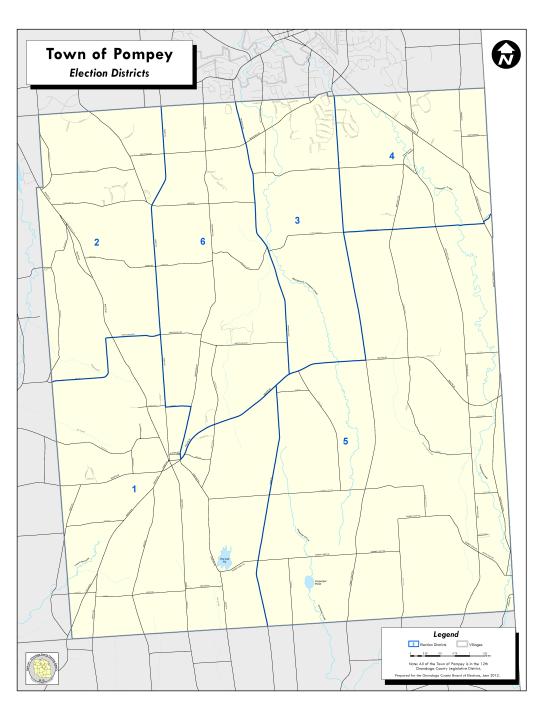
The Town of Pompey sits on the eastern border of Onondaga County just south of Manlius and north of Fabius. The northern portion of the town has larger housing developments whereas the southern portion of town is more rural with agrarian and larger single more affluent housing plots of land. Pompey is not split up by County Legislative districts and has no villages. We will be looking at the 6 Election Districts that divide up the town.
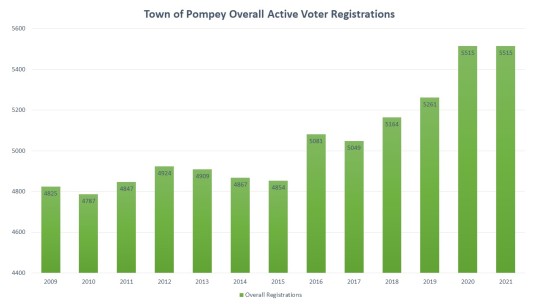
The overall population of the town of Pompey is definitely in the smaller side but it is growing. General population shifts and more housing could be part of the growth. Just as likely are the easier voter registration tools since 2016 allowing some of the population to stay registered and active. 2020 saw a huge registration surge in this town as well which is typical for a Presidential year.
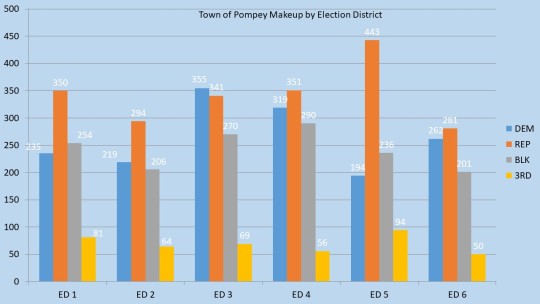
The current registration of the Town of Pompey shows a solid GOP town. Republicans make up 37% of the town with Democrats at 29%. Non-enrolled (BLK) voters makeup 26% of the town. The two Election Districts are not quite equal in size. The 6 election districts in the town of Pompey are oddly drawn but not overly unbalanced in the voter population.
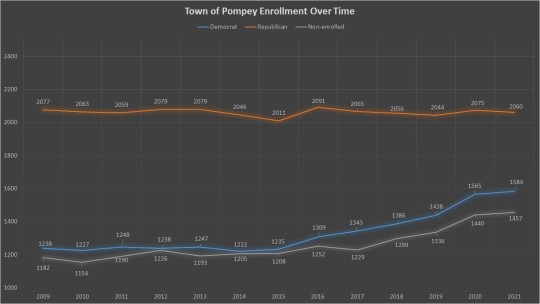
Pompey is a smaller town but there appears to be some changes happening in the partisan population. Pompey’s GOP population has been relatively stable. However since 2016 the Democrats and Non-enrolled have been gaining steadily and cutting into that plurality. Since the GOP is remaining stable this could be new moves and younger residents enrolling as Democrats and non-enrolled rather than massive party switches or population change.
The election districts in Pompey provide an example of the dichotomy of this changing town. ED 3,4, and 6 share borders with the emerging Democratic stronghold of Manlius. These eds while not overly Democratic at least are competitive enrollment wise. The other EDS have more in common with other border towns like Lafayette and Fabius. It is likely the differences in these areas will continue to grow if current demographic trends are to be believed. The more suburban areas of Pompey continue to get bluer as the rural areas stay red or get redder.
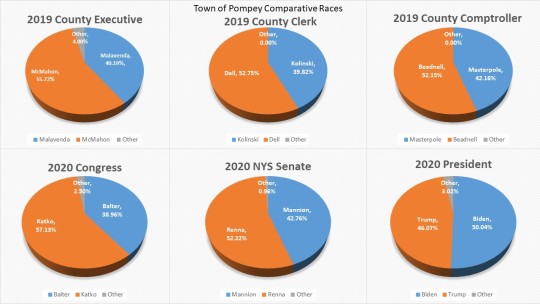
The significant six races provide some evidence that the growing dichotomy of the town presents some opportunities for Democrats under the right circumstances. In 2019 the County Executive, County Clerk, and County Comptroller had solid margins of victory in this town. However Democrats were able to take advantage of a GOP civil war and win control of the Town Board and put a Democrat in as Supervisor. The same dynamic happened in 2020 with Congress and State Senate breaking for the GOP but Biden winning the town for President. While there is a conservative lean to this town they will reject more Trumpian leans of the party if there is a coalition of Democrats and Non-enrolled working together.
The Town of Pompey Democrats nominates their candidates by caucus. They will elect their Supervisor and two town councilors in 2021. If you are interested in getting involved or running for office contact Pompey Town Democratic Chair Victoria Lightcap at victorialightcap@gmail.com
Today I talk about the decision to remain with 6 Early Voting sites in Onondaga County. I also address some of the various election hijinks happening in Arizona and the take a few questions. I hope you enjoy.