In today’s holiday offering of Zoom with Czarny I sit down with Assemblyman Charles Lavine of Nassau County. Mr. Lavine chairs the Assembly Election Law committee and is a wonderful advocate for voters and Boards of Elections throughout New York State.
Commissioner in a Car: Holiday edition
Quick updates on what the Board of Election is working on, mainly updating registrations and getting ready for 2021.
Wonky Wednesday: Absentee, Affidavits and Court orders oh my.

Welcome to Wonky Wednesday. Each week I intend to do a deeper dive into the data that drives elections in Onondaga County. Before we look ahead to the 2021 elections I intend to spend a few weeks dissecting the remarkable 2020 general election dat. Last week I looked at overall turnout in Onondaga County. This week I dive into one of the main driving factors of that turnout, Absentee, Affidavit, and Court Order ballots.
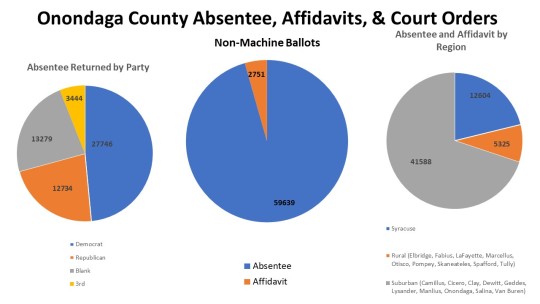
Vote by Mail, or Absentee Voting as we call it in New York, saw a boon across the country this year. The ravages of COVID-19 and the wish not to congregate in crowded Election Day and Early Voting polling places drove many members of our community to voting from the safety of their home. 59,639 voters turned in Absentee ballots in Onondaga County, with 57,203 of those absentees counted after Election Day. The most common reason for an absentee ballot not to count was undeliverable (1353) followed by voted in person (433) and then unmatched signatures (131). Democrats dominated the absentee ballot count with 48.5% of the absentee ballots returned compared to just 22.3% for the GOP. In fact, Non-enrolled outnumbered GOP with 23.2% of absentees. In a later wonky Wednesday I will dive into the Red Mirage vs Blue Shift phenomenon during 2020 election.
We can’t track party registration of affidavits as they often are either changing parties or switching registrations from other counties. Unfortunately, our registration system is not able to track those changes and give voter history based on affidavit voters only. We can however combine the affidavit ballots received with the absentee ballots received and track them based on region as I do here. We see that the City of Syracuse only accounts for 21.2% of the post-election affidavit and absentee totals. But as we know form last week’s Wonky Wednesday: Onondaga County Turnout 2020 General that the City of Syracuse represented 20.2% of the overall turnout. While it does look like the City of Syracuse tended to use Absentee voting a little bit more on average it is statistically irrelevant.
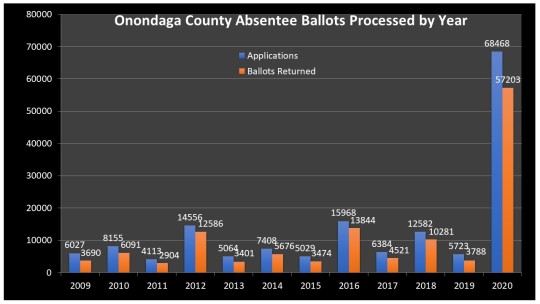
Obviously, the big story of absentee ballots in 2020 is the massive increase in use. This chart shows you just how drastic a change it was. The next closest year in absentees was the last presidential election in 2016. 2020 saw well over a 400% increase in both applications received and absentee ballot returns. Obviously fear of contracting COVID-19 is the driving factor here with voters. However, convenience is part of the answer here as well. It will be interesting to see if this trend continues next November and more importantly in 2022 when all restrictions on absentees could be removed as a constitutional amendment to remove the excuse for absentees will be put before voters.
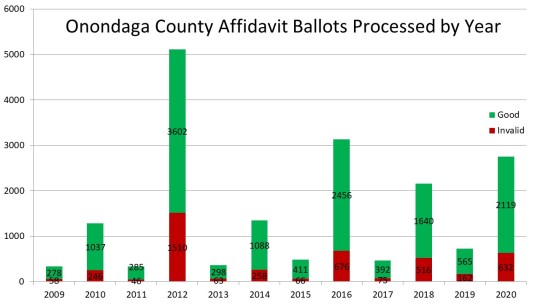
There is a myth when it comes to affidavit ballots. Many believe that these are rarely counted and routinely thrown out. In Onondaga County, and most counties throughout New York State, that is not true. In fact, it is quite the opposite. The vast majority of Affidavit Ballots are counted each year. The main reasons for rejection are voters who are not registered or show up to the wrong polling place. Overall Affidavit voters have decreased when compared to 2012 and 2016 presidential years despite turnout overall going up. The reason for that is it is easier to register and maintain your registration through Mydmv.com. This keeps more voters active and properly registered at their correct address thus limiting the need for affidavit ballots.
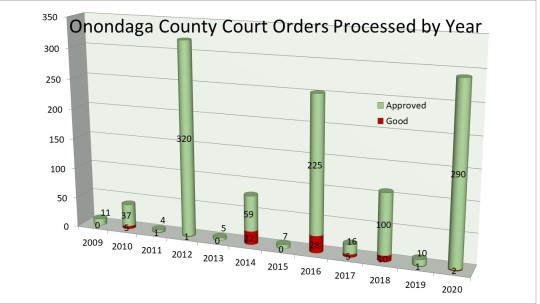
Finally let’s take a look at Court order ballots. Unlike Affidavit and absentee ballots, court orders vote on the image cast machines on Election Day and Early Voting. It was thought the need for court orders would be less since registration portability allowed voters from other counties to vote by affidavit ballot instead of the arduous court order process. Turnout though was remarkably high this year thus it is likely the reason court orders went up from 2016 as well. With more citizens interested in voting it resulted in more unlikely voters showing up to the polls. COVID-19 made registration drives harder so some voters that wanted to vote may have not been given the opportunity to register thus necessitating a court order. Judges in Onondaga County tend to be pretty forgiving and believing of citizens who come before them asking for the right to court and they only rejected 2 voters in the 2020 General Election and historically have been reluctant to deny a voter their right to vote when a compelling case is given.
That is all for this week’s Wonky Wednesday. Next week I plan to do a similar look into Early Voting in Onondaga County during the 2020 General Election.
Zoom with Czarny: SU Professor David Driesen
In today’s Zoom with Czarny I have a conversation with SU professor David Driesen who is authoring an upcoming book The Specter of Dictatorship: Judicial Enabling of Presidential Power. We talk about the lasting effects of the Post election litigation from President Trump and how we can recover from the possible slow slide into authoritarianism.
Virtual Town Hall in support of City of Syracuse Redistricting
Fair Maps CNY organizers host a virtual Town Hall to support the City of Syracuse proposal to enact a Citizen Led Redistricting effort. Speakers include Common Council President Helen Hudson, Mayor Ben Walsh, Councilors Khalid Bey, Rita Paniagua, Ronnie White, Joseph Driscoll, Commissioner of Elections Dustin M. Czarny, and Fair Maps organizer Perrine Wasser.
Zoom with Czarny: Susan Lerner Executive Director of Common Cause NY
I welcome back to our program Susan Lerner, executive director of Common Cause NY.. In today’s episode we talk about the Independent Citizen led redistricting movement in Syracuse NY, Ranked Choice voting in NYC, and what lessons we need to take from 2020 elections in New York State and progress we need to make in 2021 legislative session
Wonky Wednesday: Onondaga County Turnout 2020 General
It’s the formal return of Wonky Wednesday! Each week I hope to do a deep dive into data that can bring insight into elections in Onondaga County and NY State. This week I take a look back at the November presidential election. As you may remember when the voting was done Democrats did quite well in Onondaga County. They picked up a Supreme Court Justice (Rory McMahon) 2 Family Court seats (Julie Cerio & Christina DeJoseph) and NY Senate 50th (john Mannion) while successfully defending NY Senate 53 (Rachel May), and NY Assembly 127 (Al Stirpe), 128 (Pam Hunter), and 129 (William Magnarelli). The GOP successfully defended US Congress 24 (John Katko), NY Assembly District 120 (Will Barclay) and 126 (Greg Lemondes). These victories though were mostly possible as those districts extended into neighboring counties. In fact in Onondaga County it is likely Dana Balter would have won the county if not for the appearance of Steve Williams on the Working Families line that drew likely Democratic votes from her totals.
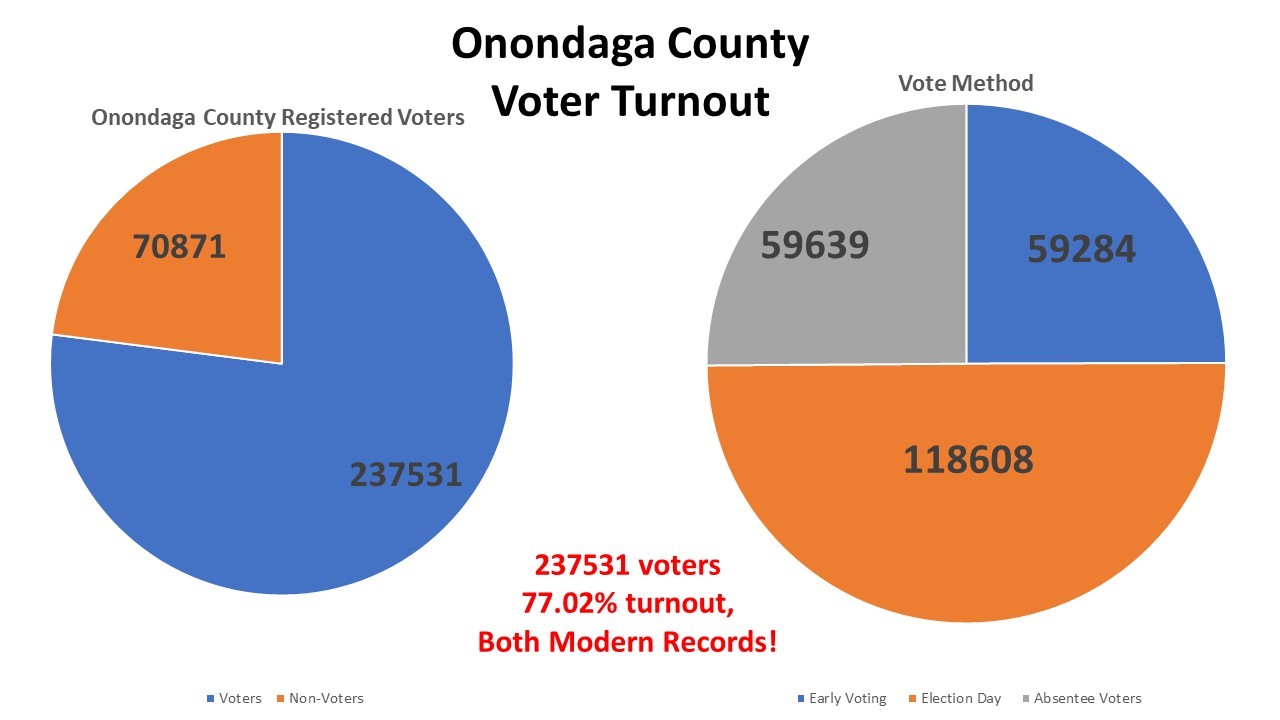
Part of the story of why Democrats did so well in Onondaga County is the massive record breaking voter turnout in 2020 in both raw numbers and percentages. Onondaga County entered the November election with a record high voter turnout of 308,402. This surpassed the previous record of 306860 set before the 2004 election and was a gain of 22540 since the 2016 Presidential Election (285,756). This is despite a pandemic making traditional voter registration drives nearly impossible.
A big story of this election is not just the number of voters but the way in which they came to the polls. In 2019 Early Voting was introduced and during the summer of 2020 because of the onset of the COVID-19 pandemic stringent rules on Absentee voting were lifted creating a nearly ubiquitous Vote by Mail option for voters. These options proved to be quite popular for voters in 2020. Only 49.9% of voters chose to vote on Election Day in 2020, 25.1% chose to vote from the safety of their homes, while 25% chose the convenience of Early Voting. This is a tidal change in how voters chose to exercise the franchise and likely will continue until we eventually see equal 1/3 shares in future years.
The fervor of the Presidential Election combined with this high registration number to result in 237,531 voters that came to the polls which reflected a turnout rate of 77.02%. This surpassed the previous records from the 2008 election of 224,032 and a turnout rate of 76.83%. Its also not surprising given the enrollment edge in Onondaga County that Democrats made up a large portion of the voter turnout at 39%. This is slightly better than the 38% share that Democrats make up in the County of Onondaga.
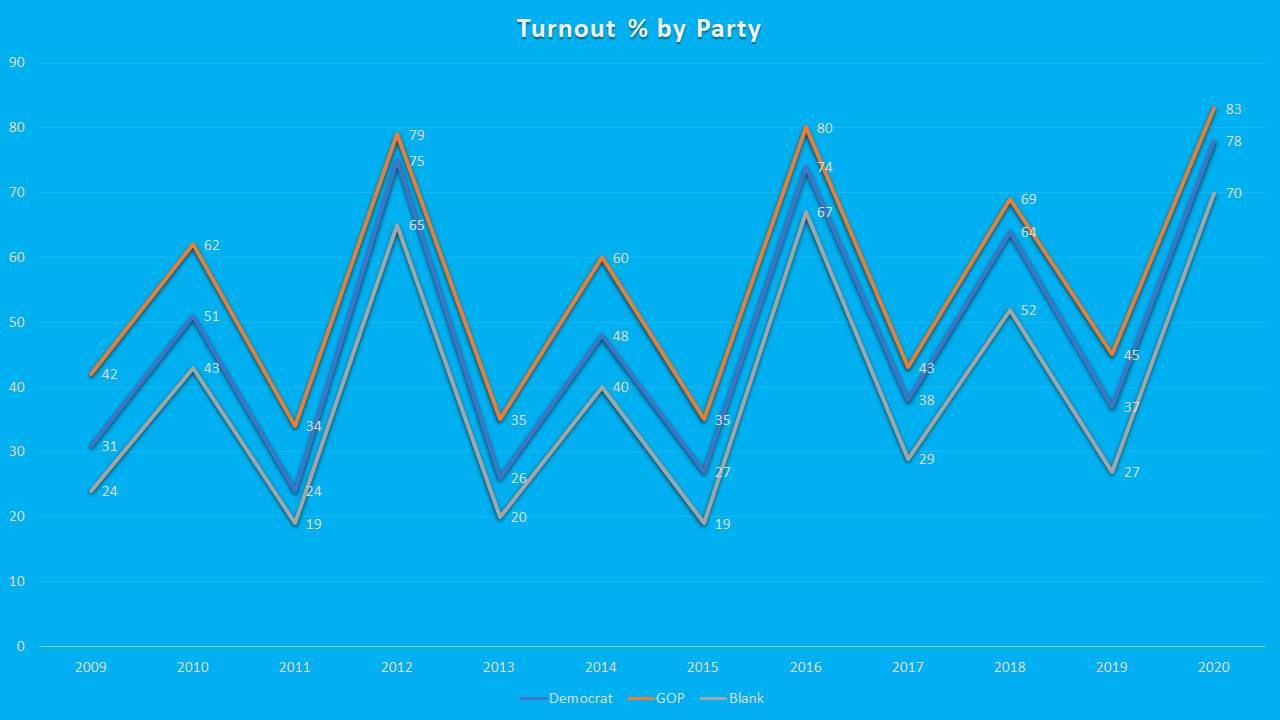
Though Democrats over performed their voter enrollment share, so did Republicans by an even bigger margin. The GOP continues to have better turnout as a percentage then Democrats. Though both parties as well as non-enrolled all saw record turnout rates, the GOP continues to outpace both Democrats and non-enrolled. Non-enrolled voters continue to be the least participatory in voting no matter the year as well. Democrats need to do a better job at increasing their turnout as well as turning out non-enrolled voters that align with their candidates.
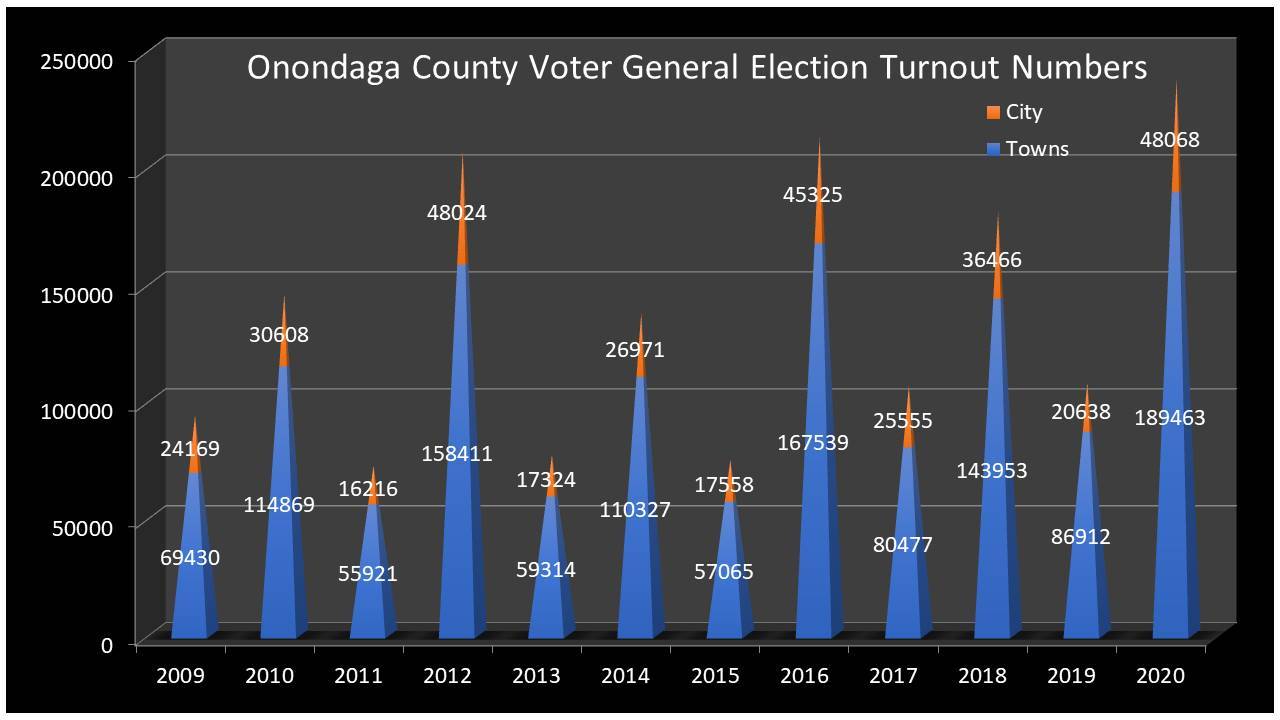
The City of Syracuse tends to dominate the media market and lexicon of Onondaga politics. However its actual vote share continues to decrease. As we can see in this chart the City of Syracuse is just over 1/5th of the actual vote share in Onondaga County. The large suburban towns is where most of the vote lies in county wide races. We will do a deeper dive on town data later as well as the City of Syracuse. It is worth noting though the City of Syracuse vote share in Onondaga County is not as big as it once was falling from about a 1/4 share to 1/5 share the last few years.
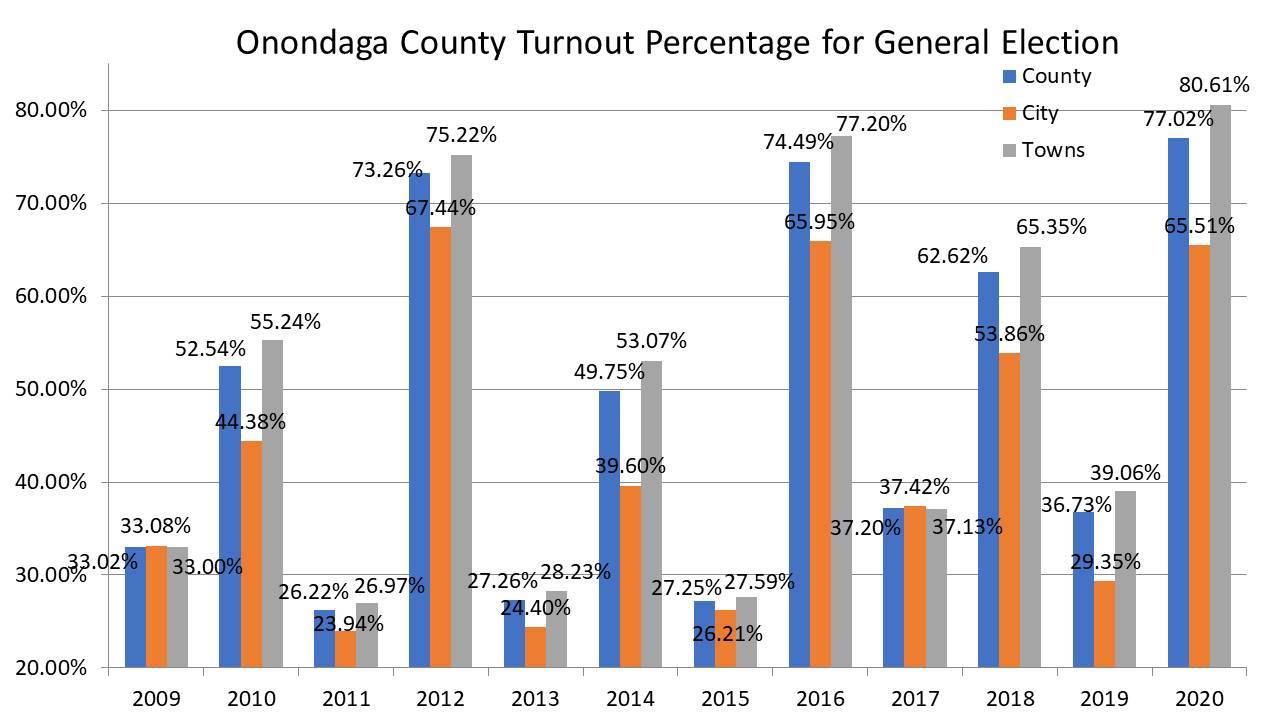
The high voter percentage in Onondaga County was not distributed equally and may be contributing to why the City vote share continues to fall. Towns and the suburbs continue to have a significantly higher voter turnout among its growing population and the City of Syracuse continues to fall behind with a shrinking population. the 15% gap amongst turnout in the Towns and the City of Syracuse in 2020 is the highest on record. The lack of competitive city races in general elections may be a contributing factor. The only time where City turnout has been higher than the towns is 2009 & 2017, both open races for Syracuse mayor. Even then the difference was less than a percentage point. With an overwhelmingly Democratic city driving up city turnout is key to further county wide Democratic victories.
Commissioner in a Car: The Party ends for some edition.
Changes are coming to the ballot in 2021. Learn what parties survived, what happens to the voters in the parties that were eliminated, as well as my thoughts on the EC vote and continuing ridiculousness of the challenges to this election. You have till February 14, 2021 to change your party in NY state. Goto onvote.net to find out how.
Zoom with Czarny: NYS Senator Mike Gianaris
In this Zoom with Czarny I sit down with Senator Michael Gianaris who is the New York State Senate majority leader. We talk about the progress made in elections over the last two years. We also look forward to how the new super majority will shape election legislation in the coming session.
Zoom with Czarny: NYS Senator Mike Gianaris
In this Zoom with Czarny I sit down with Senator Michael Gianaris who is the New York State Senate majority leader. We talk about the progress made in elections over the last two years. We also look forward to how the new super majority will shape election legislation in the coming session.
 Dustin M. Czarny