The Weekly Wonk: Onondaga County 2025

Welcome back to the #weeklywonk!  Each week I take a deep dive in some form of electoral and registration data.  By examining this data, I hope to give a more comprehensive view of our home, Onondaga County.  This week I start looking at the political subdivisions having elections this November.  We start with a top line view of Onondaga County as a whole.

As of March 6, 2025, Onondaga County has 318,699 Active registered voters. 119,239 are Democrats (37%) and 84,909 are republican (27%).  The non-enrolled portion is the 2nd highest voter type at 95,162 (30%).  The rest of the county is divided between the conservatives (5,217 voters 2%), Working families (1,600 voters <1%) and the other category (12,572 4%).  The county itself is broken up into 5 main sections.  The Northern towns have the largest voter enrollment at 84,290 (26%).  That is followed by the City of Syracuse at 77,843 voters (24%).  The eastern towns make up 66,706 voters (21%).  The western towns have 62,601 voters (20%).  The largest land area of the county is the southern agrarian towns, but they have the smallest voter portion of just 27,259 (9%).

This graph measures the active voter population right before the general election of each year dating back to 1996.  As you can see Onondaga County set a record in 2024 with 319,960 voters before last November’s General Election. This reflected a decent jump in registration as is normal in a Presidential election (+13,883).  However, it paled in comparison to the jump we had in 2020 (+15,581) but was more than the jump in 2016 (+11,916).  We have started to lose voters in 2025 because the new registrations are being outpaced by the deaths and voters being made inactive due to return mail. 

Democrats in Onondaga County continued to outpace the GOP but it’s the non-enrolled that is the biggest story.  Going back to 1996 Democrats have added 33,539 voters while the GOP has lost 21,213 voters. The non-enrolled has only added 22,596 voters since 1996.  However, if we look at the last four years, the story is different.  The Democrats have added 950 voters, the GOP has added 2,188 voters, and the non-enrolled has added an outstanding 13,316 voters.  This is a marked change from the previous four years during the first Trump presidency. We will see if this was the result of a democratic administration being in office or the start of a long-term trend.  What is no doubt a major force in Onondaga County is the increasing share of non-enrolled voters.

When looking at the Democratic advantage in Onondaga County in terms of overall registration you can not just look at raw numbers of democratic vs. republican.  We have two other parties in New York, the Conservative and Working Families.  These parties tend to align ideologically with the major parties.  The Conservatives sit to the right of the GOP and generally support GOP candidates.  The Working families sits to the left of the Democrats and generally support Democratic candidates.  If you couple those together and compare them to the overall voters currently the Democrats have a +9.64% in March of 2025.  However, despite the GOP faring better in overall registrations, the Democrats held a +9.86% in November of 2024, growing from +9.57% in November of 2020. 

A new facet of analysis this year for me will be the average age of different voting populations inside a political subdivision.  Our new registration system has some better features for me to do this analysis and I hope to put them to good use this next year.  The average age of Onondaga County active voters is 50.17 years old.  Democrats reflect the general makeup of the county with an average age of 50.00 years old.  Republicans have the oldest average age at 54.67 years old followed closely by the conservatives at 54.42 years old.  The Working families is the youngest age group at 44.69 years old.  The non-enrolled population is slightly older at 46.29 years old.  The other category is just under the county average at 49.70 years old.  I hope to do a deeper dive on age statistics later this summer.

The five basic regions of the county reflect Onondaga County’s diverse but slightly blue nature.  The City of Syracuse is overwhelming Democratic with Democrats owning a +40.36% registration advantage over the GOP.  This followed by the eastern towns of Dewitt, Manlius, and Salina with Democrats having a +10.33%.  The northern towns (cicero, Clay, & Lysander) have a collective borderline GOP lean (GOP +0.81%).  The same can be said for the western towns of Camillus, Elbridge, Geddes, Onondaga, and Vanburen (GOP +0.44%).  The only place where the GOP has a solid collective advantage is the southern towns of Fabius, Lafayette, Marcellus, Otisco, Pompey, Skaneateles, Spafford, & Tully (GOP +11.08%). 

The overwhelming blue nature of Syracuse and solid blue nature of the eastern towns has outpaced the slight GOP leans of the other areas and has led to significant victories for Democrats on a county wide basis.  Over the last 4 years there have been 24 competitive races that covered the entire county of Onondaga.  These are races where both the Democrats and the GOP fielded candidates.  The Democrats have won the Onondaga County portion of those races in 21 of those 24 contests.  It should be noted the 2021 and 2022 supreme court races the Democrats won Onondaga County but went on to lose the races in the other counties.  2024 was a banner year for Democrats locally, most notably in congress.  John Katko won Onondaga County by 1.52% in 2020.  Fran Canole’s congressional campaign won Onondaga County by 12.00% even though he went on to lose the race.  John Mannion not only won Onondaga County by 18.78%, but he also outpaced the Presidential ticket and went on to win NY22 propelled by his success here.

It’s a new year and I have a new set of comparative races that will give us some insight on a political subdivision’s voting habits.  For each of the last four years I chose the countywide race that was the closest election in a one-on-one matchup countywide.  In 2021 this was Anthony Brindisi’s unsuccessful Supreme Court run, in which he won Onondaga county portion by 5.04% but ultimately lost the race.  In 2022 Governor Kathy Hochul won Onondaga County by 7.75%, which was higher than her statewide total but not by much.  Emily Essi won the 2-23 County Clerk race in one of the closes county wide elections in Onondaga county history, winning by just .33%.  Finally, Christina El-Bayadi won family Court in 2024 by 9.89%.  These races in essence show the political leanings of a region based on general party preferences and can by a good gauge to whether a generic Democrat can be successful and under what conditions.  We will come back to these in each #weeklywonk throughout the year.

That is, it for this week’s edition of the #weeklywonk.  In the next edition I will focus on the suburbs of Onondaga County as a whole.  These unpredictable areas are the key to winning county wide for both Democrats and republicans. You can subscribe to dustinczarny.com for all content and election news updates.

Voter Turnout with Walt Dixie and Dustin Czarny on George Kilpatrick Inspiration for the Nation

How was the voter turnout for the elections? We talk about this and more with Walt Dixie, President of Alliance Network, and Dustin Czarny, Onondaga County Democrat Elections Commissioner. Join the conversation here on George Kilpatrick Inspiration for the Nation!

Subscribe to dustinczarny.com for all content and election news updates

Commissioner in a Car: The Save Act

This episode I speak about the say that. A piece of legislation working its way through Congress that could have drastic effects on voting rights but however may not pass. I’ve been getting a lot of calls on this so I decided to do a podcast about it to lay it all out there. Thank you to issue one and the Brennan center for Justice for some briefings they have done on this that help me prepare some of the statistics I shared in this podcast. Enjoy.

Subscribe to dustinczarny.com for all content and election news updates

The Weekly Wonk: 2024 Election Day and Overall Turnout

Welcome back to the #weeklywonk. This is the semi-weekly column I write on dustinczarny.com. In this article I examine electoral and registration data that makeup our home, Onondaga County and New York State. It has been a few weeks since I have been able to publish an article, but I am finally ready to finish my analysis of the 2024 General Election. This week I look at Election Day and Overall turnout in Onondaga County.

Going into the November 2024 General Election Onondaga County had 319,960 voters. By the end of the 2024 election 231,617 voters participated in the election. Meaning 88,343 registered voters did not participate in the 2024 election. We had 72.39% turnout, which is actually the lowest Presidential turnout since I started tracking data going back to 2009. Of the Turnout we saw 89815 Democrats (39%), 67,867 GOP (29%), 60,157 non-enrolled (26%), 8,783 enrolled in other party choices (4%), 4134 Conservatives (2%), and 861 Working Families (<1%). On Election Day there were 119,320 voters checking in via the Knowink poll pads. That was made up by 42,357 Democrats (35%), 36,199 GOP (30%), 33,000 non-enrolled (28%), and 7,764 made up of other parties (7%). The Election Day universe was more conservative than the overall turnout, but nowt overly so as Democrats still outnumbered Republicans by a significant amount.

The election Day universe has been decreasing since the introduction of alternative voting methods in 2019. In 2019 Early Voting was introduced, then in response to the pandemic more permissive absentee voting was used 2020-2022. Finally in 2024 the Early Vote by mail option finalized these alternative voting methods. The raw vote total of 119,320 for 2024 was the lowest even year total since the alternative voting methods. When we look at the percentage of the election day when compared to overall turnout, we really see the lasting and permanent change to the Onondaga County electorate that these alternative voting methods had. 51.6% was the lowest total since the pandemic year of 2020 (50.1%). We can also see that there is a steady decline, especially in higher turnout even for years.

The ten top polling places in Onondaga County. Election Day reflects the original polling place sizes. All ten polling places are suburban polling places which tend to be larger polling places that can support large vehicular traffic. They are specially located in the larger suburban towns. Gillette Road Middle School & Brewerton Fire Station are in Cicero. Buckley Road Baptist Church, St. Elizabeth Ann Seton, & N. Syracuse School District are in Clay. Camillus Municipal and St. Joseph’s Parish are in Camillus. Liverpool Christian Church is in Salina. The only one of the top polling places in a small town is Marcellus Fire House in the town of Marcellus.

The adoption of electronic polling books in 2019 allowed us to get a unique set of data to map out the hourly turnout for an election. Of the five elections we have been able to track, 2024 acted in a typical fashion with three other elections. Moderate turnout in the morning with a lull around the afternoon and a ramping up of activity in the after-work dinner rush leading to a sharp decline into the evening. We now can see that the pandemic election of 2020 was atypical with the largest hours being the opening of polls with a steep decline into the afternoon and a moderate dinner rush and really low turnout in the evening hours. This highlights the uniqueness of 2020 and why it is hard to make comparisons to it when looking at predicting future presidential elections.

In 2024 75% of Democrats turned out compared to 80% of the GOP. Democrats always trail the GOP in turnout among their members. However, in Onondaga County the turnout deficit of about 5% was the lowest deficit since 2012. The non-enrolled turnout was just 63, 17% lower than the GOP. This was the highest deficit in the three presidential elections I have tracked since 2009 (2012, 2016, & 2020). Just like Democrats always trail the GOP, the non-enrolled are always the least participatory of the three main categories of voters.

We can also look at geography when determining turnout discrepancy. The overall turnout was 72.39%. Turnout in the suburban towns was seventy-seven. The City of Syracuse turnout was just 58.00%. The 19.04% deficit between the city of Syracuse and the suburban towns is the highest on record since 2009. This is a problem that is getting worse with few exceptions. In 2009 and 2017 are the only two years on record where city turnout was higher than the suburbs. These were open mayoral elections following an incumbent that termed out. 2025 is another one of those years so we will see if the pattern holds.

Looking at the individual town turnout we see that the closer we get to the City of Syracuse, the lower the turnout as well. The towns around the City of Syracuse (Salina, Dewitt, Geddes, & Onondaga) have urban feelings and tend to turn out at lower rates than the exurban and rural towns that radiate away from the city of Syracuse. Inside the City of Syracuse, we see a similar pattern. Inner city wards of nine. 10. 15. & Eighteen are lower than other wards inside the city. 16th ward is also low, but that is mainly due to another low turnout population, younger voters in the City of Syracuse.

That is, it for this edition of the #weeklywonk. My next edition I will start to look at Onondaga County as a whole. Every February we take enrollment numbers statewide, and it will be a good opportunity to look at our county and where it stands electorally post this Presidential Election. Subscribe to dustincarny.com to get all content and election news updates.

Commissioner in a Car: Designations and Petitions

This week I talk about county party designations and the start of designating petition period on February 25, 2025. I explain why County parties do designations and what they mean for ballot access in New York. I also explain the petition process which 90% of all candidates will need to get on the ballot this fall. Enjoy.

Subscribe to dustinczarny.com for all content and eleciton news updates

Commissioner in a Car: Enrollment Numbers in New York

This week’s Commissioner in a Car I talk about the annual enrollment collections in New York. This enrollment pull is very important as it determines the number of signatures someone needs for running for office. I also explain the events that changed our enrollments from last November to today. Enjoy.

Subscribe to dustinczarny.com for all content and election news updates

Onondaga County Democratic Elections Commissioner urges funding in NY budget hearing – WRVO

Czarny asked that lawmakers provide more flexibility in the grants they provide and longer time periods for them so election commissioners can do long-term planning to continually upgrade election infrastructure.

“We are usually one of the least funded departments in our county governments and a lot of times those funds are evaporate even quicker in non-presidential years,” Czarny said. “But we still have several elections that we’re running this year and our costs don’t really go down.”

https://www.wrvo.org/politics-and-government/2025-02-17/onondaga-county-democratic-elections-commissioner-urges-funding-in-ny-budget-hearing

Subscribe to dustinczarny.com for all election news and content updates

Commissioner in a Car: Party Change Deadline Approaches Friday.

This week I come to you from San Diego as I am attending the Partnership for Large Election Jurisdictions conference. More on that next week as today I want to talk to you about the party change deadline on Friday February 14th. Yes its Valentine’s Day but its also Fall in love with Your Party Day. I talk about how to change your party and you can go to onvote.net to do it today!

You can subscribe to dustinczarny.com for all content and election news updates
My Testimony Joint Legislative Hearing on 2025 Exec. Budget Proposal: Local Government – 02/04/2025

I participated in a panel in the Joint Legislative Hearing on 2025 Exec. Budget Proposal: Local Government. I along with my good government colleagues from Brennan Center, NYS League of Women Voters, Fair Elections NY, and Common Cause NY argued for direct NY funding of county boards of elections as well as funding the NYS Board of Elections.

My written testimony is below:

Testimony before The New York State Assembly & New York State Senate

Joint Legislative Budget Hearing on Local Government

Tuesday, February 6, 2024. 9:30 AM

Dustin M. Czarny, NYSECA Democratic Caucus Chair, Commissioner (D) Onondaga County

Thank you for letting me testify today. My name is Dustin Czarny, and I am an Elections Commissioner in Onondaga County and the Democratic Caucus Chair of the New York State Elections Commissioner Association. NYSECA represents the diverse sixty-two counties throughout New York State. I am proud of our bi-partisan Election Board system, and this is a model that should be followed nationwide. The Democratic and Republican Commissioners must work together to ensure the integrity of our election system. The built-in checks and balances help NY avoid the partisan battles we see unfolding in other States. Commissioners must find ways to put partisan ideologies aside to meet the needs of the voters.

The Board of Elections has faced many hurdles over the last few years and has risen to the challenge. Since 2019 we have implemented election reforms such as Early Voting, Electronic Pollbooks, Universal transfer of registrations. We have administered one of the highest turnout Presidential elections in modern history. We have revamped a robust system of delivering absentee ballots to voters at the highest volume in NYS history. Implementing a cure system to prevent accidental disenfranchisement of absentee voters over technical deficiencies. We have done all that in the middle of a multi-year pandemic that challenged the very nature of our mostly in-person voting system and put the health of our election workers at risk. While no system that is made up of human workers is without its flaws, our Boards have risen to the challenge, and kept our electoral system afloat in New York.

The Executive budget has many positive aspects which I will detail later in this testimony. However, there are two glaring needs for 2024 that it is silent on:  Temporary workers and public information campaigns to service the Presidential Election. At the close of 2023 many counties refused the budget requests of their bi-partisan election commissioners to increase staff. In some cases, they refused to provide adequate money even for the bare minimum to field election inspectors. This has set up a dangerous situation as we head into what may be the highest turnout election in our generation. In 2024 we will be implementing Early Vote by mail for the first time. Other reforms such as online voter registration, pre-canvass of absentees, and expanded Early Voting will experience their first Presidential Election. Increase turnout and registration along with new reforms will tax the resources of many Boards of Elections. We need an additional $10 million Aid to Localities grant to be distributed by the NYS Board of Elections to host counties with the express purpose and permission to hire temporary workers and fund informational campaigns so we can administer an orderly Presidential Election in the fall.

The Executive budget comes a long way for providing the necessary funding for the New York State Board of Elections. This is righting many years of misery when it comes to funding the State Board of Elections. It is a welcome and crucial step as the State Board of Elections will be a vital partner for County Boards. The State Board of Elections will shoulder the burden of Online and Automatic voter registration as well as tracking of our absentee ballots and the Campaign and Public Finance systems. The budget also properly funds the new Public Campaign finance Board and its mission to level the playing field for small donors in New York politics.

In 2024 we face implementing the expansive New York Early Voting by Mail reform in the middle of the Presidential year. This important reform will expand opportunities for voters in this crucial Presidential election. We applaud the Executive budget once again including reimbursements for postage and mailing costs. It is imperative the legislature includes this funding in the final budget. It is unclear how many voters will take advantage of this new reform the Democratic caucus of commissioners looks forward to implementing it.

We have aging electronic poll books that need to be upgraded. The Executive Budget specifically addresses this, and I applaud those efforts. Almost all poll books bought in 2019 at the adoption of Early Voting were sixth generation iPad. While these are still serviceable under the current version of IOS (17), there is a strong likelihood when IOS 18 is released later this year it will no longer support sixth generation iPad. This will not affect the 2024 election but going into 2025 many counties will need wholesale replacements of their fleet of IPad to stay up to date on security enhancements. Having that money allocated in the 2024 budget will allow counties to purchase that equipment for implementation in early 2025.

These annual funding requests will serve the needs of 2024 however we still need to address structural issues to maintain adequate minimum funding for Boards of Elections throughout the state. We must protect our Board of Elections from interference from local elected officials. We need to establish minimum staffing levels tied to voter registration rolls for each county Board of Elections. We need mandates for full-time commissioners as our political calendars demand input and guidance year-round. These guidelines can be established and monitored by our State Board of Elections to maintain the independence we need of our Boards of Elections while assuring that counties and New York State give the vital resources for us to accomplish our mission.

If we can establish these minimums, New York should also establish an annual funding stream to offset some costs of host counties. Make no mistake, the primary responsibility for funding elections rests at the county level. We are not a mandate but a responsibility. However, that responsibility also falls on the shoulder of New York State which sets election regulations and reforms that county Board of Elections must follow. A dialogue about how New York can assist counties properly staff and run the Board of Elections is necessary as we embark on the changes to elections mandated by the State legislature over the next few years. New York is one of a handful of states that does not have annual funding streams for the local Boards of Elections. Doing so would eliminate the need for annual funding requests and allow for long term planning for Boards of Elections as well as bring parity of service to all citizens of New York no matter where they live.

Thank you very much for this opportunity to testify today. I hope that we can count on the legislature’s support in defending our democracy here in New York.

Dustin M. Czarny

Commissioner (D), Onondaga County

Democratic Caucus Chair, NYS Elections Commissioner Association.

Subscribe to dustinczarny.com for all content and election news updates
Town hall addresses low voter turnout in 2024 presidential election – Daily Orange

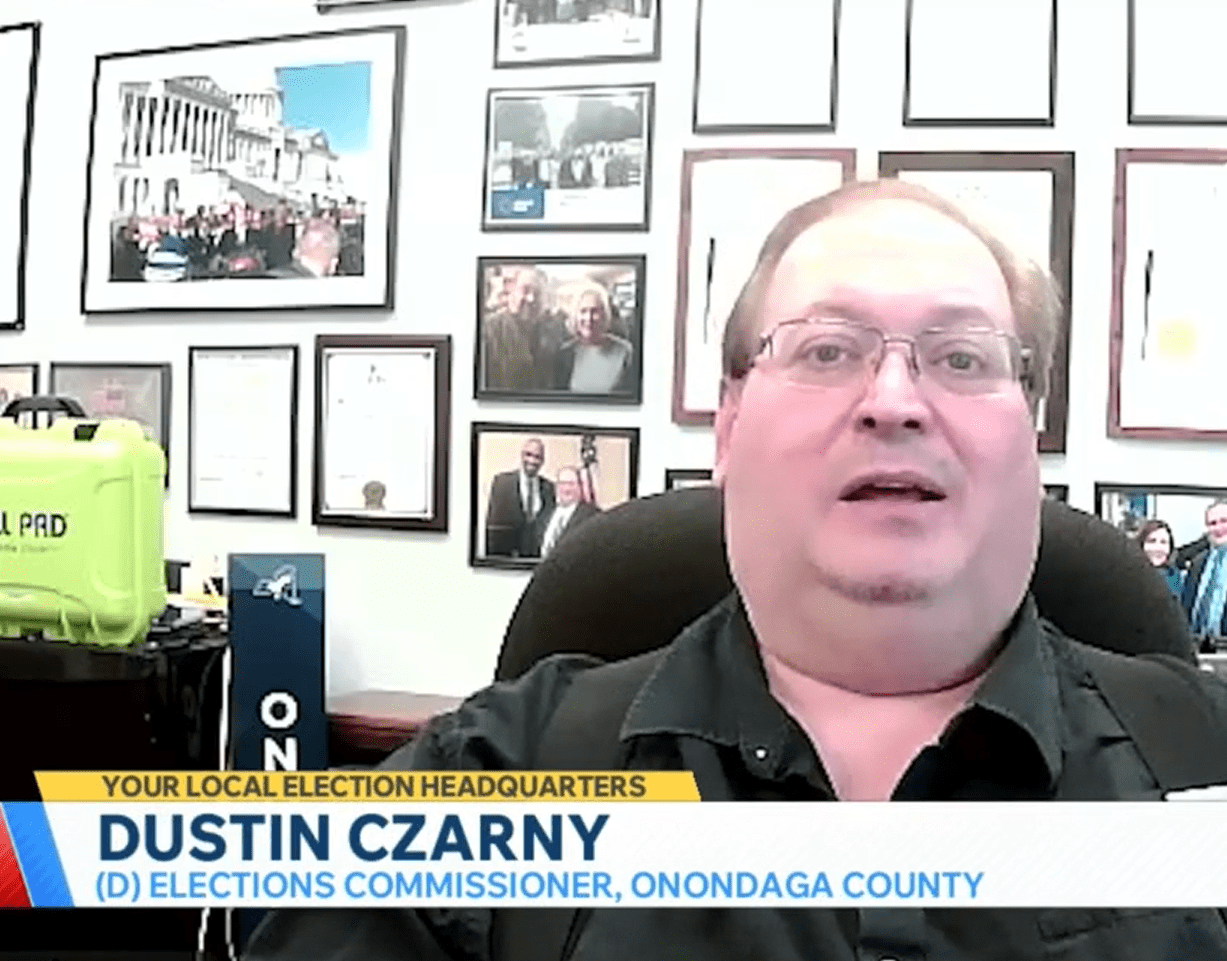
With these statistics in mind, Czarny said New York residents should take advantage of state programs to make voting easier and more accessible in future elections, including by voting by mail and at early voting sites. He also encouraged community members to get involved in the election process more personally, like by serving as polling inspectors.

“You’re doing the work of making sure that the election is protected. And that is vitally important, important and needed. Inspectors are our eyes and ears at the polling place,” Czarny said.

https://dailyorange.com/2025/02/town-hall-addresses-low-voter-turnout-in-2024-election/