Democratic Elections Commissioner Dustin Czarny said the board will now process and review the objections filed and hold hearings toward the end of next week. If the board removes a candidate from the ballot, that candidate can challenge the decision in court.
“What we’re looking at now is either the witness is wrong, where a whole sheet can be thrown out, or the individual lines are wrong, and that’s where 90% of the objections are going to come in. And we’re literally going to be going line by line once the objections are made,” Czarny said.
This week i talk about the objection process at the Onondaga County Board of Elections. We have had over 140 petitions filed and now we are starting to get some objections in. I talk about the process going forward and why this will take all month! Enjoy.
I was honored to speak at the Hands Off Rally in Syracuse on April 5, 2024. Over 2k people came down to hear a variety of speakers stand up to federal over reach and our fellow citizens.
Subscribe to dustinczarny.com for all content and election news updates
This week I talk about designating petitions. the cutoff was 5pm Thursday to file for office. Nearly 150 petitions and 500 candidates have chosen to participate in this year’s election. More to come this summer. Enjoy.
Subscribe to dustinczarny.com for all content and election news updates
City mayoral campaigns will be among hundreds that will file petitions at the county elections board, with this year’s election featuring races for city, county, town and village offices.
“Outside of election week, it’s the biggest week of the year,” Czarny said.
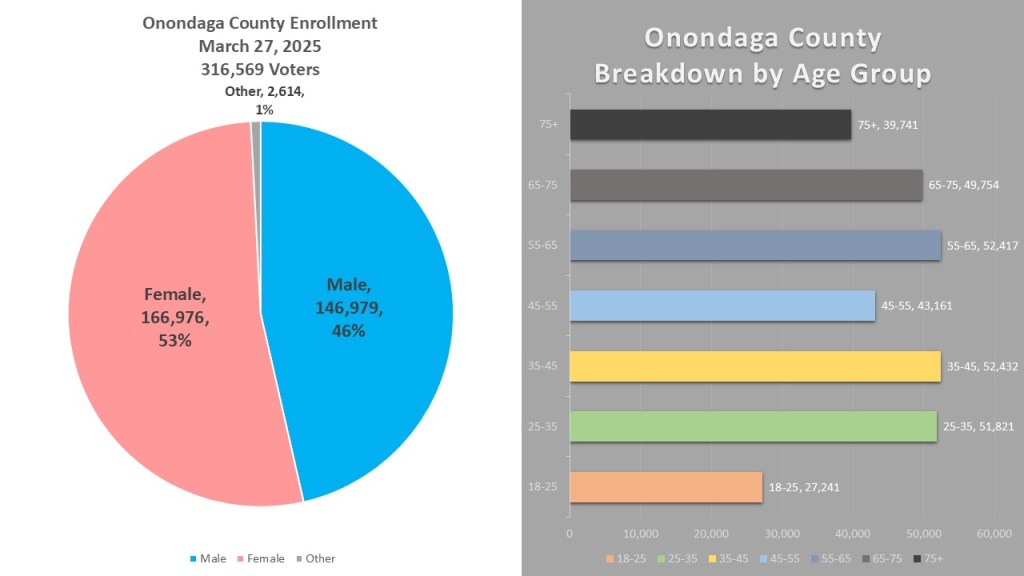
Welcome back to the #weeklywonk. Each week I take a deep dive in some form of electoral and registration data. By examining this data, I hope to give a more comprehensive view of our home, Onondaga County. I am excited to bring you a fresh look at Onondaga County this week. For the first time I do a deep dive into Age and gender in Onondaga County.
There are 316,569 voters in Onondaga County as of March 27, 2025. Of those 53% (166,976) identify as Female and 46% (146,979) identify as Male. Another 2,614 (1%) either refused to identify a sex, were unisex, or another option. We also breakdown Onondaga County into the standard age categories used to study population. The most populous age group is 35-45 with 52,432 voters. This is closely followed by 55-65 (52,417) & 25-35 (51,821), Dropping down a bit is 65-75 (49,754) then 75+ (39,741). In last place is the youngest demographic 18025 (27,241).
There is a stark divide in the partisan registrations among the gender. Democrats dominate the Female population with 71437 voters. The none-enrolled is second in the Female electorate with 46,950 voters. Gop comes in 3rd in the female electorate with 39,328 voters. The male population is a bit more even. First in the male population is non-enrolled at 46.199. This is followed in close second by Democrats at 45,935 voters. Third is the Gop at 44,926. The Other category is much smaller with 1,358 NE voters, 876 democrats, and 291 GOP.
When we look at partisan makeup by age group Democrats lead in just about every age group. As we progress through the age groups lead tends to shrink. The non-enrolled is in 1st place in the 18-25 age group by quite a bit, outpacing the Democrats and double up the GOP. As we progress through the age groups the NE influence lessens, and the GOP grows. Though the GOP does not lead in any age group it is 2nd place in the 55-65, 65-75, and 75+. The GOP comes closest to the Democrats in the 55-65 and 75+ group.
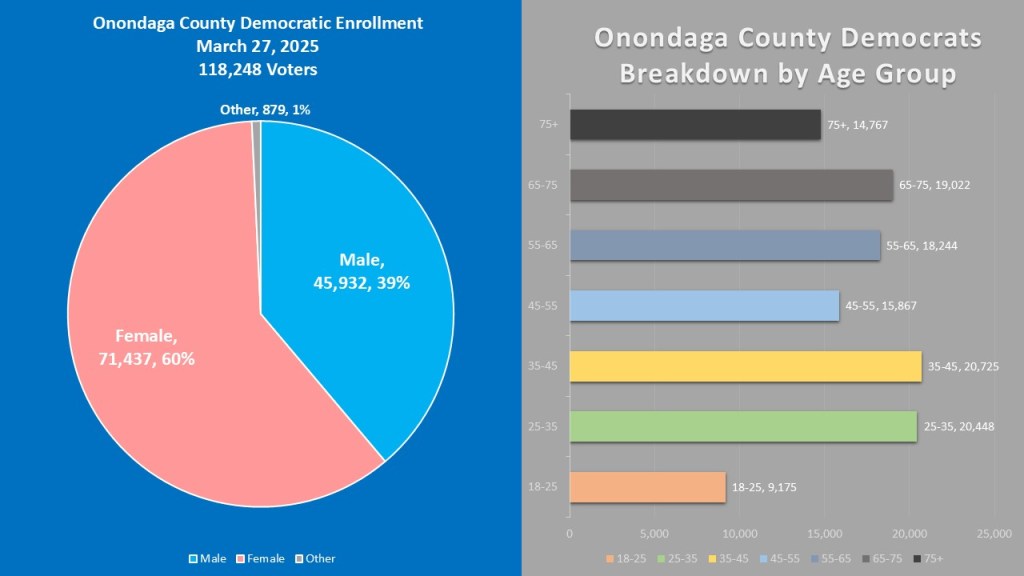
Looking at the Democratic electorate it is decidedly more female and younger than the overall Onondaga County electorate. There are 118,248 Democratic voters in Onondaga County. 60% (71,437) are female, 39% (45,932) are male., 1% (879) are other. When looking at the age groups that Democrats are most popular, the 35-45 is the most populous with 20,725 voters. This is followed by the 25-35 age group (20,448). The third largest is the 65-75 age group (19,022 voters). Most of this population resides between 25-55.
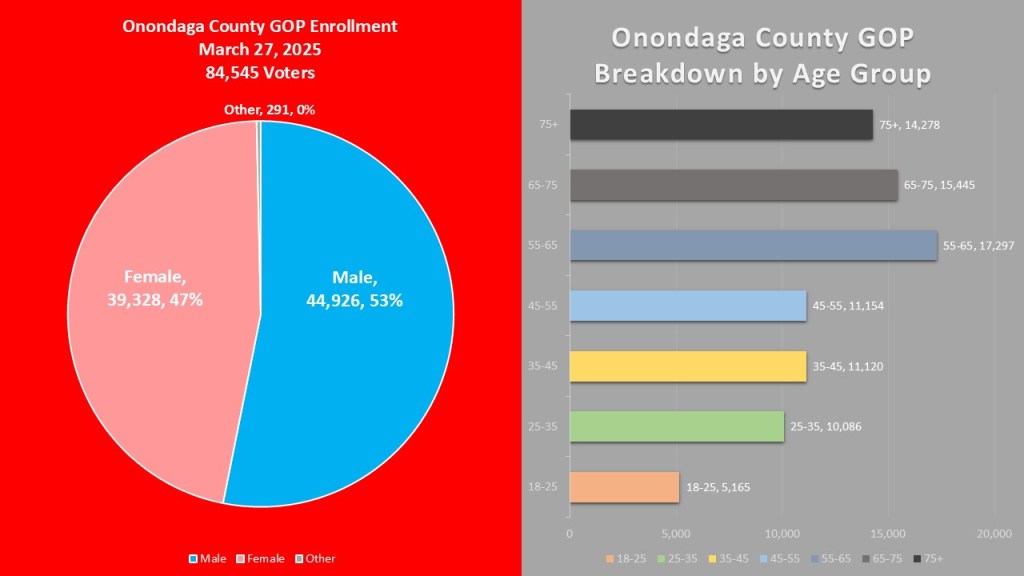
The GOP electorate is the opposite of the Democrats, more male than the county and older. There are 84,545 voters. 53% (44,926 voters) are male, 47% (39,328 voters) are female, and <1% (291) are other. The three oldest age groups are where the GOP mostly reside. 55-65 is the biggest group with 17,297. This is followed by 65-75 with 15,445. Finally, is 75+ at 14,278. Most of this population is 55+.
Lastly let’s examine the non-enrolled population. This is a balanced population and only slightly more make than Onondaga County as a whole, but significantly younger. There are 94,507 non-enrolled voters in Onondaga County. The highest plurality resides in the 25-35 with 18,421 voters. The second biggest group is 35-45 with 17,034 voters. The third biggest group is 55-65 with 13,142 voters. Most of this population is under 45 years old.
That is, it for this edition of the #weeklywonk. Next week I will return to the City of Syracuse to look at each of the 5 common council districts to get ready for the expected June primaries. I start on the northside with common council district 1. As always you can subscribe to dustinczarny.com for all content for election news and content update.
“A birth certificate replication was over $100 last time I did it. $80 for a passport. These are real costs for people when deciding whether they can afford it or not. It’s the essence of a poll tax, something we’ve gotten away from,” he explained.
A few thoughts this morning on the President’s executive order on elections. Some caveats, I am not a lawyer, but I have read up extensively on this to prepare. I also am collecting some thoughts for a Commissioner in a Car on Monday.
Let’s start with what this order isn’t. It isn’t the SAVE act. It is not changing the federal election laws or sweeping overhauls of state election laws. What it seems to do is withhold federal funds to get compliance.
This is wrong, but also not likely to have any impact. The biggest criticism of federal spending on elections is that it has been virtually non-existent since 2020. Withholding funds is unlikely to force states to change.
The withdrawal of funds will affect states like New York who count votes received after election day and every state but Arizona that does not have documentary proof such as birth certificates, required at registration.
It does not however force states to change their laws, only withhold funds from states who do not comply. This is the difference between this and the SAVE act.
The other main directive is the direct intervention on the US Elections Assistance Commission (of which I serve on a subcommittee). This is thought to be an independent agency and not under the executive control.
This will likely be the first thing challenged in court. This bi partisan commission was set up to be an independent agency to prevent this type of meddling from a partisan president or congressional body.
If the order stands it will change the way voting machines are certified. The main question is how will voting machines be certified under the new standards within 180 days.
No system is certified under the new VOLUNTARY standard now that was just recently adopted. Certifying every system throughout the country in 180 days seems unworkable.
Also, the changing of the voter registration form will in essence make it unworkable. The documentary proof of requiring things like a birth certificate will be cost prohibitive and create major issues with election office record retention.
I expect these points and many more to be fought through litigation over the coming weeks.
A great deal of things happened this last week that I want to talk about. Wrapping up of the march village elections. I also talk about the court of appeals decisions on NYC Non citizen voting and remanding of the even year legislation back down to the appellant division. Check it out.
Subscribe to dustinczarny.com for all content and election news updates






 Dustin M. Czarny