I talked about my trip last week to represent New York in the local leadership council for the Elections Assistance Commission. It was a good trip with a lot of learning from the brightest election minds in the United States as well as the history of the EAC and the many ways they help voters throughout the United States.
Welcome back to #WeeklyWonk. Each weekend I publish an article on a subject relating to elections in Onondaga County and New York State. Often these articles will have detailed stats to consume but sometimes they will be a recap of a prominent issue or on relevant election law. I am turning my eye to the 2023 elections. This week I take a break from looking at the political subdivisions and focus on breaking down the 2023 Primary Election. This is the second in a two-part series focusing on all aspects of the 2023 primary. This week we finish with Election Day & Affidavit voting as well as Overall Turnout.
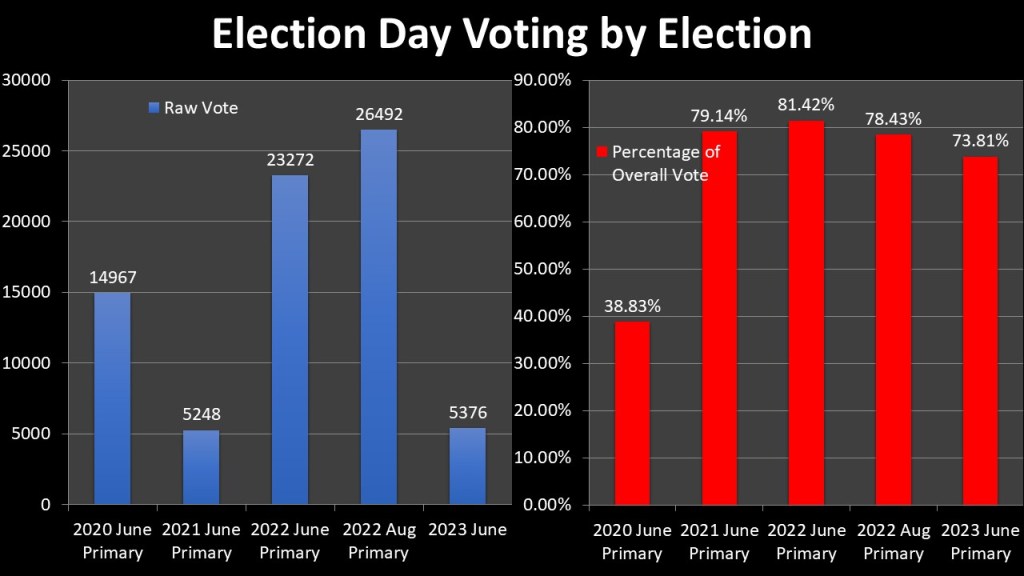
In Person Election Day voting remains the most popular form of voting. 5,376 voters (74%) voters chose to vote In-person on Election Day. 1,113 (15%) Early Voters followed this, 724 (10&) Absentee voters, 69 Affidavit voters (1%), and a single court order voter. Of the voters who voted on Election Day 3,977 (74%) were Democrat. 932 Republican (17%), and 467 (9%) Conservative. The seeming domination of Democrats on Election Day is a bit of a mirage. Because we are analyzing a primary, we must recognize the fact that Democrats had far more voters eligible for this primary than the GOP. Thus, the raw total was always going to be skewed to the Democrats.
As noted, the 2023 June Primary had a limited scope with only Democrat. n Syracuse, Republicans in Pompey and Salina, and Conservatives county wide. This results in a small number of voters (5376) showing up on Election Day when compared to the County Wide primaries of 2020 and two primaries in 2022. However, it is similar to the 2021 June Primary which had a similar number of eligible voters. We are seeing though an interesting pattern in Election. voting as a percentage of the overall primary vote. The 2020 Pandemic primary forced many voters to Absentee. Early Voting showing the smallest amount of Election Day votes. It seemed as if Election Day was going to make a major com. ck with 2021 and 2022 June primaries. However, with the August 2022 primary and 2023 primary we have seen a steady decline in percentage of voters waiting for Election Day and we could see this being a slow steady pattern over time.
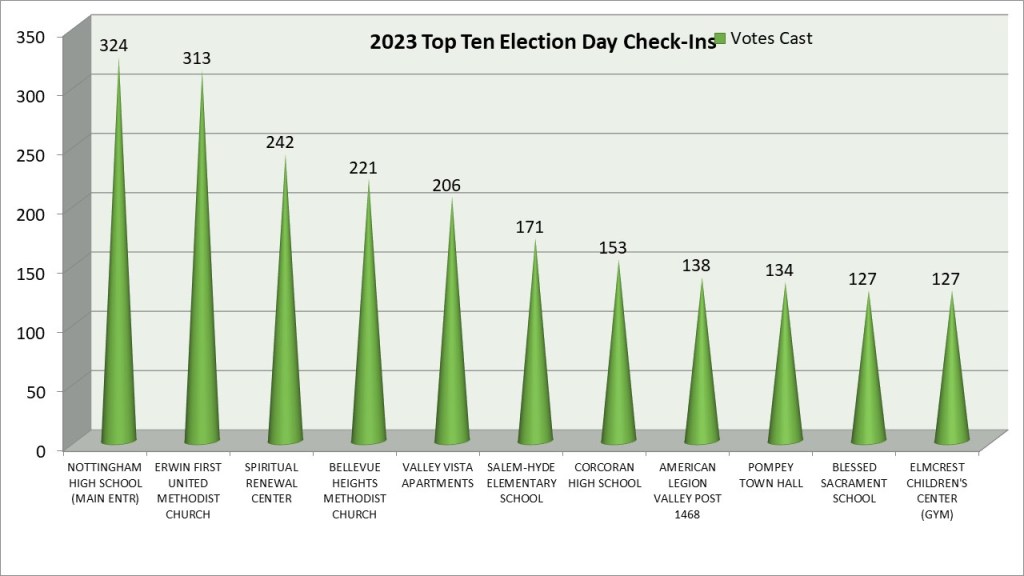
When we look at the ten top polling places for Election Day an interesting pattern emerges. We actually have eleven polling places here as there is a tie for tenth place. Of the eleven top polling places seven of them (Nottingham, Erwin, Spiritual, Bellevue, Valley Vista, Corcoran, & American Legion) were located in the OCL 15th district lines. This primary showed a larger than average turnout. Salem Hyde and Blessed Sacrament are larger polling sites and Pompey Town Hall was part of the Pompey GOP primary. It is also noted the top three polling places (Nottingham, Erwin, Spiritual) are part of the east side 17th Ward/University area where a large number of Democrats live and are activated by the Democratic Primary there.
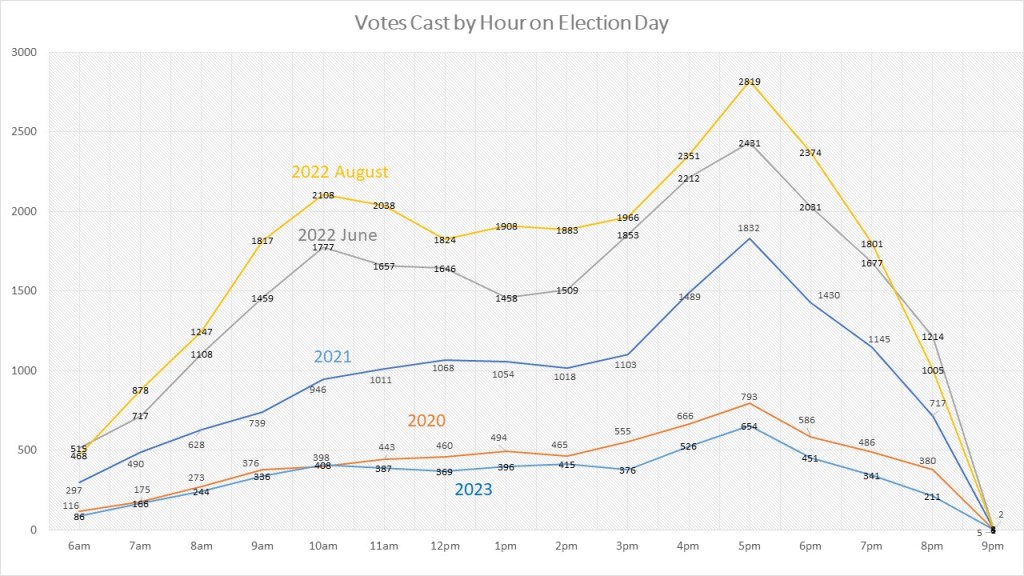
This graph shows the voter check-ins by hour. Before 2020 we could not capture this data as the image cast voting machines only tracked totals by day, not hour. Our Knowink Poll Pads tracks the times of voter check-ins, so we get a decent feel for how voters ebb and flow throughout the day. All five primaries we have been able to track show a similar pattern regardless of turnout. Voters tend to increase in rate per hour until 10am. Then turnout tends to level off until 4pm. We see the biggest hours in 4-6pm as voters get out of work and vote on their way home. We then see a steep decline in the last few hours of voting until the close of polls.
Another form of voting is Affidavit voting. This is when voters show up at the polls and either do not show up in the poll book or have incorrect information such as an address that is not updated. One of the major election myths out there is that affidavit ballots are routinely thrown out. New York has done an excellent job of loosening technical violations that threw out previous ballots. In fact, 78.4% of all absentee ballots in 2023 Primary were valid and counted. Democrats took the most advantage of this with sixty-seven using this method, 5 GOP, three conservatives, eleven non-enrolled voters, and two voters enrolled in the other category. You may ask how voters not enrolled or in other parties participated in the primary, and the short answer is, they did not. The overwhelming reason for an affidavit ballot to be denied is that they were not enrolled in a party or enrolled in the wrong party for the ballot they requested with fourteen voters being disqualified because of that. Another three voters were not registered at all. And two voters returned an absentee ballot to the Board of Elections and thus we counted the absentee and not the affidavit.
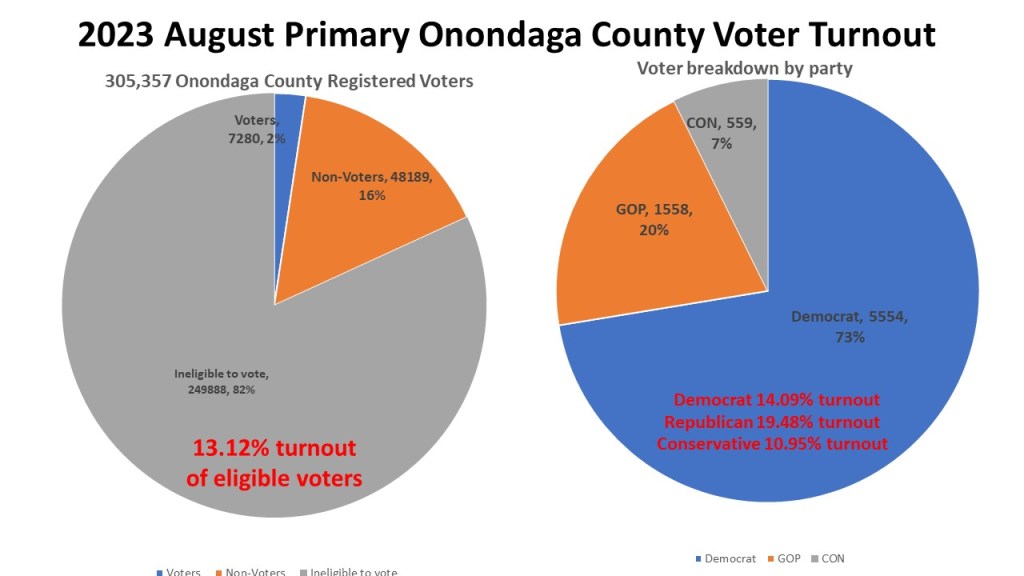
As we start to look at the overall turnout, we really see just how small in scope this primary was. Onondaga County had 305,357 registered voters going into the June 2023 primary. 249,888 (82%) voters were not eligible by geography or party to vote in the primary. Another 48,189 (16%) voters were eligible but did not come out to vote. Just 7,280 (2%) of voters in Onondaga County participated in the June primary. Of those who participated Democrats had 555f (73%) voters made up the voter population. 558 (20%) were from the GOP. 559 (7%) were Conservative. When we look at turnout as a percentage of eligible voters, we saw a final turnout % of 13.12%. Democrats had 14.09% turnout, Republicans 19.48%, and Conservatives were the drag of the election with just 10.95% turnout.
When we look at primary elections going back to 2009, we see that Democrats not only have more primaries, but they are usually larger than the GOP in raw turnout. We have had nineteen primaries since 2009 with only one year, 2011, with no primary from a major party. 2 years there was only a GOP primary, 8 years there was a GOP and Dem Primary, and eight had just a Democratic primary. However, the last five primaries we have seen that there Are Democratic and GOP contests indicating more of a willingness of GOP candidates to challenge their party nominees. When it comes to turnout in a primary another pattern seems to be emerging. Early on the normal GOP advantage in turnout percentage was also represented in primaries. From 2013 2021 it was rare that the GOP had a primary and their turnout was usually lower than Democrats. However, in the last three primaries GOP turnout in primaries has tied or surpassed Democratic turnout in primaries.
Finally, we also can look at turnout in terms of regions. The normal thought on turnout in regions is that the City of Syracuse lags behind the suburbs. However, in primaries, when the primary may be the only election that matters, the City of Syracuse has often surpassed the suburbs ibn turnout, until recently. Of the nineteen primaries since 2009, 5 primaries were solely inside the City of Syracuse. Of the remaining fourteen the City of Syracuse beat the suburbs in eight of these elections. However, the last three primaries saw a correlation with the declining Democratic turnout in primaries with the decline in City turnout in primaries as Syracuse has trailed the suburbs in turnout.
That is, it the last part of my look back at the 2023 June Primary. Next week we will look at the Party Changes and New Voter Registration happening in Onondaga County. In the coming weeks, I will return to the analysis of political subdivisions having elections in 2023. Remember to subscribe to dustinczarny.com for all election news and content updates.
This week I sit down with Carrie Wood who is running for Onondaga County Legislature 10th district. We talk about what its like to be a first time candidate in what is historically one of the most competitive districts in the county. We also talk aquarium, transparency, and her vision for her district. Enjoy.
Subscribe to dustinczarny.com for content and election news updates
The U.S. Election Assistance Commission (EAC) is an independent, bipartisan commission whose mission is to help election officials improve the administration of elections and help Americans participate in the voting process. The Local Leadership Council was established by the EAC in June 2021. This new FACA board is made up of 100 local election officials who are current or former officers in each state’s local election official association. This is the first in-person meeting of this advisory board as previous meetings were virtual.
While in the Nation’s Capital Commissioner Czarny will participate in elections for EAC Local Leadership Council leadership and bylaws as well as discussions on how to make the LLC an effective advisory board. He will attend the EAC Data Summit as well as the LLC meetings on Thursday and Friday. At the LLC meeting he will participate in sessions looking ahead to 2024 challenges, training and workforce development, election technology, and other breakout sessions.
“I am honored to be able to represent New York State on this new advisory board. I look forward to working with bi-partisan representatives from across the country to improve elections for election officials and voters. I commend the U.S. Election Assistance Commission for creating this new advisory board and leading the way in bringing us all together this summer.” – Dustin M. Czarny Chair, NYS Elections Commissioner Association Democratic Caucus and Elections Commissioner (D) Onondaga County
Commissioner Czarny will have limited availability for phone and zoom interviews while on this trip however will return to Syracuse on Monday July 24th. Media inquiries can be emailed to dustinczarny@gmail.com or 315-383-4318.
Welcome back to the #WeeklyWonk. Each weekend I release an article on a subject relating to elections in Onondaga County and New York State. Often these articles will have detailed stats to consume but sometimes they will be a recap of a prominent issue or on relevant election law. I am turning my eye to the 2023 elections. This week I take a break from looking at the political subdivisions and focus on breaking down the 2023 Primary Election This is the first of a two-part series focusing on all aspects of the 2023 primary. This week we will focus on Early and Absentee voting and next Election Day and Overall Turnout.
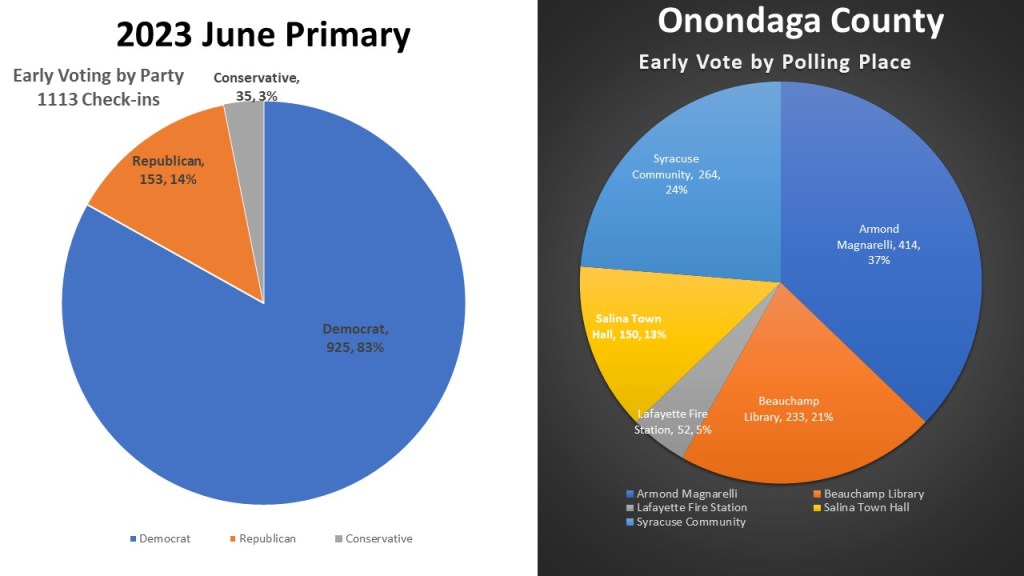
The June 2023 primary was smaller in scale than most primaries. Only Democrats in the City of Syracuse, Republicans in the Towns of Pompey and Salina, and Conservatives County wide. 1,113 Voters checked in to vote Early in the 2023 primary. 925 Democrats, 153 Republicans, and 35 Conservatives showed up to the five open Early Voting sites. Since the primary was smaller in scope both in number of voters and geographic locations. The three locations in the City led all Early Voting with 414 voters going to Armond Magnarelli Center (37%), 264 at Syracuse Community Connections (24%), and 233 at Beauchamp Library (21%) The suburban sites did not do as well with Salina Town hall chosen for proximity to the GOP primary there having 150 voters (11%) and Lafayette Fire station just next door to the Town of Primary at 52 voters (5%).
Diving into Early Voting by site we can compare how the sites do over time. As noted above Salina Town Hall appears as a site for the first time. It essentially took the place of Lysander Town Hall as the Northwest suburban EV site, so their figures are listed there. Traditional EV sites Clay Town Hall and Dewitt Town Hall were not opened for this action as newer sites like OCC Mulroy Hall and North Syracuse Community Center were closed as well. The difference in the 2021 primary and 2023 is the three City sites spread the small voter load out more equally. Even so the Armond Magnarelli center leads city sites in every Primary election we have had.
When looking at Early Voting it is important to now just look at the raw numbers but compare it to similar elections. We have now had five primary elections with Early Voting and 2023 1113 voters is bigger than the similar primary in 2021, though the 2023 primary was the least populous in terms of eligible voters. However, when you look at the percentage of the voting population Early Voting continues to grow. In 2023 15.29% of voters chose to vote early, this is the highest percentage in any primary so far. In fact, each year more of the overall turnout has been represented in the Early Voting numbers regardless of scale and scope of the primary.
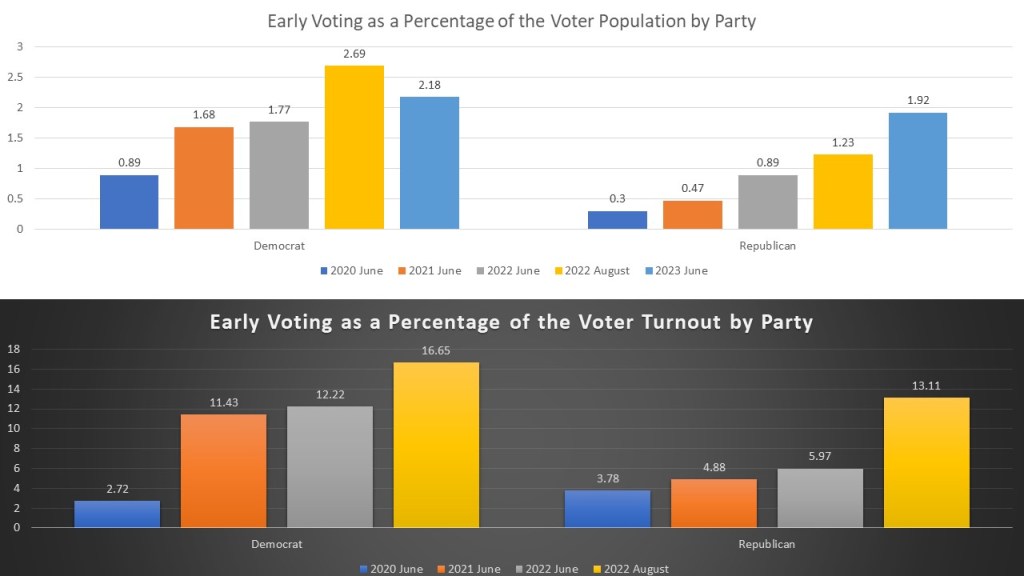
One of the reasons why Early Voting is growing as a share of the population is that we are seeing more adoption of Early Voting by the GOP as opposed to just Democrats. The GOP performed better than Democrats when looking at overall voter population eligible for this election. Democrats saw a fall in participation at 2.18% of the eligible population Early Voting, down from 2.69& in the august primary last year. The GOP was just 1.92% of their voting population, which represents a rise from last year and previous years. In fact, when you look at the percentage of the turnout Democrats did have the larger percentage of the voters who chose to turnout show up at 16.65% Early Vote. However, the GOP came closer than ever to matching the Democratic voter share with 13.11% of their voters choosing to Early Vote.
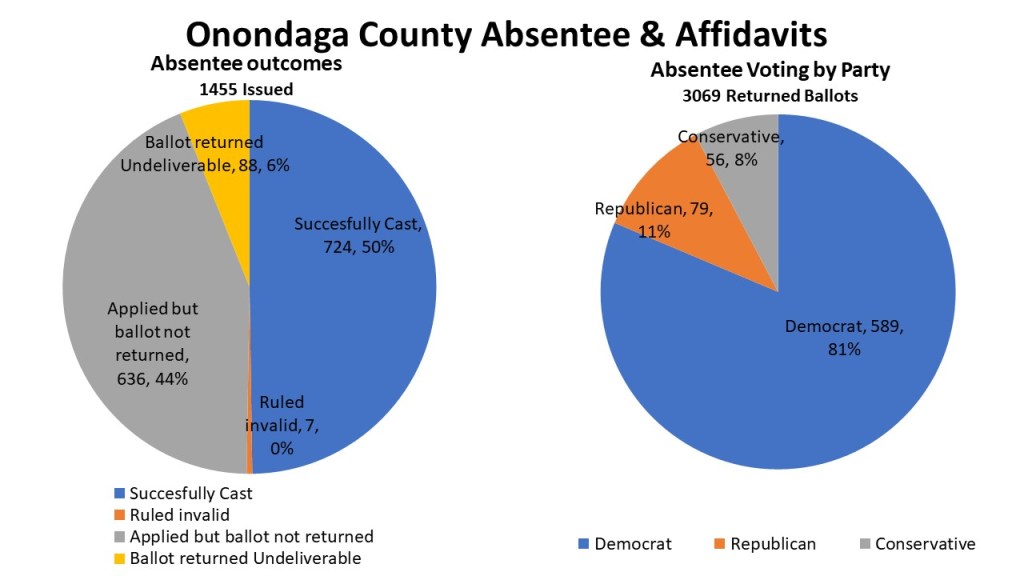
The other form of pre-Election Day voting is Absentee. 2023 is the first year since 2019 where the pandemic excuse for absentees is not in effect. We only issued 1455 absentee ballots in 2023724 ballots (50%) were accepted and counted, 637 ballots (44%) were unreturned, 88 (3%) Ballots were returned undeliverable by the US Mail, and just 7 ballots returned (<1%) were rejected. Democrats dominated the absentee ballot returns with 589 ballots back (81%), Republican s returned 79 (11%), and Conservatives 56 (8%).
Absentee ballot usage for this primary in terms of actual applications received and ballots returned was one of the least in recent history. The 1455 absentee ballots issued is second least to 2019. The same is true for the ballots returned. However, when looking at percentage of actual votes at 9.95% is comparable to what the primaries were in 2022. With the pandemic easing voter’s reliance on absentees has dropped, however it is still well above the pre pandemic years of 2017-2019.
That is, it the first part of my look back at the 2023 June Primary. Next week we will look at the Election Day, Affidavit voting and overall turnouts for the June Primary. In coming weeks, I will return to the analysis of political subdivisions having elections in 2023. Remember to subscribe to dustinczarny.com for all election news and content updates.
This week I sit down with recent primary winner Elect Maurice Brown. He is the Democratic nominee for OCL 15 inside the City of Syracuse. We talk about campaigning as a candidate for the first time and issues facing Onondaga County.
Find Mo here: http://www.electmauricebrown.com @MoBreezy213 – Twitter @electmauricebrown – Instagram Elect Maurice Brown – Facebook
Subscribe to DustinCzarny.com for all content and election news updates.
I talk about what happened in the last week, how the close races ended up not being handcounts. I also talk about where to find certified results and what is to come this summer at the OCBOE. Enjoy.
Subscribe to dustinczarny.com for all election news and content updates
It has been nearly two months since my last #Weekllywonk, but its back. In May and June, I was preoccupied with the June primary, then end of the legislative session, and personal obligations. But I am back now and committed to weekly updates from now until the General Election in November. Each week I will dive into political subdivisions that are having elections this fall. However, for the next couple of weeks I will be focusing on some Board of Elections matters. This week I will focus on the 2022 Annual Report and the Board of Elections financial performance and struggles last year.
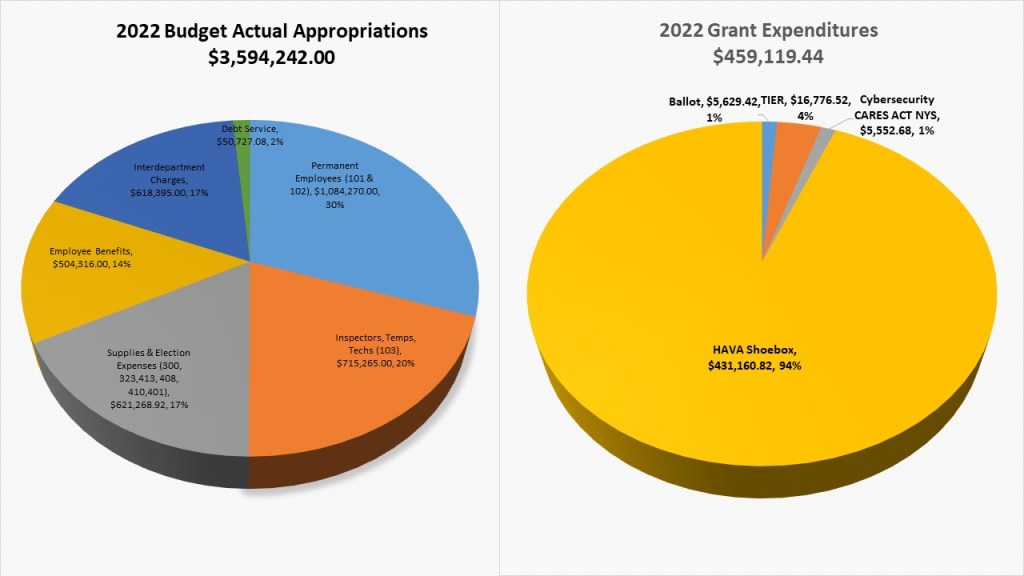
Boards of Elections are required by Election Law to do an annual report. At the Onondaga County Board of Elections, we make all our Annual Reports available online at onvote.net here: http://www.ongov.net/elections/annual-reports-and-minutes.html. We also distribute these reports to the County Executive, County Clerk, County Comptroller, and all County Legislatures. The report is intended to document all aspects of the Board of Elections operations. If you have followed my #wqeeklyWonk you are familiar with some of the statistics within as I have already talked about voter registration, turnout, and voter preference. In this #weeklyWonk I will highlight the financial statistics of the Board of Elections. In 2022 we spent $3,594,242.00 in local dollars and $459,114.44 in Grant spending. In the above graph you can see exactly how much we spent on each subcategory.
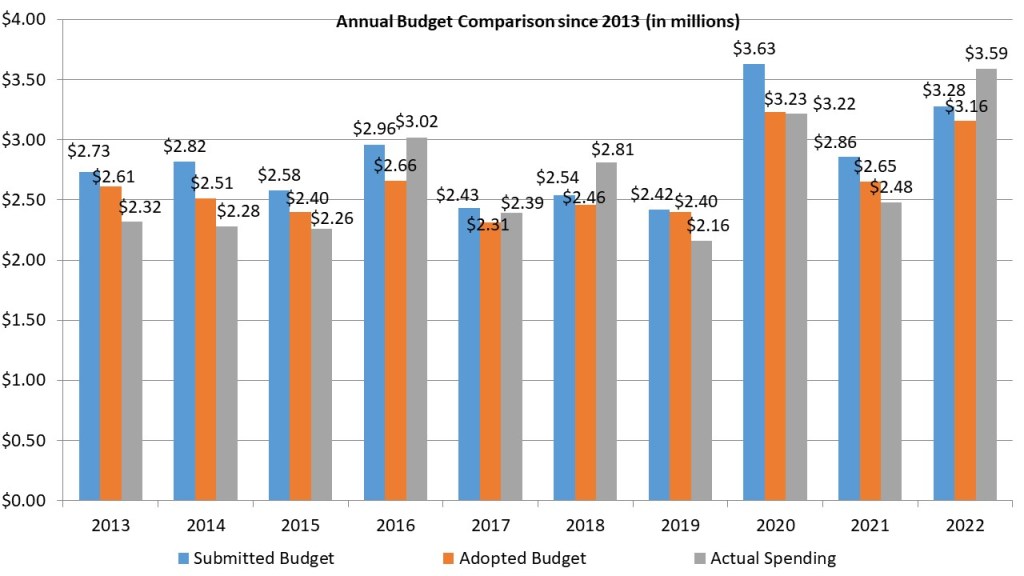
2022 was a financial struggle for the Onondaga County Board of Elections, and practically every Board of elections throughout New York State. When New York State by judicial order added the 2nd of August Primary for Congress and State Senate it was not anticipated in our already set budgets. In this slide we see our budgets going back to 2023, when I started as Commissioner. Each budget season both Commissioners agree on a budget that is submitted to the County’s Division of Budget and Management. The County Executive then proposes a budget, and the County Legislature makes changes. Often, they reduce our requested budget and many times the Board of Elections must exceed the budget to service the needs of the voters, which we are allowed to do in Election Law. The Board of Elections has only exceeded their submitted budget in 2016, 2018, and now in 2022. In 2022 we exceeded the budget because of the needs of the extra primary having spent approximately 3.59 million against the submitted 3.28 million and approved 3.16 million.
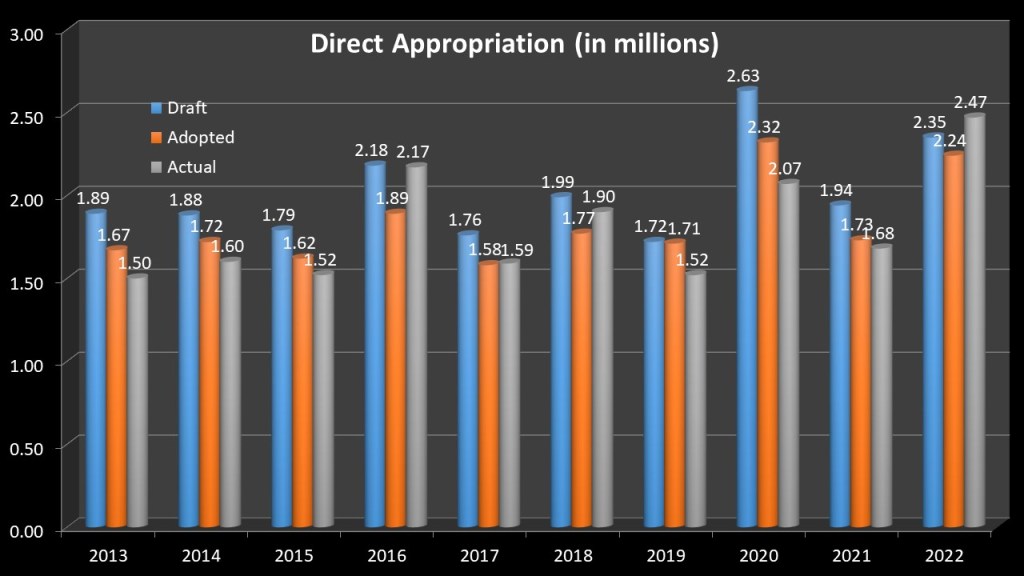
The budget is broken up into three different subsections, Direct Appropriations, Indirect Appropriations, and Revenue. The Direct Appropriations are made up of items that the Board of Elections controls directly such as salary, supplies, contracts, and all election inspectors. The BOE requested 2.35 million however the County Executive and legislature cut it to 2.35 million. We spent approximately 2.47 million, just 1.27 million over budget. Considering primaries cost approximately 300k dollars we performed admirably well. In fact, 2022 was the only year since my time in Commissioner where the direct appropriation came in over the requested amount by Elections Commissioners. Previously The Board of Elections did exceed the budgeted amounts in 2016, 2017, and 2018 however these were because of cuts by county government that did not consider increased turnout or primary costs.
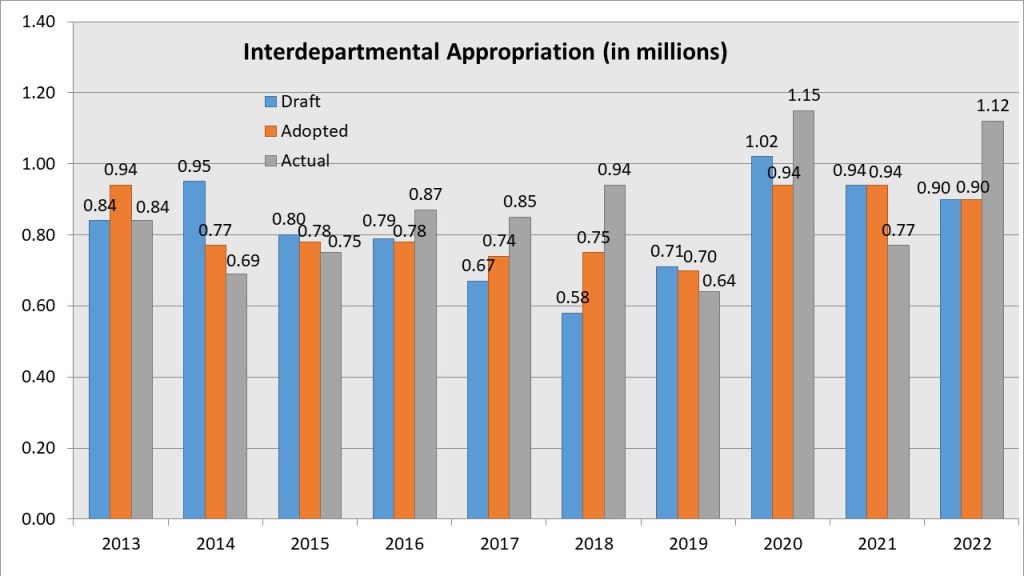
Indirect appropriations are the portion of the budget that is least controlled by the Board of Elections. This budget category is made up of mainly permanent employee benefits and charges from other county departments. At the beginning of each year the office of Management and Budget assigns values to our budget. Estimates for benefits are based on permanent employees and interdepartmental charges are based on past performance in similar years. Unfortunately, 2022 was not a similar year to 2018. Though 2018 had higher activity the third primary and legal challenges in 2022 to absentees drove our interdepartmental charges way through the roof resulting in nearly 220k in charges over budget. Once again OCBOE has no control over these charges, and they are only assessed at the end of the budget year.
The third and smallest portion of our budget is Annual Revenue. The Board of Elections is not a profit-making department. Most of our revenue comes through programming and ballot charges when we help government entities hold their elections. This is mostly the May School district elections but also villages that hold elections in March and June. Since COVID our revenue base has been unstable as some villages have moved their elections to November and School districts went to all mail options in 2020 and 2021. In 2022 we started to reevaluate our reimbursement costs from School districts which resulted in us coming in 1.9k over budget. In 2022 we will be doing the same for villages as well.
It is important to look at the OCBOE budget performance not just against itself but the rest of the state. The State Board of Elections compiles budget, employee, and inspector stats in their annual budget. One of the stats they collect is the annual budget of all Boards of Elections throughout the state. The 57 counties and the NYC Board of are various size so you can’t do direct comparisons. The best comparison is to use the active voter registration numbers in each county and compare it against the chosen statistic. The next few stats I will compare how the OCBOE employee structure, overall budget, and inspector deployment compares to other Boards of Elections. These comparisons are compiled annually by me and posted at onvote.net here: http://www.ongov.net/elections/documents/NYSBudgetEmployeeComparisons.xlsx
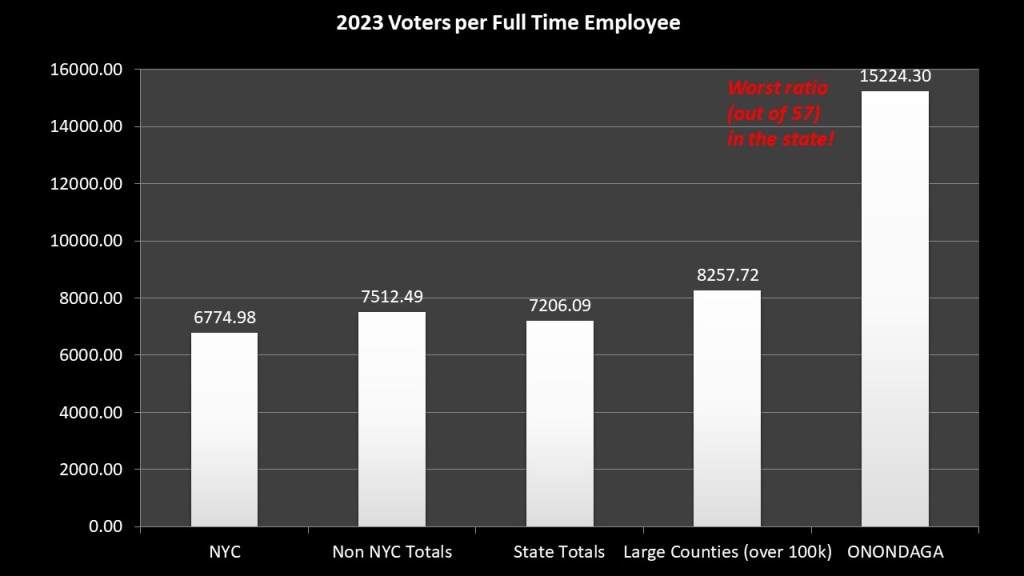
The first and most obvious comparison is the number of permanent employees compared to the rest of the state. The Onondaga County Board of Elections fields 20 full time employees (including Commissioners) and for the 2022 election had 304,486 registered voters. This means that OCBOE employs one full time employee for every 15,224.30 voters. This is the worst ratio in al of New York State. The other counties in New York State average 1 employee for every 7206.09 voters. When you take NYC out of the mix, the rest of upstate averages 1 for every 7512.48 voters. When you compared to large counties over 100k voters they average 1 for every 8257.72 voters. Despite adding 4 positions over the last two years, Onondaga County has not kept up with the rest of the state. In 2019 when electoral reforms added responsibilities to the local boards other counties responded by staffing up significantly. OCBOE was already the worst in the state and the county only added a few employees, so OCBOE has continued to fall behind other counties.
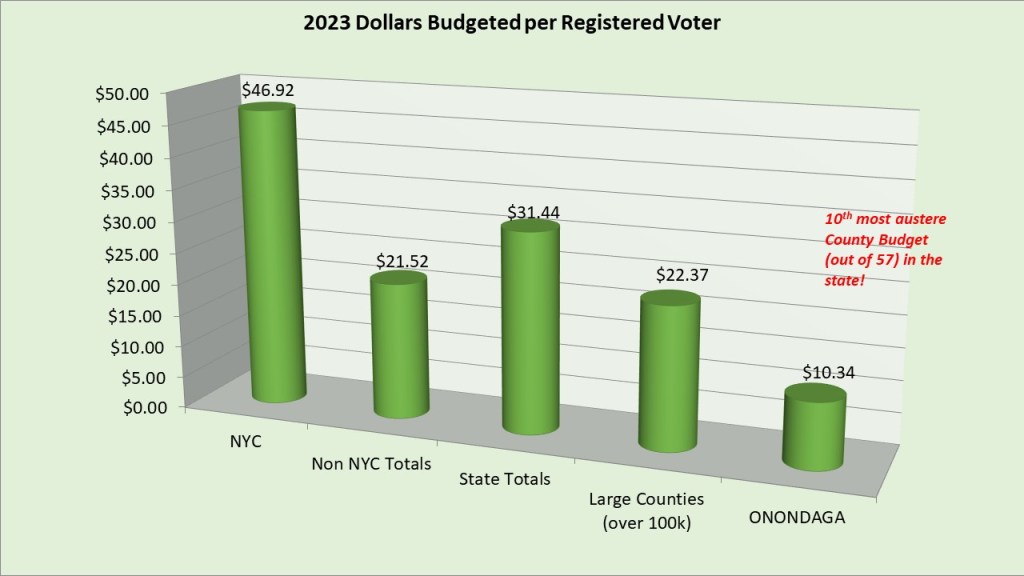
The lack of permanent employees is reflective of the overall budget that is annually approved by the County Legislature. In 2022 our budget was approved for $3,148,648.44. When divided by the active registered voters is $10.34 per voter. This is the second most austere budget in New York state, trailing only Cayuga County. New York State averages $31.44 per voter but that is skewed by NYC spending of $46.92 per voter. When we look at non-NYC counties, they spend $21.52 per voter and large counties over $100k spend $22.37 per voter. We make up for some of the lack of resources through the Grant spending outlined earlier and adopting of technological advances.
One of the places where technology has helped us grow more efficient is in the Inspector Deployment. The adoption of the Know ink Epoll Book and Printing on-demand allows us to have a streamline the voter check-ins on election day and early voting. Having more centralized polling places are also helping They no longer must staff individual election district tables and voters check in at one table and pick up ballots at the other. This has allowed us to deploy 1 inspector for every 253.95 voters. This is the 10th most efficient in the state. New York State averages 1 election inspector for every 157.12 voters. Once again NYC brings that average down by averaging 1 inspector ever 112.37 voters. Non-NYC counties average 1 for every 210.97 voters and large counties over 100k are 1 for every 219.53. With new machines and on-demand ballot printing being rolled out this year we are looking to be even more efficient in.
That is, it for this #WeeklyWonk. The next two weeks I will focus on recapping the June Primary first looking at Early and Absentee voting and finishing with Election Day and overall turnout. After that I will get back to analyzing the Towns, County Legislature seats, and villages that have competitive elections in November. Remember to subscribe to dustinczarny.com for all content and election news updates.
This week I sit down with one of my favorite guests, Tom Keck of Syracuse University and CNY Solidarity. Professor Keck is one of the foremost area expert on the Supreme Court. We talk about the controversial decisions from the last term as well as some of the ethical scandals surrounding the court. Enjoy.
Subscribe to dustinczarny.com for all cntent and election news updates
I go over the 23 pieces of legislation relating to elections that was passed by both houses in the 2023 Legislative session. & of which already signed by the Governor, another 16 awaiting her signature. I also give an update on the 2023 June primary and my thoughts on creating our more perfect union which started with the Declaration of Independence that we celebrate today. Enjoy.
Subscribe to dustinczarny.com for all content and Election News Updates