Today I sit down with Alissa Italiano for Manlius Town Board. She is running to fill a vacancy on the Manlius Town Board while also sitting on the board and preparing to run again next year. She is a fine member of the Town of Manlius Board and I hope you enjoy.
Subscribe to dustinczarny.com for all content and election news updates.
This week I touch on the lawsuit the Democratic Caucus of the legislature plan to file, The strong start for Early Voting for the August primary, and I touch on how you can cast your vote for August 23rd. I also show some love for found and adopted dogs in tribute to my late dog Karma. Enjoy.
Welcome to the #weeklywonk. This is my weekly blog about statistics, registration data, and election law on my website, dustinczarny.com. This is a rebrand of my #wonkywednesday and #sundaythoughts columns I have been writing since 2020. In merging these two side projects together I am hoping to be a little more regular in my production. I have also not tied myself to a particular day to release these columns, hoping to release them weekly on the weekend, so I can have more time to gather the statistics and resources that I want to devote to these articles. This week I return to our General Election registration previews with NY Assembly District 128.
#AD128 has a portion of the City of Syracuse, mainly the eastside and center city election neighborhoods. It also has the entire towns of Dewitt, Onondaga, and Salina. Assemblywoman Pam Hunter (D) has represented the 128th since winning a special election to assume the vacant seat in 2015. Before her it was represented by Sam Roberts (D) who is running for congress this year. Before 2012’s redistricting this seat was pretty much the same and represented by Joan Christensen (D).
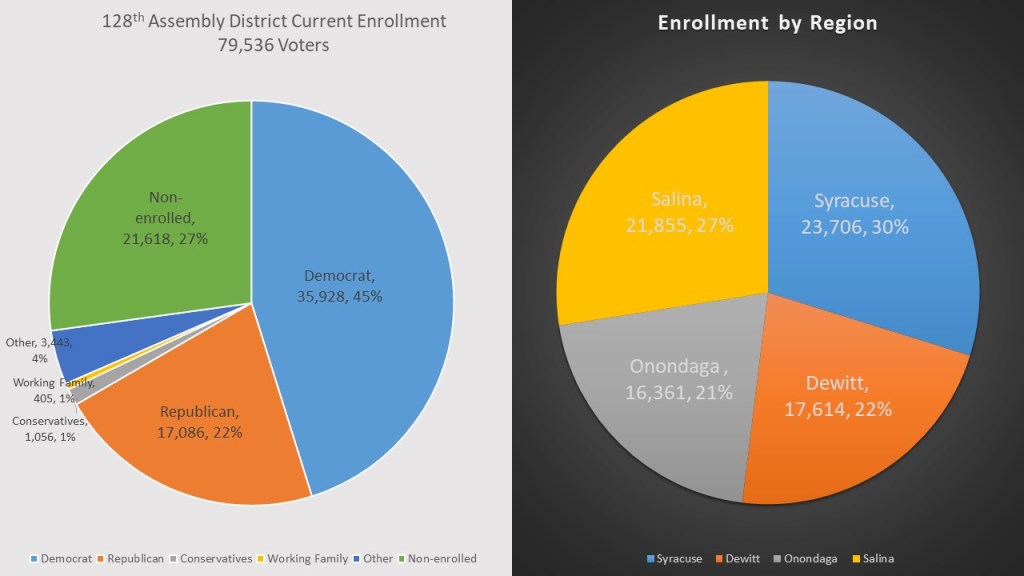
A quick look at the registration of this district and we can see it has all the hallmarks of a safe Democratic seat. Democrats have the large plurality of registration at 45% and the GOP has 22%. Less than half the Democratic registration. Non-enrolled is significantly higher than the GOP and in second place at 27%. In terms of Geography this seat is almost equally split among its four distinct regions. Syracuse has 30%. Salina 27%, Dewitt 22% & Onondaga 21%.
Though this seat is actually only more than a ¼ inside the City of Syracuse, it is a solid Democrat seat. We can see why in this breakdown. Dewitt and Salina are two of the more solid Democratic towns in terms of enrollment. Onondaga has recently started to swing the Democrats as well with a slight Democratic plurality. Of course, Syracuse’s huge Democratic registration edge is what pushes this seat from Lean D territory to Overwhelmingly Safe D.
This seat is essentially unchanged from the 2012 version with only minor changes around the edges. Thus, the party enrollment looks over time remains an accurate assessment of how the enrollments have shifted over time. Democrats have gained 2467 voters since the creation of this district in 2012. The GOP have lost 2080 voters over that same time period. The Non-enrolled is the biggest mover gaining 3,260 voters. The growth of Democrats and non-enrolled paired with the significant losses of GOP voters makes this seat non-competitive outside of a major unseen circumstance.
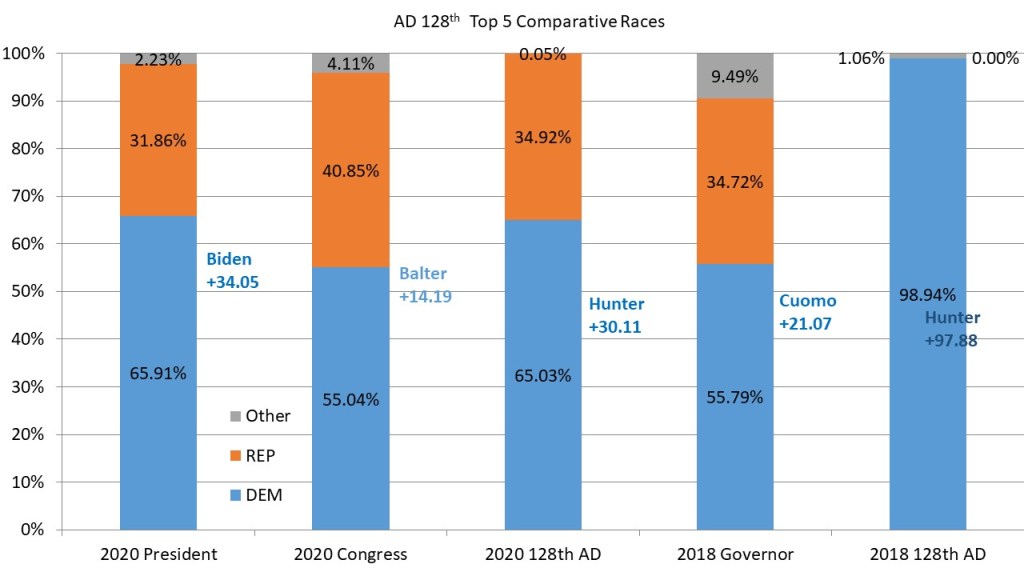
We also see this in performance of this district. President Biden won the vote in this district by +34.05 in 2020. Dana Balter won the Congressional vote in this district by +14.19 despite losing the race in 2020. Andrew Cuomo performed very well in his Gubernatorial race with +21.07 in 2018. The Current representative, Pam Hunter, easily won her re-election bid in 2020 by +30.11. She was unopposed in 2018. Democrats outperform their countywide results, especially in federal elections.
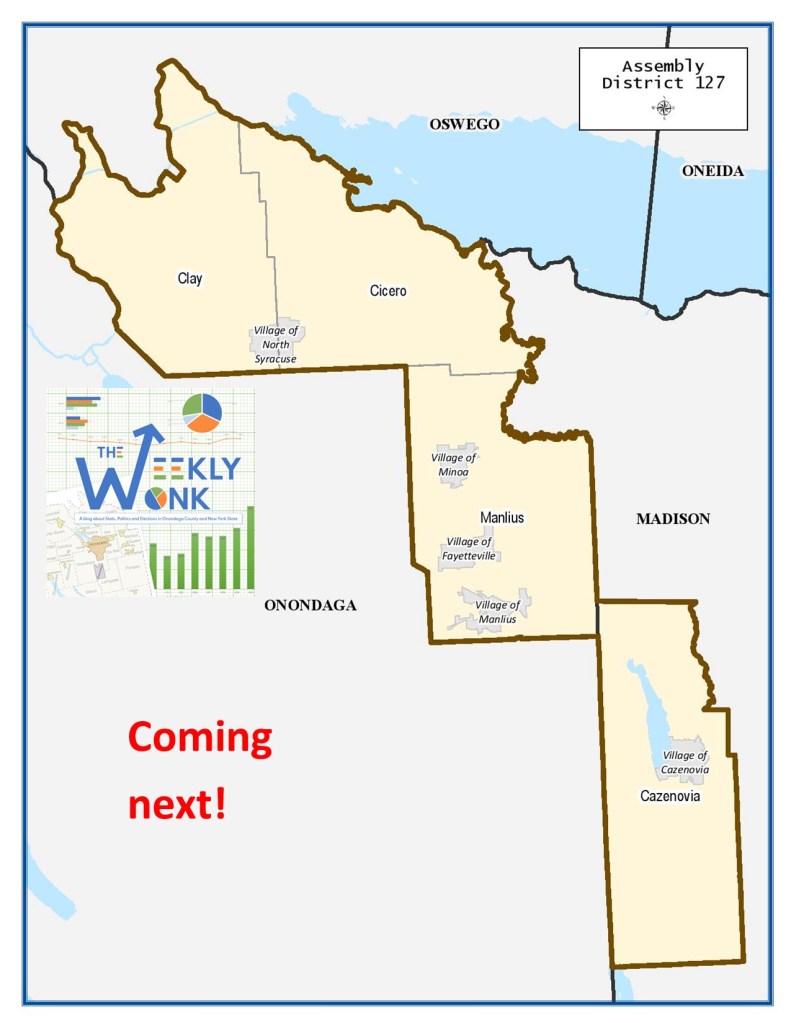
Next week I will continue my review of the races on the ballot for the General election. Next up I look at the 127th Assembly District held by Al Stirpe. I plan to look at each race on the General election ballot leading up to November. Remember to subscribe to dustinczarny.com to get all election news and content updates.
This week I sit down with Family Court Judge Julie Cecile. We talk about her first ten year term and her re-election campaign this fall for her 2nd. She has a long history as an advocate for our community. Enjoy.
Subscribe to dustinczarny.com to get content and election news updates
On August 9, 2022 I spoke to the Syracuse Common Council about the proposed maps delivered to them by the City of Syracuse Redistricting Commission. I urged them to trust the commission and finish this project which would bring changes to our city lines for the first time in over 20 years. See the entire meeting here
Early voting for the August primary starts Friday, Absentee ballot deadline by mail has passed but you can still do in person requests, party changes must now be received by August 11, 2022. Check it all out at onvote.net.
Subscribe to dustinczarny.com for all content and election news updates
Welcome to the #weeklywonk. This is my weekly blog about statistics, registration data, and election law on my website, dustinczarny.com. This is a rebrand of my #wonkywednesday and #sundaythoughts columns I have been writing since 2020. In merging these two side projects together I am hoping to be a little more regular in my production. I have also not tied myself to a particular day to release these columns, hoping to release them weekly on the weekend, so I can have more time to gather the statistics and resources that I want to devote to these articles. This week I will finish my look back at the June 2022 primary looking at overall turnout.
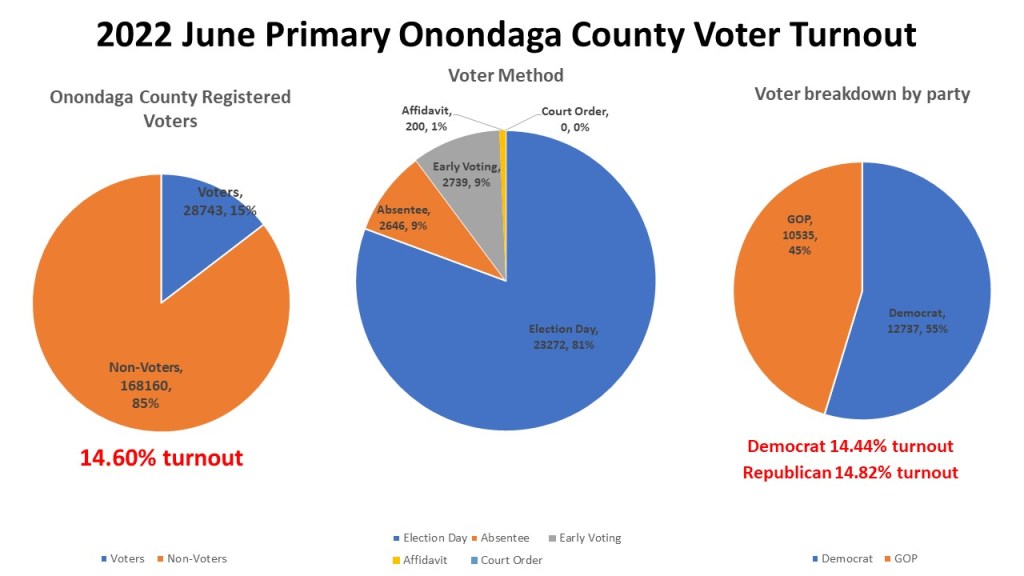
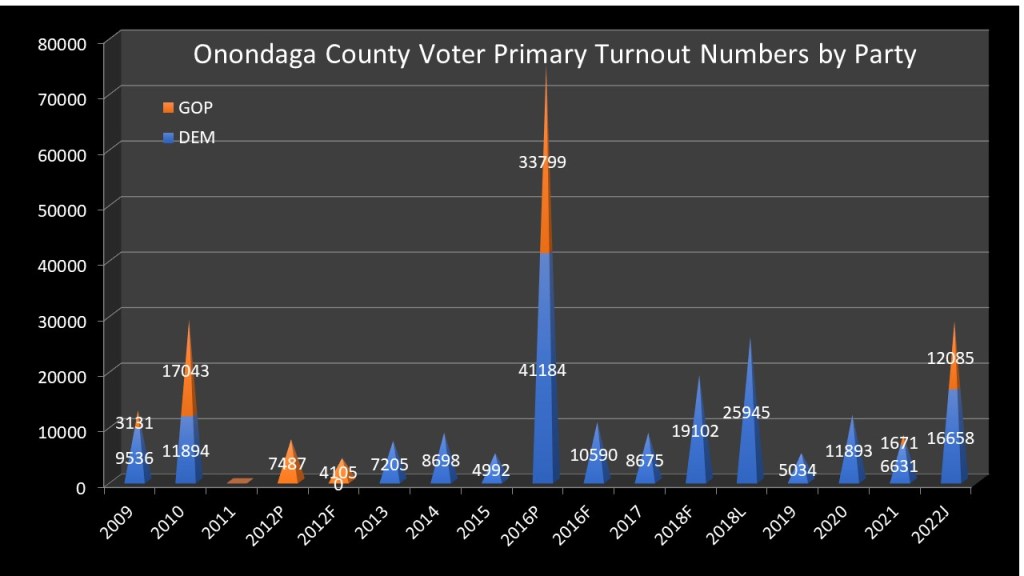
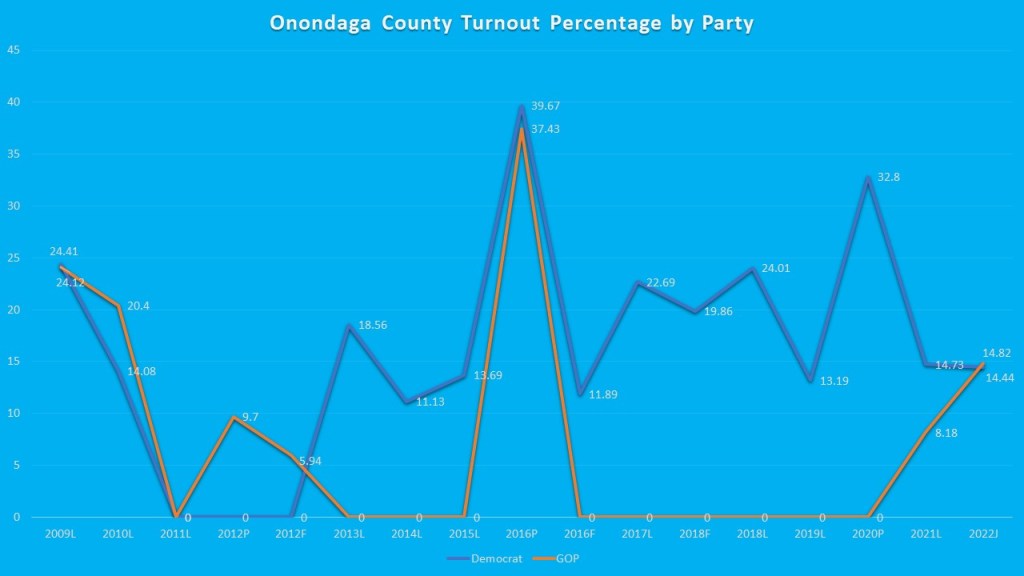
Primaries by their very nature are low turnout events, and the June 2022 primary was no different. On the ballot in Onondaga County there was a Democratic and republican primary for Governor and Democratic primary for Lt. Governor. Other areas of the state had Assembly and local office primaries, but we did not in Onondaga County. We had 196,903 voters eligible to vote in the June Primary. 28,743 voters showed up to the polls for a turnout percentage of 14.60%. As we explored in the last three updates, 81% voted on Election Day, 9% voted Early & Absentee, and an additional 1% voted via Affidavit Ballot. In the overall populace of the Primary Democrats made up 55% of the raw vote total and GOP made up 45%. The turnout percentages though were virtually tied with the GOP getting 14.82% turnout and Democrats getting 14.44%.
It is actually rare that a primary election has both GOP and Democratic choices on the ballot at the same time. Since 2009 we have had 16 different primary elections, including last June. Only 5 of those primaries were bi-partisan primaries with both major parties having choices. Only 2 primaries (2012 Presidential & Federal) were primary elections with only GOP choices. 9 primaries have occurred with only Democratic choices and no GOP choices. Only one year where there no primary election, that was 2011. It should be noted in August we will once again have both GOP and Democratic choices for Congress. This will make the third primary in a row where there is competition on both sides and possibly a harbinger of more primaries in the future.
Turnout rates for primary fluctuate based on the number of races on the ballot in non-presidential years. The 2020 Presidential primary stands out as the big daddy of all recent primaries. Turnout soared in those primaries because New York was uniquely situated as the do or die states for Trump and Clinton as wins in New York would all but cement their general election nominations. It was also alone in the primary calendar allowing all Presidential campaigns to focus solely on the state. The 2020 combined Presidential primary for Democrats is next. This is a unique primary where the Presidential and congressional and local races were all combined into one primary. The various competitive offices drove turnout. Turnout in non-presidential primaries tend to be driven by number of candidates on the ballot. Another example of that is in 2018 the later local primary with Governor and local offices had higher turnout that the 2018 Federal primaries with only Congress on the ballot. Of the 5 primaries with both Democrats and GOP on the ballot the GOP had higher turnout in 2 primaries (2010 & 2022 June) and Democrats had higher in 3 primaries (2009,2016 Pres,2021). Most of the time the differences are negligible in the ratio of turnout, though that is notably different than General Elections where Democrats usually trail in turnout rates.
Another interesting difference in primaries as opposed to general elections is the regional turnout rates. In General elections the City of Syracuse tends to trail both the suburbs and overall turnout. In Primary elections that is not always the case. The City of Syracuse is a Democratically held city and in recent years the primary tends to be the election for the city offices. This has led the city to participate at a higher rate in their primaries. We have had 5 City only primaries of the 16 primaries since 2009 (2009, 2013, 2015, 2017, & 2019). Syracuse has led the turnout in in 8 different years (2010, 2012 Pres, 2012 Fed, 2014 Local, 2016 Fed, 2018 Fed, 2018 Local, 2021 Local). The three years where the primaries acted more like the general where Presidential Primaries in 2016 & 2020 and this last June 2022 primary. In all three of these primaries, we had county wide competitive primaries and turnout among suburban voters increased. City voters are used to primaries and usually have more races to choose from and that in my opinion is why on average they are more likely to show up for a primary than suburbanites.
This wraps up my four-week look back at the June Primary. In September after the certification of the August Primary I will do a similar breakdown of that election. It will be interesting to look at the turnout difference between June and August. For years New York had bifurcated primaries with Federal primaries in June and local ones in September. This was because New York was under a court order to move their local primary earlier or have two different primaries to allow the federal primary to comply with the MOVE act. Democrats in the Assembly wanted a single June primary, and the GOP in the Senate wanted an August Primary. The Court eventually moved federal elections to June and New York had two primaries until Democrats took over the State Legislature in 2019. It should be noted that we have had only two normal political calendars 2019 & 2021. Covid combined the Presidential primary in June of 2020 and Redistricting once again split the primaries in June and August of 2022. This real-life experiment will give us some insight on that past debate.
Next week I will once again return to looking at some of the races on the ballot for the General election resuming my look at the Assembly races with the 128th Assembly District. I plan to look at each race on the General election ballot leading up to November. Remember to subscribe to dustinczarny.com to get all election news and content updates.
This week I sit down with Assemblyman Al Stirpe who represents the Clay, Cicero, Manlius and now Cazenovia in the 127th Assembly district. We talk about his long career, the recent NYS legislative and special session, and what he hopes to accomplish in his next term. Enjoy.
Subscribe to dustinczarny.com for all content and election news updates
Today I talk about the upcoming absentee ballot deadline for the August Primary. I also talk about the party change issue for the August 23rd primary and do a small history lesson on party change eligibility in NY. Enjoy.
Subscribe to dustinczarny.com to get all content updates
I have some changes as we prepare for the 2022 General Election season. Yes there is a primary in August but this year we have to learn to walk and chew gum while balancing on a wire over Niagara Falls. In August I am changing the way I deliver my podcast and writing content to you to allow me to continue to do the content but also be best positioned for my duties at the Onondaga County Board of Elections this busy fall season.
Since 2020 I have been doing a weekly blog post on Election and politics. Most of those came in the form of #wonkywednesday articles but also a few Sunday Thoughts articles. I have decided to combine those efforts into one weekly endeavor called the The Weekly Wonk. I will release these on the weekend. This will allow me more time to edit and gather the statistics and pieces of Election law I like to bring to the readers.
I also plan on decoupling my Seminar series from being released on Sundays. I plan on doing yearly Czarny’s Seminars on Getting on the Ballot (February), Absentee Balloting (April), Registering to Vote (August), Early Voting (October), and Previewing New Election Law Changes (December). They will take the place of my other scheduled podcasts for that week.
Speaking of my podcasts, I am also altering the release days of my podcasts. Commissioner in a Car will now release first on Facebook Live at 5pm on Tuesdays and then on Spotify and Youtube afterwards. My Zoom with Czarny weekly Interview show will release on Thursdays on all of my platforms. This new schedule will allow more time to prepare content and schedule interviews.
I launched this website in January of this year and have added almost 1k posts since then. Here is what they entail:
This along with my 6 different Site updates (including this one) brings me to a toal of 965 posts. That is a good deal of posts since January but not all of it is new content. My Zoom with Czarny and Weekly Wonk content dates back to 2020. My Editorials date back to 2018. I have Testimony dating back to 2017. Commissioner in a Car Content goes back to 2016.
The bulk of the content on my website is my media archives. I have posts in there starting with my nomination as commissioner in 2012. The bulk of my content is 2016 and beyond. I have not been able to completely archive before then yet, though I plan on doing some work on that this winter.
If you are reading this I ask you consider subscribing to dustinczarny.com and get an email notification when I post election news and content updates. I am blessed to appear in the media A good deal and while I try to post no more then one post a day, closer to elections there may be several media appearances and content releases on the same day. I suggest when you subscribe you choose daily updates instead of individual updates if you want to avoid multiple emails. You can also connect with me still on Facebook, Twitter, Linkedin, and Instagram to get more content. You can also subscribe directly to my Youtube and Spotify channels as well.
Subscribe below and thank you for taking time visiting dustinczarny.com