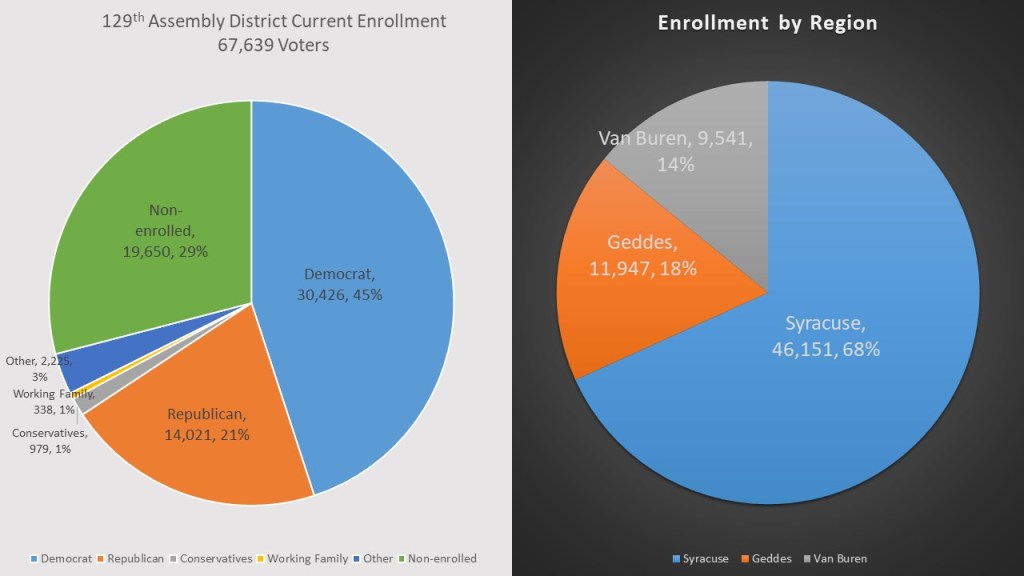
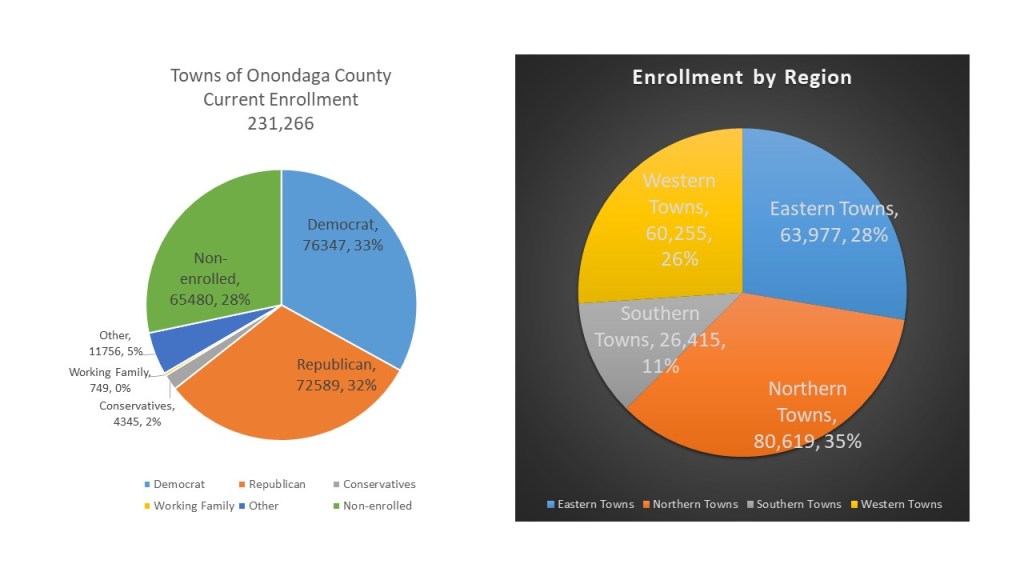
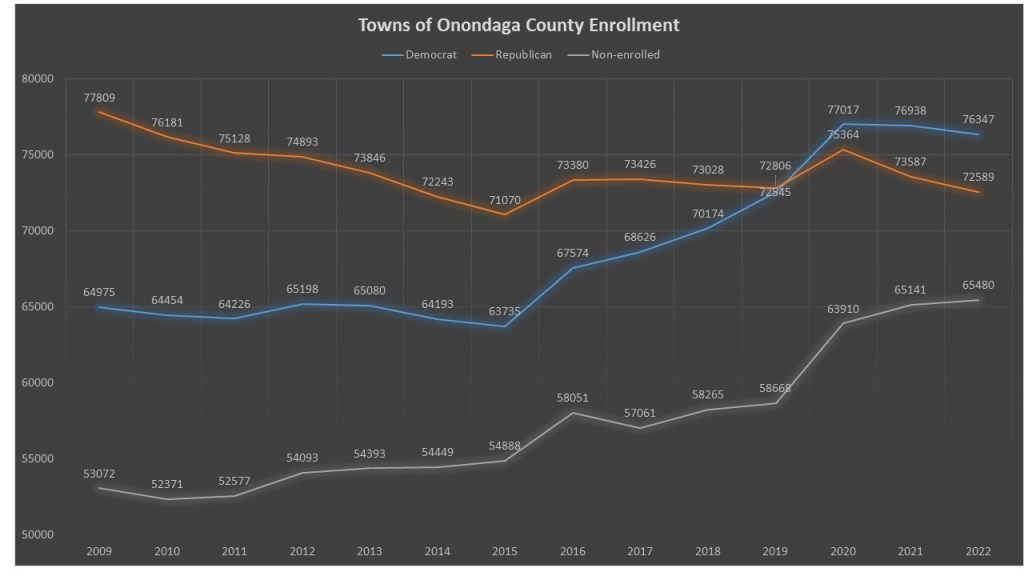
In this week’s Zoom with Czarny I sit down with Casey Cleary and Mark Matt who are running for Village of Fayetteville trustee. We talk about village government, why they are running, what they hope to do in office, and the challenges of running in a March election. I hope you enjoy.
Subscribe to dustinczarny.com for content and election news updates.
Welcome back to #wonkywednesday. Each week I dive into a facet of electoral data for Onondaga County. My hope is by understanding these data points we can appreciate the many facets of election administration and voter participation. This week I am investigating Budget and staffing levels of Onondaga County in relation to the rest of New York State. Each year the New York State Board of Elections askes each of the fifty-seven counties and NYC Board of Elections to submit data based on our operations for the previous year and budget and staffing levels for coming years. In that data I have settled on four main points of comparison where we can measure Onondaga County resources devoted to Elections. Those four main categories are Annual Budget, Full time permanent staff, Inspectors Appointed, and finally Commissioner Compensation.
When comparing the Onondaga County Board of Elections to other counties you must account for the variety of sizes in New York. Onondaga County has 303,387 voters as of last November. This ranks the sixth most populous County in New York State outside of NYC. The range of counties varies widely with Hamilton County being the least populous (4,287 voters) to Suffolk County being the most (1,305,408). New York City encompasses five different counties (Bronx, Kings, New York, Queens, & Richmond) which operate the NYC Board of Elections jointly and serves 5,565,015 voters. New York State in total has 12,933,976 voters.
Using ratios to active registered voters is the best way to get a contrast on how Onondaga County is doing in relation to the other boards. Furthermore, smaller boards, under 100k, the ratios will be different as they have minimum amount of work that needs to be done regardless of size. For this comparison I am going to contrast the Onondaga County statistics to the entire New York State Average, to NYC, to Non-NYC Counties (57), and finally to counties (16) over 100k voters. This will give a broad sense of places where we are more efficient than others and other areas where Onondaga County voters are disadvantaged because of frugality.
In 2022 the Onondaga County legislature approved a budget of $3,134,217.00 for 2022 year. Later in March the Onondaga County Comptroller will close the book on 2021 and we will do a #wonkywednesday where we compare the budget to previous years. Today we will look at the number of dollars spent per voter. NYC leads the state here spending $30.34 per voter in 2022. This makes sense as NYC has ranked choice voting and a variety of special elections it must run each year. Outside of NYC the fifty-seven counties only average $17.88 per voter which leaves a New York State Average of $23.24. The sixteen counties that have over 100k voters have budgeted $18.07 per voter. Onondaga County has only budgeted $10.33 per voter in 2022. This is the 8thleast investment budget in all of New York State using this metric. This is due both to efficiency by our board and frugality by the Onondaga County legislature.
The lack of permanent full-time staff is a long running criticism of the Onondaga County Board of Elections. In 2022 the County Legislature finally allowed a staffing increase, the first in over a decade, at the Board of Election. This still gets us the worst ranking of full-time employee to voter ratio in the state, despite the increase. What is surprisingly consistent across the state is what they believe a proper employee to voter ratio. NYC (7561.16), Non- NYC Counties (7,051.64) NY State Average (7,262.20) and counties over 100k (7,751.6) all have a consistent ratio on average. Onondaga County’s 1 full time employee for every 15,169.35 voters is not only the worst it is over double the average of the rest of the state.
One place where Onondaga County is one of the most efficient in the state is the number of Election inspectors we appoint annually. In 2019 we invested in Electronic Poll Books and that revolutionized how we conduct elections in Onondaga County. Gone are the inefficient single table check ins for each Election District. Now singe check in stations combined with on-demand ballot printers in our most populous counties has allowed us to deploy less inspectors without any noticeable increase in voting lines. Onondaga County deploys 3.35 inspectors for every one thousand voters. New York City deploys 7.57, non-NYC counties 5.02, for a statewide average of 6.12. When compared to the counties over 100k they deploy 5.02. Onondaga County is the seventh most efficient county in all of New York State because of our reliance on technology.
Finally, I address the question of Commissioner compensation. In 2020 the Onondaga County legislature attempted to arbitrarily cut the pay of the Elections Commissioners in a last second budget amendment. This was followed by a County Executive veto after tremendous public outcry. However, the County legislature was not done as it decided to reinstate the salaries but freeze our pay which resulted in costing the county thousands of dollars. We are one of the few employees or elected officials who do not get automatic salary increases each year. I decided to do this comparison because wild claims were made about our compensation despite running one of the more efficient boards in all of New York State. For this comparison we must leave out the NYC commissioners as they are not full-time commissioners, not even part time. They get paid small stipends to attend monthly meetings. This leaves the rest of New York State which averages a compensation of $.51 per voter. Smaller counties will tend to have a higher prorated salary since commissioners take on more duties in the office. However even when compared to other counties over 100k voters we are near the average of $.30 clocking in at $.33. That prorated average is the eighth least in New York State. The commissioners are well compensated, and I feel blessed to go to work every day, but the claims about being overpaid, especially considering the frugal comparative resources we are tasked to deal with, is factually inaccurate.
If you are interested in the underlying statistics for this article, check out the statistics page at onvote.net which is the home of the Onondaga County Board of Elections. You can specifically look at the NYS Budget Employee Comparisons linked here: http://www.ongov.net/elections/documents/NYSBudgetEmployeeComparisons.xlsx. Next week I will be taking a week off as I will be away at my bi-annual Elections Commissioner Conference in Albany. But check back in two weeks as I preview village elections in Manlius and Fayetteville.
Subscribe to dustinczarny.com for all content and election news updates
In this week’s Commissioner in a Car I talk about some of what I believe are the underrated moments of the Lincoln and Washington presidencies. I also outline a few things that are going on at Board of Elections through New York to get ready for signature petitions next month.
Subscribe to dustinczarny.com for content and election news updates.
In this week’s zoom with Czarny I speak to Christopher Ryan, 8th district Onondaga County Legislator, Floor Leader for the Onondaga County Legislature Democrats, and co founder of Fair Maps CNY. We talk about the surprising change in leadership at the Onondaga County Legislature, the progress of the lawsuit against the GOP drawn maps, and what he hopes to accomplish going forward. Enjoy.
Subscribe to dustinczarny.com for election news and content update
Welcome back to #wonkywednesday. Each week examine an aspect of electoral data and analyze it. I hope by doing so we get a better picture of our home in Onondaga County and beyond. This week I am investigating registration rates in Onondaga County. Every ten years we get reporting back on population numbers from the US Census. This gives us a rare opportunity to glance at registration rates of the 18+ population in our various towns and cities inside Onondaga County.
A quick note about the methodology of this #wonkywednesday. This should not be depended on as exact statistics but used to compare the different communities in our county. The Decennial US Census does not ask a citizenship question. This means a portion of their 18+ population are not eligible to register to vote but we are unable to determine the size. The America Community Survey has better data on this and will be released by the Census Bureau in 2024. However, for today I will use the data from the Decennial Census from 2010 and 2020. I will compare that data with registration data collected by Onondaga County and State Board of elections in October of each of those years. This will give us a snapshot of what our communities looked like regarding registration rates during those months.
In New York State the Census estimated a population of 20,201,249. Of that population it estimated that 20% were under the age of eighteen, meaning 16,088,135vitizens of New York are over the age of eighteen. NYS Board of Elections showed 12,363,072 registered voters in October of 2020 meaning an estimated 76.85% of the over eighteen population were registered to vote in New York. In Onondaga County we are ahead of where the rest of the state stands. Of our population of 476,436 the Census estimates 377,786 are eighteen and over. In October of 2020 Onondaga County had a record 308,338 registered voters equating to a registration rate of 81.62%.
Breaking down the registration rates inside of the towns and cities of Onondaga shows us where we need to improve. The City of Syracuse is the least estimated registration rate for the County with just 62.75% estimated 18+ population registered to vote. The Towns are substantially registered. It is interesting that the two towns that are least registered could not be more different. The Town of Salina has a registration rate of 81.9% and is a large suburban town. The Town of van Buren is a smaller more agrarian town and is second least registered at 82.86%.
You may notice three towns have higher than 100% registration rates (Pompey, Skaneateles, & Spafford). That is an undercount of citizens in these smaller towns having an outsized effect as well as registration date comes later in the year. Registration numbers were culled from October of 2020 while self-response surveys were done in March and April of 2020 whereas door to Door surveys proceeded until mid-October. As we approached the 2020 election more citizens registered to vote than ever before which led to the highest turnout in generations.
As we look inside the City of Syracuse, we can see the different registration rates amongst the city wards. The lower rates in the wards 1-4 may be directly tied to our large immigrant communities in the northside of Syracuse. Eastwood (5) & Strathmore (11&12) are fairly highly registered. It is a little surprising that the valley has such a dichotomy with as it consists of the 13th and 14th ward with both doing drastically different. The university area in the 16th ward is one of the lowest and that is not surprising as students may count as population in Syracuse but remain registered to vote back home. This also stretches to 17th and 19th ward which has significant student rental housing. The hardest hit area of our city, the beleaguered 15th ward is also the lowest registration rate at just 22.64%. The shadow of eighty-one has not only produced abject poverty but first-year student housing which are traditionally two of the least registered populations.
The good news is it looks like New York and Onondaga County has made progress in the percentage of registered voters. When comparing from 2010 Census and registration data New York State grew by almost 6%. Onondaga County also saw growth in overall registered rate by a little over 4.65%. A substantial portion of those gains came in the suburbs which grew over 6.24% while the City of Syracuse grew just over 1%. Registration changes like online DMV registration is one of the main factors as its implementation in 2016 correlates with the increase in voter registration numbers. The implementation of portable registration in 2019 also has helped keep people properly registered. As online and voter registration come online it will be interesting to see if New York and Onondaga County see registration rate increases in the 2024 American Community surveys as well as the 2030 Census.
That is all for this week. Next week I have fresh data from the Annual Reports counties give to the State Board of Elections. We will compare some aspects in that report, namely staffing and Budget levels, as well as Commissioner compensation. See you next week.
Subscribe to get updates on all Election news and content
Today i talk about the Fall in Love with your party day, February 14th. if you want to change your party before the June primary registrations must be in our office by 5pm today. Visit onvote.net to check your registration.
Subscribe to dustinczarny.com for all election news and content updates
From time to time I will do a site update letting you know my progress in building this website. I launched site officially on January 2, 2022, but I started actually working on it on December 24, 2021. The idea for this site was to catalog not only be a home for my current podcasts, writings, and media appearances, but also a repository for the past. It is becoming somewhat of a journal for me documenting my career as an Elections Commissioner.
As of right now I have 682 different items now on this website. 5 of those posts are site update posts, including this one. The rest break down into three main categories:
All of my Wonky Wednesday articles from my Tumblr blog & Zoom with Czarny podcasts are completely uploaded to the website.
My progress in scrolling through my Facebook page now dates back to January 1, 2019. So Editorials, Features, Interviews, Testimony, & Commissioner in a Car episodes from before then are limited on the website.
Since my last update I added about six months worth of content from January 1, 2019 to July 1, 2019. This period of time covered the most consequential NYS legislative session for Election Reform in NY State History. It was during this time when Early Voting, Electronic Poll Books, Universal Registration, June Primary, and other reforms became possible as for the first time in over a decade New York had united Democratic government with large majorities in the Assembly and Senate as well as holding the executive mansion.
It was during this time that my role as Democratic Caucus Chair for the New York State Elections Commissioner Association became an outsized portion of my political and professional life. Being Caucus Chair during this time allowed me to have a formative role in the adoption of policy for the first time. I had been lobbying for years for Election Reform and better election administration. However I was forced to nibble around the edges as major reforms were blocked by a NY Senate held by the GOP. Even in 2019 the national mood for restricting the vote had taken ahold of the GOP in NY and made any real changes impossible.
But in January of 2019 that all changed. I was honored to be in the chambers of the Assembly and Senate as they passed major reforms on the first day of Session. Early Voting was finally a reality, as well as the June Primary. Another under reported reform, Universal transfers of Registration that allowed New Yorkers to travel from county to county without having to re-register to vote was passed. Constitutional amendment process for No excuse absentees and Same day registration were started, though they ended up doomed to failure in 2021 at the ballot box.
The June primary upended the political calendar and had the most immediate impact on our elections. Overnight the political calendar was moved 3 months earlier. Petitions, the basis for getting on the ballot in New York, moved from starting the beginning of June to the end of February. Not only were we now walking in snow to get candidates on the ballot, candidate recruitment was shortened overnight. I was instrumental in advocating for reduction in signatures to allow upstate New York to aclimate to this major change.
Electronic Poll books were another major reform that got approved during this time period but it was frustratingly slow. The NYS Senate approved them in early in January however the NYS Assembly waited for the budget process in April. There was reticence among some members to the technological changes in some corners. However much of the delay was a push from Speaker Heastie to make sure this reform was funded by New York. It was understandable but the delay made implementing this reform a little harder. Luckily Early Voting was not going to be part of the June Primary and we would have the summer to purchase and implement them. My co-commissioner and I decided to fully implement E-poll books countywide and it has made all the difference in accommodating all these reforms not only in 2019 in years to come.
Funding from New York for Elections was a major fight in the first half of 2019. Traditionally elections are funded by County government and usually done on the cheap in New York. Boards of Elections are bastard step children for County governments as they often don’t control our policies or staffing, but they do control to a point our budgets. They try and force us to get by with as little as possible, specially in Onondaga County one of the more underfunded boards in the State. Winning New York State funding for operating Early Voting and implementing Electronic Poll books was key.
New York came through with $10 million in Aid to Localities funding and $25 million in capital funding. Furthermore the Aid to Locality funding was structured to encourage expansion beyond the minimum Early Voting sites prescribed by law. I was hopeful that with New York State providing funding that I could convince my counterpart as well as the County Executive and GOP controlled legislature to expand Early Voting in New York. I had agree to an Early Voting plan of 6 sites with the understanding that if funding came through we would expand to 8.
Unfortunately that I could not get buy in from our county government. The County Executive, Legislature and Comptroller all rallied against expanding Early Voting despite it being paid for. The crux of their newfound opposition seemed to be the desire to place an Early Voting Center at Onondaga Community College. Without agreement from them I could not convince my co-commissioner to take the money and expand Early Voting and we left thousands of dollars in grant money on the table.
At the end of the first June primary that year I was able to look back at a 6 month period of personal and professional growth. I finally felt that my life was coming into focus. I knew later this year I would be retiring from community theatre and focusing on elections as my life work. These six months validated that choice. I knew this is where I was meant to be, fighting for voting rights and fair elections as well as reform in new York. Despite the tumultuous times since I have never waivered from that choice.
You can subscribe to dustinczarny.com for all my content and election news updates.
In this week’s Zoom with Czarny I speak to Christine wood from Public Citizen. We speak about the failure of federal Voting Right’s legislation, the promise and problem with the Electoral Count Act, and steps that can be taken right now to ensure American Democracy this fall. Enjoy.
Subscribe to dustinczarny.com for all content and election updates
“As seats tilt heavy towards one party, the primary election starts to become more important than the general (election),” said Dustin Czarny, Onondaga County’s Democratic elections commissioner.
Czarny said it’s clear the winner of the June primary in Central New York will be considered the frontrunner in November against any Republican or Conservative Party challenger.
“The new district has more urban and Democratic areas in it than the old NY-24, which gives Democrats an advantage,” Czarny said.
Testimony before The New York State Assembly & New York State Senate
Joint Legislative Budget Hearing on Local Government Officials/ General Government
Wednesday, February 9, 2022.
Dustin M. Czarny, NYSECA Democratic Caucus Chair
Thank you for letting me testify today. My name is Dustin Czarny and I am an Elections Commissioner in Onondaga County and the Democratic Caucus Chair of the New York State Elections Commissioner Association. NYSECA represents the diverse 62 counties throughout New York State. I proud of our bi-partisan Election Board system and I truly believe this is a model that should be followed nationwide. The Democratic and Republican Commissioners must work together to ensure the integrity of our election system. The built-in checks and balances helps NY avoid the partisan battles we see unfolding in other States. Commissioners must find ways to put partisan ideologies aside to meet the needs of the voters.
The Board of Elections have faced many hurdles over the last few years and has risen to the challenge. Since 2019 we have implemented election reforms such as Early Voting, Electronic Pollbooks, Universal transfer of registrations. We have administered one of the highest turnout Presidential elections in modern history. We have revamped a robust system of delivering absentee ballots to voters at the highest volume in NYS history. Implementing a cure system to prevent accidental disenfranchisement of absentee voters over technical deficiencies. We have done all that in the middle of a multi-year pandemic that challenged the very nature of our mostly in-person voting system and put the health of our election workers at risk. While no system that is made up of human workers is without its flaws, our Boards have risen to the challenge, and kept our electoral system afloat in New York.
In 2022 and beyond there are more reforms the NYS Legislature has charged our boards with implementing. This year we will take on the task of canvassing absentee ballots before Election Day, ending New York’s infamous run of being last in the nation to certify our results. We will expand Early Voting opening more sites than the last few years. In the next few years we will take on online and automatic voter registration which will swell our voter rolls and make it easier for New Yorkers to register and update their voter registration. The Democratic caucus of commissioners looks forward to these challenges as they will improve the lives of voters and participation in our Electoral system.
I would be remiss however not to point out that with these added burdens will come added burdens. The expansion of Early Voting will mean more inspectors with more pay as minimum wage increases and expanded weekend hours add to our costs. We will need to bring in additional personnel to conduct the early canvass of absentees before Election Day as our regular personnel are tied up with Early Voting and Election Day preparation. We need additional equipment such as high speed scanners, sorting equipment, and rolling our electronic poll books on Election Day as well as on demand ballot printers. Additionally we have an aging fleet of Election Day scanners that is in desperate need of replacement.
These added costs are met with skepticism and resistance from our host counties. The politicization of our electoral process is not just something happening in other states, it has been happening on the local level as well. Host counties made up of elected leaders who are hostile to these voting reforms refuse to give more than minimum funding to our Boards of Elections. This resistance is in part because of our independence and in part because of the national ideological battle over the right to free and fair elections. Too often the Election Boards are after thoughts for county budgeting and they are resistant to our requests to cover the added duties put upon us by State Government.
The Executive budget comes along way for providing the necessary funding for the New York State Board of Elections. This is righting many years of misery when it comes to funding the State Board of Elections. It is a welcome and important step as the State Board of Elections will be a vital partner for County Boards. The State Board of Elections will shoulder the burden of Online and Automatic voter registration as well as tracking of our absentee ballots and the Campaign and Public Finance systems. However the Executive Budget only appropriates old unspent Aid to Localities and Capital Funding will help some counties who are behind on upgrading their systems. However we need new and substantial funding for all counties going forward.
New York State must play a role in funding elections at the County level. The burdens that County Boards face in 2022 are similar to those we faced in 2019. We need similar funding. In 2019 we received $10 million in Aid to Localities and $25 million in capital funding. This level of funding will allow for our boards to hire personnel to accomplish the absentee staffing and staff expanded Early Voting centers. The Capital funding will allow us to expand Electronic Poll Books for use on Election Day statewide as well as purchasing technological advances for canvassing and reporting Absentee results alongside Election and Early Voting results in a timely manner. It will also allow many counties to start replacing their aging Election Day scanners as next generation machines are set to be certified by the New York State Board of Elections over the next 6 months.
We must also protect our Board of Elections from interference from local elected officials. Often the existence of state funding is a reason for county offices to us e that instead of committing the appropriate amount of local dollars. This often results in no net revenue for local board of elections to accomplish their added burdens. We need to establish minimum staffing levels tied to voter registration rolls for each county Board of Elections. We need mandates for full time commissioners as our political calendars demand input and guidance year round. These guidelines can be established and monitored by our State Board of Elections to maintain the independence we need of our Boards of Elections while assuring that counties and New York State give the vital resources for us to accomplish our mission.
Thank you very much for this opportunity to testify today. I hope that we can count on the legislatures support in defending our democracy here in New York.