In this week’s episode I sit down with CUNY professor Steven Romalewski. He is one of the senior developers of a phenomenal redistricting website, newyork.redistrictingandyou.org. This site allows you to track and try and make sense of the many twists and turns in the different lines in NY redistricting. Enjoy.
Like and subscribe to dustinczarny.com for content and election news updates
Welcome back to #wonkywednesday. Each week I take a deep dive into the electoral and voter registration data that makes up our home here in Onondaga County and across New York State. Each year I look at the measurable statistics to gauge how the Board of Elections performed in the previous year. This week I look at the final metric, our budget performance. In early April, the Onondaga County Comptroller finalized the County books for the year of 2021. This is part of our annual report to lawmakers released this week and will be released to the public shortly.
For 2021 The Onondaga County Board of Elections was spent $2,479,400.04 in local dollar appropriations. Of this appropriation 37% was spent on permanent employee salaries and Overtime, 20% on Employee Benefits, 16% on Supplies and Election expenses, 14% on Inspectors and part time seasonal employees, 11% on Interdepartmental charges, and 2% on debt service. We also spent $275,839.29 on a variety of Grant expenditures. 47% of the expenditure was from the federal shoebox Grant which covers training of inspectors and purchase of Election equipment, 23% was from our cybersecurity grant for various security installs around our building, 155 was from the 2021 Early Voting Grant to offset EV costs from NY state, 12% from the CTCL Grant which were left over expenses from the 2020 election, an just 3% from our TIER grant for Capital improvements.
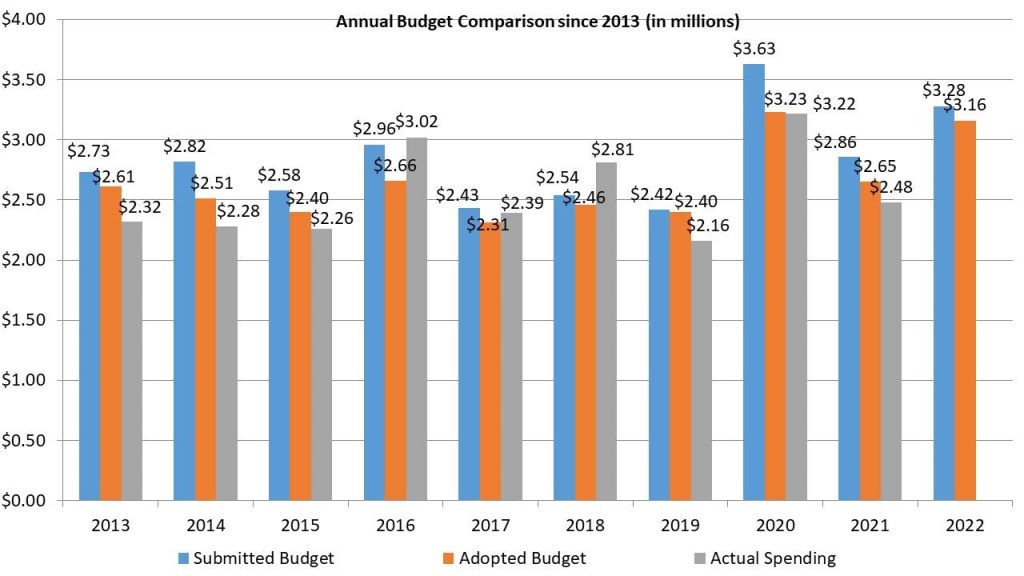
For the 2021 Election cycle the Onondaga County Board of Elections requested a budget of $2.86 million. The County Legislature only approved a budget of $2.65 million. The OCBOE only spent $2.48 million, well under both our initial ask and the approved budget. When determining a budget, the Commissioners ask for a full allotment to run a full county primary and general election in a local year like 2021. This is done in the summer of the previous year not knowing the extent of the primary. The legislature and County Executive then alter our budget. Sometimes they reduce it assuming we will not have a full primary. In 2021 they were right as we had only a primary in the City of Syracuse, significantly reducing costs. Only two years since 2013 did the OCBOE not only exceed the legislative budget and also our request (2016 & 2018). As you will see a good deal of the budget then were charges beyond our control.
Our local budget is broken up mainly into three different areas. Direct Appropriations represents the portion of the budget where we have direct control over the spending. This represents local dollars that come directly from the County taxpayers. We asked for $1.94 million which represented our best guess for expenditures if we were to run a full primary for June along with a local election for November. The Legislature only approved 1.73 million. We only spent 1.68 million coming in under budget for the third straight year. As you can see since 2013, we only exceeded direct appropriations in the years 2016, 2017, & 2018. In each case the county legislature reduced the budget well under our ask and events on the ground forced us to exceed our appropriation. It should be noted we never exceeded our initial estimate of what we would need to spend.
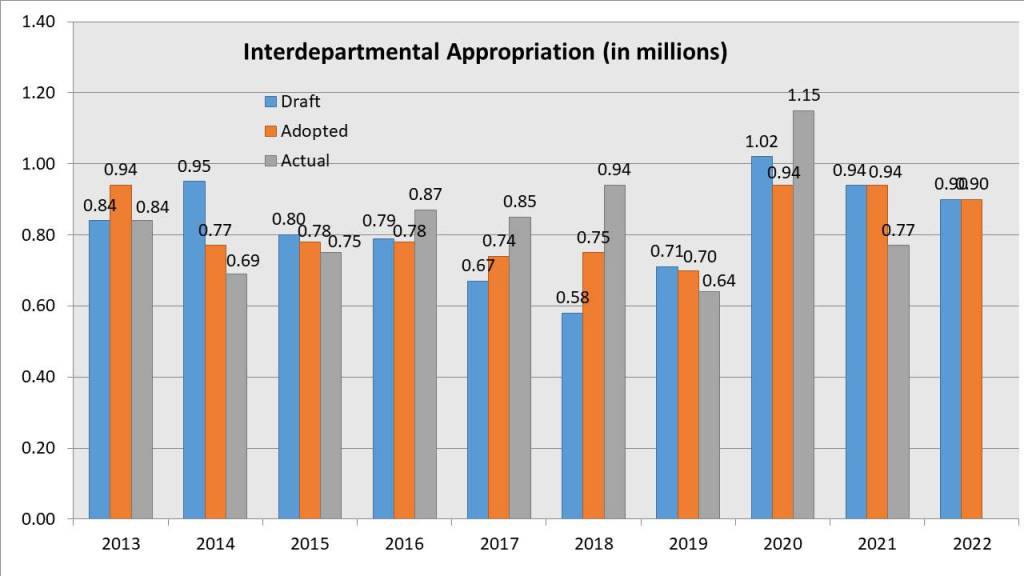
The other portion of our budget is the Interdepartmental Appropriation. This portion of the budget represents charges to the Board of Election from other county departments. This usually represents charges from IT, Law, and the print shop. It also includes employee benefits. The OCBOE does not control either the creation of this portion of the budget or even approve charged. This is all overseen by the office of Budget and management. We came in significantly under budget in 2021 most likely due to printing less ballots because of our use of on-demand ballot printers as well as having a smaller than expected primary. It should be noted that the reason for our unsatisfactory budget performances in 2016 & 2018 were the interdepartmental charges, specially in 2018. We had a large number of legal cases and an unusual number of ballots that had to be printed due to the increased turnout.
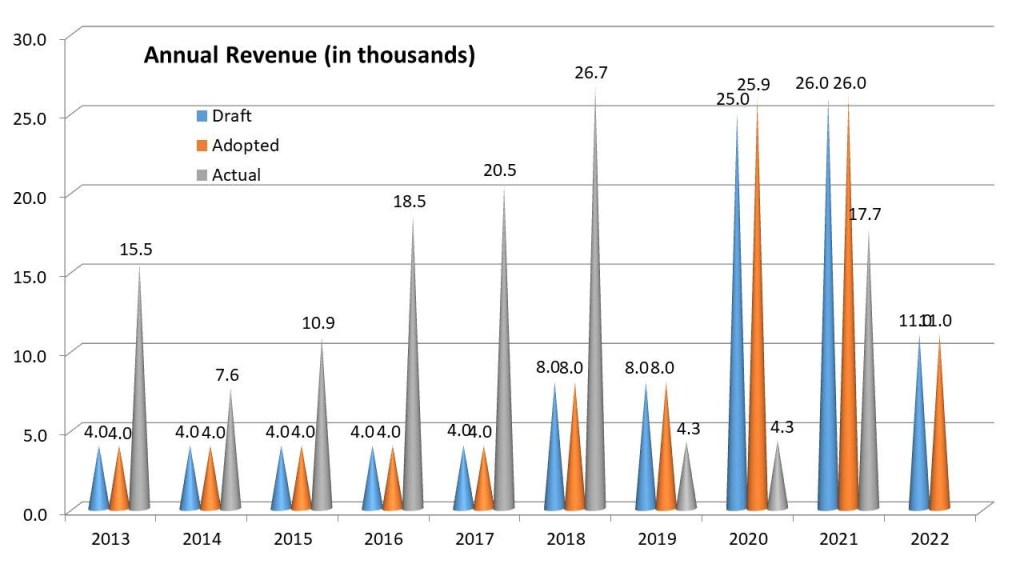
The last portion of our budget is revenue. The Onondaga County Board of Elections is not a revenue generating department. The small amount of revenue generated comes from charging school districts and villages for use of our machines and personnel in their elections. We have successfully moved some villages to the November election reducing some of our revenues. We also get little to no revenue from printing lists and copies then we had in the past as we digitized our entire petition process allowing campaigns to save money and get images for free. We also see less reliance on our paper lists as campaigns are using mobile app based GOTV and canvassing systems.
Overall, the Onondaga County Board of Elections continues our efficient use of taxpayer dollars. We are one of the lowest dollars spent and budgeted per voter in the state as seen in the NYS Budget comparisons done earlier this last year. 2021 was a successful year as the OCBOE used our dollars wisely without compromising services.
In this week’s Commissioner in a Car I announce 9 of the 10 Early Voting sites in Onondaga County, discuss what we know about the NY Redistricting cases, and touch on the replacement for Lieutenant Governor, Anthony Delgado. I also briefly react to the SCOTUS leak on the plan to overturn Roe v Wade.
Subscribe to dustinczarny.com for content and election news updates.
“None of our polling places are ready for this. None of our inspectors are ready for this. It was not on the calendar. It was not something that had been part of discussions with polling places at the beginning of the year,” said Czarny. “We are going to have to scramble to get ready for August, while we’re preparing for June.”
And with all the overtime and logistical issues this creates, it’s not going to be cheap.
“The budgets set for the boards of election are set for two elections, not three,” Czarny said. “And elections are our number one cost. And it means it could go over our election costs by a third”.
Dustin Czarny, an elections commissioner in Onondaga County, told Spectrum News on Friday that a second primary will cost at least $400,000 for his board alone.
“I think the major county boards and especially New York City and Long Island are going to see major astronomical costs that the counties are going to have to absorb,” he said.
“It throws everything out the window,” said Dustin Czarny, the Democratic elections commissioner for Onondaga County. He said localities will need to wait for the state Board of Elections and the courts to set a new political calendar, which dictates the timeline for everything from petitioning to ballot access.
Czarny estimated that he would need to spend an additional $400,000 to conduct a second primary election, when his county only budgeted enough to conduct one in June.
“The counties are going to have to bear the cost,” he said. “It’s quite a heavy lift.”
In this week’s Zoom with Czarny I talk to Jeff Wice of New York Law School. As the foremost expert on redistricting in New York this is a timely discussion on the implications of the latest New York Redistricting ruling throwing out the State Senate and Congressional lines and restarting the process for 2022. Enjoy.
Subscribe to dustinczarny,com for all content and Election News Updates
“It’s coming at the last minute and we still don’t even know the maps and where people are running for any of these races, so this is going to be very confusing for voters,” said Dustin Czarny, an elections commissioner in Onondaga County.
“In budget runs due to electoral matters, the county has to cover that cost. That is part of the county charge. In Onondaga County, this will cost us approximately $400,000 more dollars that we did not have in our budget.”
Czarny says he supports independent, citizen-led redistricting, like the process underway in the City of Syracuse, and that redrawing maps has become far too partisan. Both the state and county processes have resulted in maps that have been challenged in court.
“The big takeaway is we are upending our entire political calendar. The Congressional races and the State Senate races basically start from scratch.” – Dustin Czarny, (D), Onondaga County Elections Commissioner.