Dustin Czarny, an elections commissioner in Onondaga County, said his office received a hand-delivered copy of the petition from Renna. It included claims of problems with the county’s voter rolls.
“It is hard to respond to the specific allegations in this ‘audit’ because it lacks any specificity whatsoever,” Czarny said in an email.
“The group is opaque in its membership and the ‘examples’ they provide are not tied to any specific voter,” Czarny said. “In many cases the group provides only vague assertions and I lack the ability to pull up specific examples.”
The group claimed that 1,781 Onondaga County voters do not have an address listed in the public election records.
In response, Czarny said every active or inactive voter in the county’s database is tied to a residential address. But a small percentage of voters have physical addresses that are not released to the public because of protective court orders, he said. Other addresses may not be listed for military and overseas voters, who are still eligible to vote in New York.
Today I review some of the election bills that were passed at the end of session last week in New York and their impact on elections this year, and in the years to come. Enjoy.
Subscribe to dustinczarny.com for all election news and content updates
This week I sit down with Ted Limpert for County Court. We talk about his career on City Court, his service as a decorated fighter pilot, and his work as a pilot for “angel missions”. You can follow his campaign at http://www.judgetedlimpert.com. Enjoy.
For election news and content updates subscribe to dustinczarny.com
Dustin Czarny, Onondaga County Board of Elections Commissioner and Chair of the NYS Elections Commissioner Association Democratic Caucus said, “Now more than ever it is important for New York to lead on the issue of Voter protection. Passing The Rep. John Lewis Voting Rights Act (S1046E) will establish New York as a national leader in this important fight. This comprehensive first-of-its-kind bill will provide needed oversight which is especially needed with the failure of the federal courts to protect voters. This bill along with enhancing penalties for the Act to Penalize Voter Deception and Suppression (S1032) and Preventing Electronic Interference (S118) will give New Yorkers the protection needed to ensure successful elections. Finally, the Establishing the New York Voting and Elections Database (S8202) will provide a standard for retention of election data that is vital for campaigns and activists to conduct elections and locate it in a central depository that will be a benefit for all of New York.”
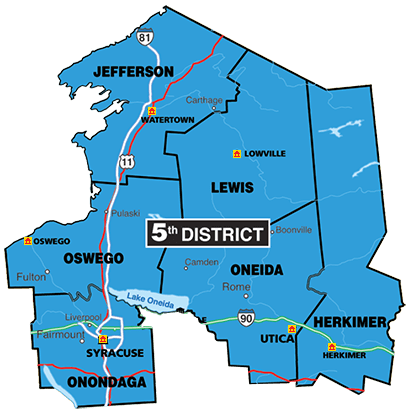
Welcome back to #wonkywednesday. Each week I take a deep dive into the electoral and voter registration data that makes up our home here in Onondaga County and across New York State. Once again, I revisit how redistricting is impacting our county. This time we take a look at the Supreme Court race for the 5th Judicial district.
The 5th Judicial District in New York spans six counties, Herkimer, Jefferson, Lewis, Oneida, Oswego, & Onondaga county. The Supreme Court is the largest non-statewide race on the ballot in New York. The Supreme Court is actually the first step for many civil cases in New York not the final court as the name would imply. Supreme Court justices serve for 14-year terms and often elected several justices in a single year due to retirements and natural ends of terms. In 2022 the 5th Judicial District will have three seats up as David Murad (D), Edward D Carni (R) terms are up, and Patrick McRae (R) has reached the mandatory retirement age of seventy.
The 5th Judicial district is a pretty evenly split district. Republicans have the smallest plurality of enrollment with 35% of the district. Democrats are 33% of the district in a close second. Non-enrolled are 25% of the district. By region Onondaga County dominates the district with 48% of the enrolled voters, Oneida County comes in second at 21% of the voters, and Oswego (12%), Jefferson (10%), Herkimer (6%) and Lewis (3%) round out the six-county district.
It is only because Onondaga County is so populous that the district remains competitive. In fact, this district could be seen as two polar opposites. Democratic leaning Onondaga County versus the other five republican leaning counties. Herkimer, Jefferson, Lewis, Oneida, and specially Oswego’s GOP tilt makes it hard for a Democrat to get elected unless the rely heavily on the turnout in Onondaga County. This often means relying on even years with higher turnout to have a chance.
Democrats have made substantial gains in the district gaining over 19k voters since 1996. Republicans have lost over 38k voters since 1996. Of course, as is the trend with many seats, the non-enrolled grew the most gaining nearly 38k voters since 1996. Democrats seemed poised to take over the plurality of this district by drawing within 10k voters in 2019. However, since then the Has grown its margin to 14k vote plurality. This is because Onondaga County has been trending blue while the rest of the district has trended redder since 2020.
Despite our enrollment disadvantage, Democrats have seen a good deal of success since 2004. From 199 to 2004 the court elected 13 GOP judges to just 1 Democratic judge. Since 2004 11 Democrats have been elected to 14 GOP. This is usually because in odd years Democrats have employed a strategy of running fewer judges concentrating all their votes on one or running in even years where Democratic turnout is higher to support Governor or Presidential candidates.
We do not yet know the official candidates for Supreme Court. Supreme Court candidates for the major parties are not nominated directly by the voters. There is a judicial convention held in August who nominate slates of candidates to face off in the General Election. While it is announced that David Murad (D) is running for re-election the other seats have no announced judicial candidates as of this time.
Subscribe to dustinczarny.com for all content and election news updates
This month’s Sunday Seminar I talk about Absentee voting in Onondaga County and New York State. Learn how to apply and vote absentee and the deadlines to do both so your ballot will count for out two primaries and the General Election.
Subscribe to dustinczarny.com for content and election news updates
In Onondaga County, turnout in the 2020 presidential election was 77% – the highest since the 1960s. The 2021 local election drew 31% of registered voters to the polls, Elections Commissioner Dustin Czarny said.
Today I sit down with Jessica Hess of the Women’s March Syracuse. We talk about the history of the organization both locally and nationally. We also talk about the perilous moment we are in with the likely demise of Roe v Wade in the Supreme Court. Enjoy.
subscribe to dustinczarny.com for all election news and content updates
Welcome back to #wonkywednesday. Each week I take a deep dive into the electoral and voter registration data that makes up our home here in Onondaga County and across New York State. Once again I revisit how redistricting is impacting our county. This time we take a look at the final maps ordered by the court for Congress and State Senate. After a long drawn out process we finally have the maps that determine the districts which our candidates will run to represent us this fall. I take a quick look at the changes from the old maps, the legislative maps ruled unconstitutional, and the final maps imposed by the courts.
The court has drawn Onondaga County into the #NY22 congressional district. This district contains all of Onondaga, Oneida, and Madison County. Curiously it also contains a portion of the village of Cleveland on the north shore of Oneida Lake in Oswego County as well. For the purpose of this article I can’t really include those 340+ lost souls in the data yet. This district is a radical change from the old #Ny24 which went North and west encompassing Cayuga, Wayne and a Portion of Oswego County. The Legislative maps ruled unconstitutional had Onondaga County in the center pf a district going southwest encompassing Cayuga and portions of Geneva, Cortland and all of Tompkins county as well as goring east through Madison and into Utica. According to Dave’s Redistricting App released by the special master the new #NY22 is a D+5.1 and deemed a competitive district.
Compiling registration data from the three main counties in the district #NY22 is dominated by Onondaga County which makes up 63% of the district. Madison country is 9% and Oneida County is 28%. Enrollment wise Democrats have a plurality at 35%, Republicans at 31%, and Non-Enrolled at 26%. While Democrats have the edge on paper we have to look into the performance of the district to see exactly how this new district might perform.
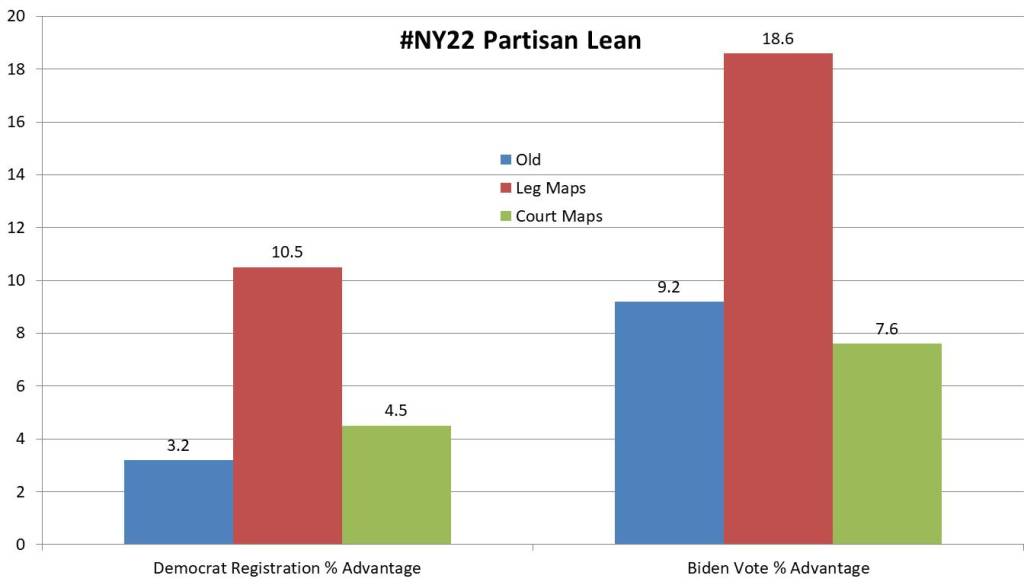
It is helpful to see how this district evolved over the three variations we have had since the beginning of redistricting in January. The old #NY24 had a Democratic enrollment edge of +3.2% and the district voted for Biden in 2020 by +9.2%. The district the NY Legislature sought to create grew the registration advantage to +10.5% and that new district would have voted for Biden by a commanding +18.6%. The final district has a +4.5% enrollment advantage for Democrats and the district voted for Biden at a rate of +7.6%. So Democrats make up a higher percentage of the enrollment population from the old district, in performance it did not support Biden as much. One possibility here is the non-enrolled portion of the new #NY22 is more conservative than the old #NY24.
The new #SD48 may be the district that has gone under the most dramatic change throughout the entire legislative process. The original district encompassed most of the City of Syracuse and went north through Salina and Cicero, south through Fabius, Pompey, Lafayette and Tully into Madison County and had a tiny portion of Oneida. The legislative maps took out Salina and Cicero and added portions of Cortland and even more of Oneida County to add Utica. The final maps by the special master flip the switch, after first having a draft that had #sd48 in the north of Syracuse, the final map has the City of Syracuse wholly inside it with Lysander, Van Buren, Elbridge, Marcellus, Onondaga, Onondaga Nation, Lafayette, Pompey, Spafford, Otisco, Tully, Fabius as well as going west to capture all of the county of Cayuga. Dave’s Redistricting App rates this as A D+16.8 and seen as a safe Democratic seat.
Onondaga County once again dominates this district making up 75% of the voter enrollment with Cayuga County making up just 25%. The enrollment of the district is definitely leaning clue. Democrats makeup the plurality of the district at 39%. The GOP is just 28% of the district with the non-enrolled right behind at 26%. 3rd parties makeup the rest of the 7% of the district. The cities of Syracuse and Auburn being wholly inside the district certainly lends to the blue tinge of the voter registration.
This is one of the rare districts that Democrats may have benefitted from the Special Master than their own legislative lines. The old district (#sd53) had a Democratic registration lean of +13.65 points. The NY legislative maps actually made the district a little more Red, dropping the registration advantage to 13.22, and the courts dropped it even further to 11.93. However in terms of performance this district is just as strong as the old district and stronger than the legislature maps for Democrats. The old district voted for Biden by 18.6 points, the legislature maps voted for Biden by 16.8 points, and the court final maps voted for Biden by 18.2 points. Even tough the district area has changed and even less Democrats in it, it seems the district performs the same as the old #SD53.
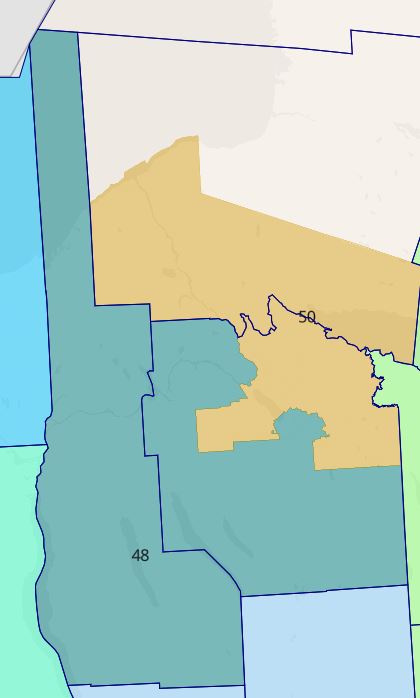
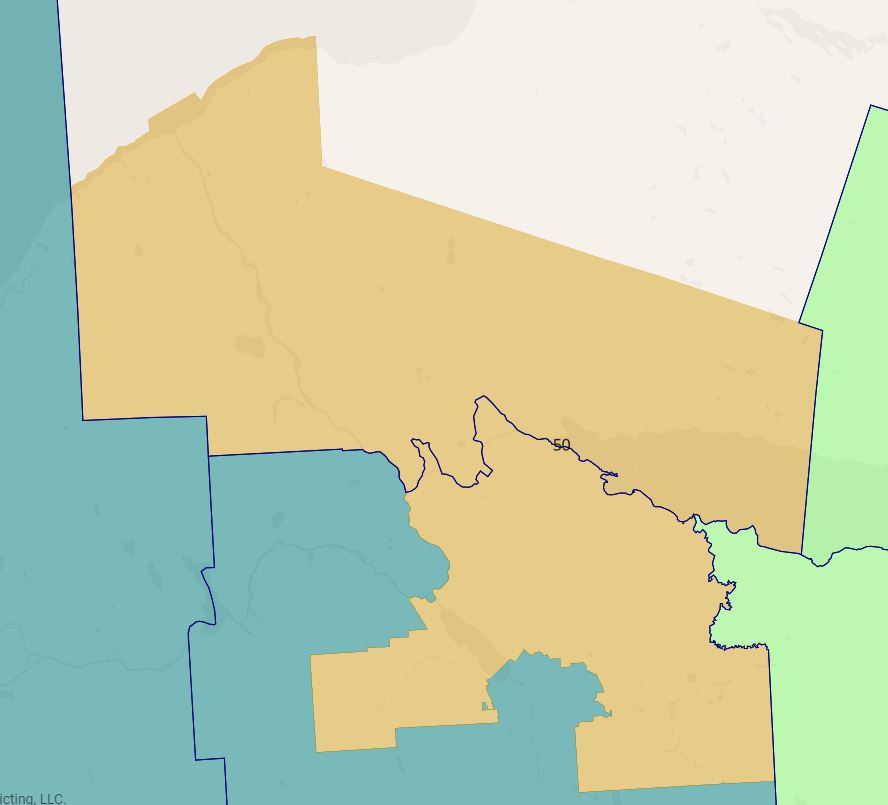
The final map we will look at today is the new #SD50. Much like its companion Senate district it has been a subject of much change. The original map had a sliver of the north side of Syracuse along with the towns circling counter clockwise around Syracuse from Clay all the way over to Onondaga and also included eastern towns of Dewitt and Manlius as well as a parts of Auburn and northern Cayuga County. The legislative map shifted the Cayuga County portion south encompassing all of Auburn, getting out of the southern portion of Onondaga County and picking up Salina and the northwestern third of Syracuse. The draft map for the courts altered the district having it go east to Utica before the final map shifted it north settling on the towns of Camillus, Geddes, Salina, Clay, Cicero, Dewitt, & Manlius with the cities of Fulton & Oswego as well as the southern half of Oswego County. Dave’s Redistricting App rates this as a Dem +3.9 district and rated very competitive.
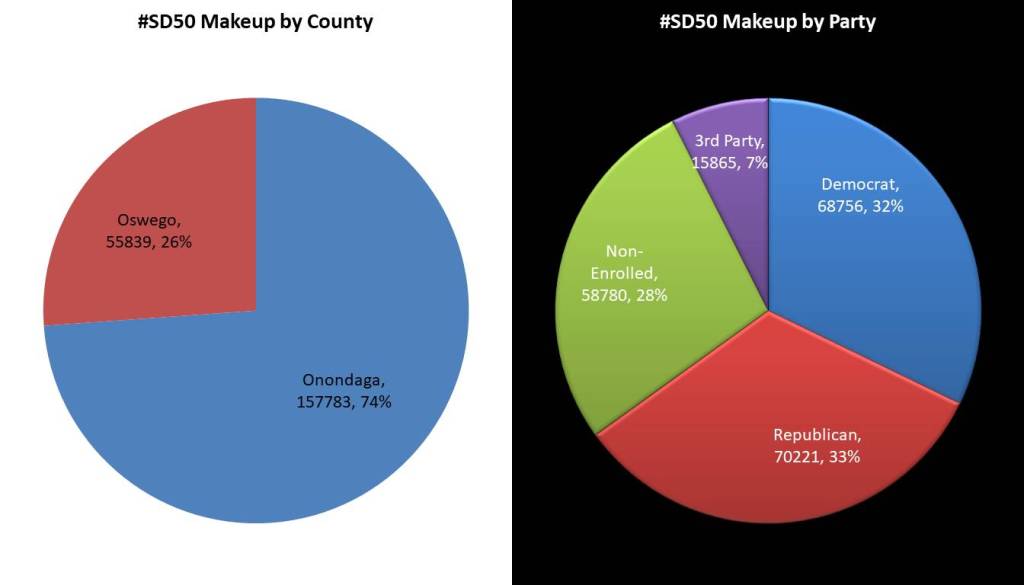
Onondaga once again makes up 74% of the voting population of the new #SD50 while Oswego County is at 26%. Despite the DAR rating there are actually more Republicans in the district with 33% of the voting population trailed just behind by the Democrats with 32%. Non-enrolled is 28% and 3rd party voters once again at 7%. The Oswego County portion of the district is heavily GOP while the Onondaga County is slightly Democratic, but more numerous making this about as even a district as possible.
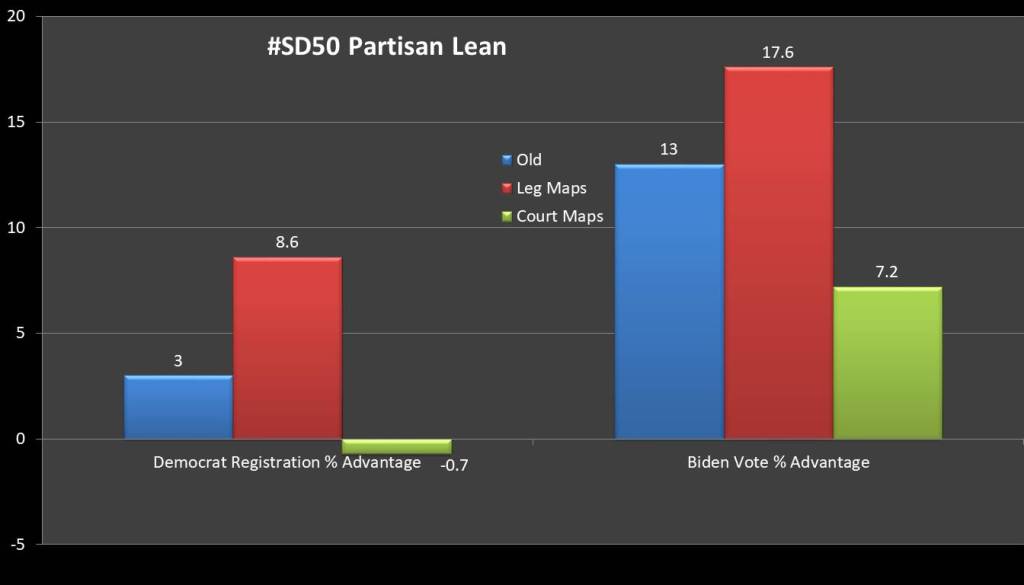
While both of the other Onondaga County Districts ended up near the metrics they started off with, this district has had a clear direction toward the GOP in the court ordered maps. The old district had a voter registration advantage for the GOP at 3.0, the legislative maps grew that by 8.6 points, the court ordered maps gave the GOP a .7% registration advantage. Performance wise the district took a hit as well. It went from a +13 Biden district, to +17.6 under the legislative plan, to just +7.2 Biden advantage in the final map. All of these metrics point to a very competitive seat that could flip either way in a normal election year.
Later this year I will do a deep dive into all three of these districts investigating the individual registrations of the various communities. Until then we have until June 10th this year before we know the full candidates field. Previous candidates have until May 31, 2022 to file a certificate and new candidates have until June 10, 2022 to turn in petitions. The primary for these seats will be August 23, 2022.
Back in Onondaga County, voters might have some whiplash over changes to the state senate map and the area’s two main Senators John Mannion and Rachel May. Czarny can understand if voters might be confused.
“These are radically different senate districts than we’ve seen in the previous versions of any of the maps, and it’s something people are still trying to wrap their head around. Both district are democratic leaning districts, but the Mannion district is more competitive, kind of like it is now, just in different areas.”