This week I sit down with Alejandra Pollack the new Executive Director of the New York Democratic Lawyer’s Council. This group is the voter protection wing of the New York State Democratic Committee and plays a vital role in our Democracy. They are launching a helpline for voters this week: 1-888-3NY-VOTE (English) and 1-888-3NY-VOTA (Spanish). Enjoy.
Subscribe to dustinczarny.com for all content and election updates
“It’s incredibly convenient and I think if you’re ready to vote and you know who you want to vote for and you’re near one of these sites or driving by one of these sites, remember it doesn’t have to be where you live. You can go to any one of these sites.” – Dustin Czarny, (D) Onondaga County Elections Commissioner
“More sites than we’ve ever had before, more hours than we’ve ever had before, you can go to any site in Onondaga County and vote, you’ll be checked in by the poll pad and we’ll print a ballot on demand with our poll print units here,” said Czarny.
The second primary will be in August, with different seats and candidates to vote for. Democrat Elections Commissioner Dustin Czarny says its hard to say if the split primary this year will impact voter turnout.
“We’ve had bifurcated primaries before and its very confusing for voters. And that’s when we had years to plan for it and everybody knew in January what the races were and what races were when and now we just found out in may all of this has happened,” said Czarny.
Welcome back to #wonkywednesday. Each week I take a deep dive into the electoral and voter registration data that makes up our home here in Onondaga County and across New York State. Once again, I revisit how redistricting is impacting our county. This week I look at the Towns of Onondaga County.
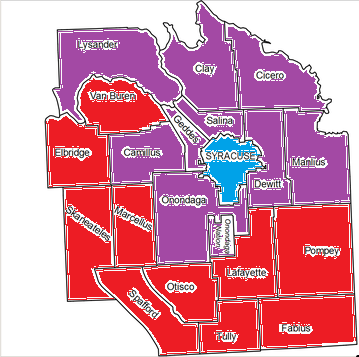
Looking at the registration advantages in the towns we see there is a wide variety. In this chart I have color categorized each town. The City of Syracuse in Dark Blue is still the most reliably Democratic community. However, the towns of Dewitt, Salina, and Manlius in solid blue have significant Democratic enrollments. The Town of Clay in light blue has a slight Democratic Advantage. The towns of Camillus, Geddes, and Onondaga in purple are swing towns with almost even registration. The Town of Cicero in light pink has a slight registration advantage for the GOP. The solid red towns of Lysander, Van Buren, Skaneateles, and Marcellus have solid GOP advantage. Finally, the dark red towns of Elbridge. Fabius, Lafayette, Otisco, Pompey, Spafford, and Tully are the heaviest GOP areas.
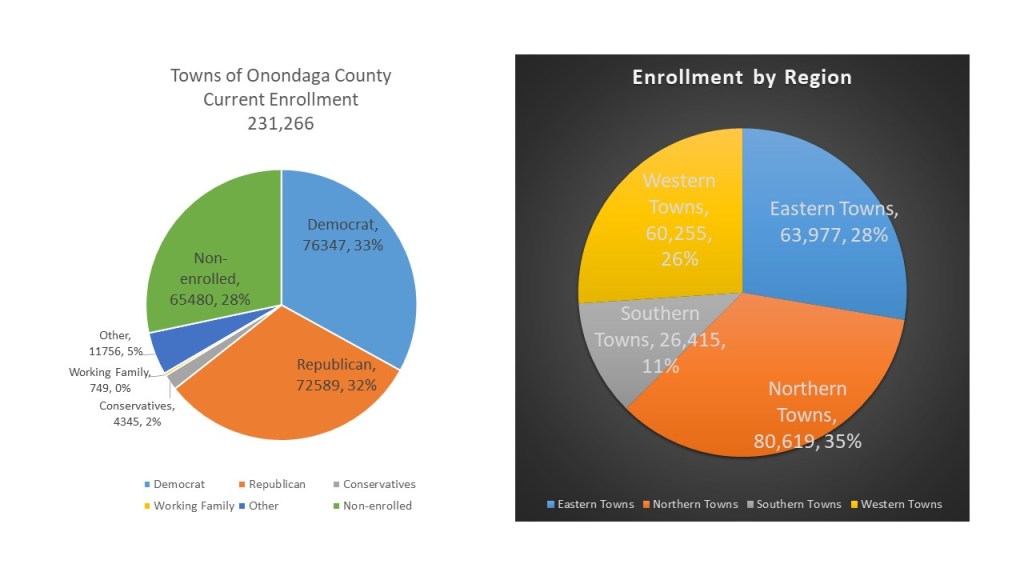
As a whole it may surprise some that the Towns of Onondaga actually break Democratic in terms of enrollment. Democrats have a 33% plurality, just edging out the Republicans at 32%. The non-enrolled are at 28%, other parties at 5%, and Conservative at 2% with Working Families at less than 1%. The usual political alliance of conservatives and GOP as well as a more conservative N/E population teds to overwhelm any Democratic enrollment advantage. For purposes of looking at the suburbs by region I have categorized them into four geographic areas. The Eastern towns of Dewitt, Manlius, And Salina which has 28% of the suburban population. The Northern towns of Clay, Cicero & Lysander with 35% of the suburban population. The western towns of Camillus, Elbridge, Geddes, Onondaga, and Van Buren which has 26% of the suburban population. Finally, the Southern Towns of Fabius, Lafayette, Marcellus, Otisco, Pompey, Skaneateles Spafford, and Tully which makes up the largest land mass but just 11% of the suburban population.
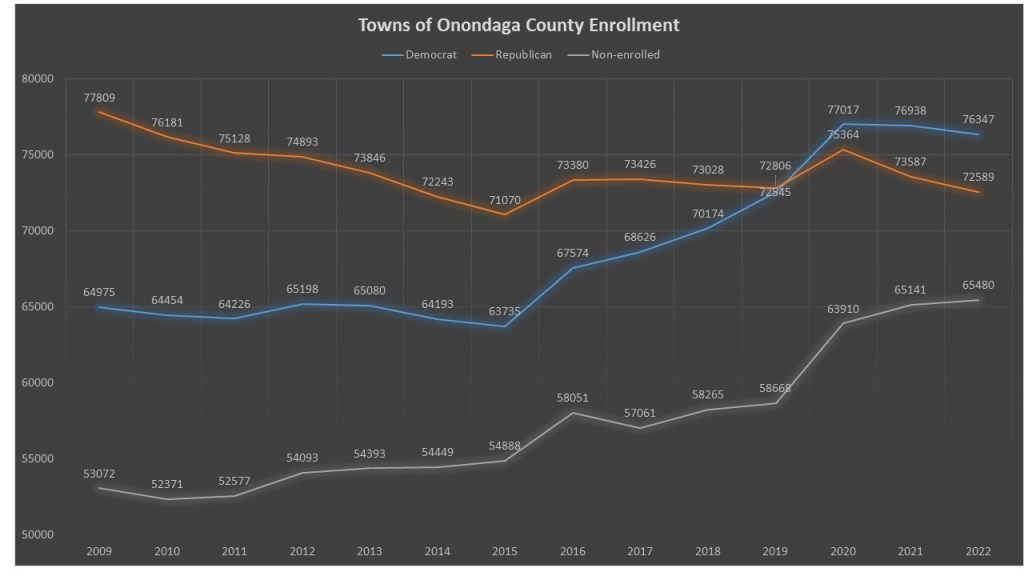
The changing Demographics of the suburban population is what is driving the changes we see in Onondaga as a whole., especially since 2016. Since 2009 Democrats have gained 11,372 voters while the GOP has lost 5,220 voters. We really see in 2016 the GOP basically remained flat as the Democrats made solid gains each year and overtook the GOP in 2020. The Non-enrolled though is the biggest gainer with 12408 additional voters since 2009 and is becoming the swing voting bloc in the towns.
When we look at the regional registration differences, we do see a bit of a geographic trend. The Eastern towns have become the more reliably Democratic with Democrats getting significant advantages in all of the towns there. The Western towns are the swing towns with nominal advantages one way or the other in each individual town. The Southern Towns are the most reliable GOP with a significant advantage in enrollment there. The Northern towns though are the Neapolitan ice cream of Onondaga County. Together they seem like another swing region, but you have solidly red Lysander, slightly blue Clay, and slightly red Cicero combined together.
In 2009 only two towns had a Democratic enrollment advantage. The Town of Dewitt was just emerging as a reliably blue suburb and grew dramatically since. The town of Salina also grew significantly and votes blue in federal years but not in local years. Since 2009 Camillus, Clay, Geddes, & Manlius have made the jump to Democratic pluralities in their registration. Manlius seeing the most dramatic reversal from a solid red town to one of the more solid blue towns. Almost every town, with the exception of Fabius, has seen a shift towards the Democrats during this period as well.
The Trump effect is the biggest phenomenon driving the registrations in the suburban towns. Looking at the shifts toward Democratic enrollment in each town since 2016 (adjusting for WFP registrations being added to the Democratic totals and Conservatives to the GOP totals) we see that almost every corner of the suburban population is seeing these shifts in registration, with the exception of Fabius. It is too early to tell if this is changing post-2020. A good test will be leading into the 2024 election to see if there are shifts from 2020 that are significant differences from 2016.
The towns of Onondaga County are continuing to change, but turnout is always a factor. Though Democrats are starting to get an advantage, their turnout in local years allows the GOP to remain control in local offices. However, when turnout is higher the Democrats are seeing pockets of support grow in the suburbs. It will be up to grass roots organizers to take advantage of that support and grow it in the coming years.
This week’s Commissioner in a Car I talk about the end of the absentee ballot deadline (today) and start of Early Voting (Saturday). You can apply up to midnight tonight at http://www.onvote.net or find your voting information, polling place, or Early Voting locations.
Subscribe to dustinczarny.com for all content and election news updates.
The New York Legislature officially wrapped up their 2022 session this month. For those unfamiliar with how our legislature works “session”, or the time when the legislature is actively meeting to pass legislation, lasts from January to June each year. Though constituent work and committee meetings happen throughout the year, actual legislation must be passed before the end of session in June. While it is possible that the legislature can be called back for special session, this is for emergency legislation, and it is doubtful that election bills alone would be the subject of such a session.
I have decided to do a wrap up of the Election related bills that passed both houses this year. Many await the Governor’s signature, and some are not effective immediately. It is rare for a Governor to veto election legislation but sometimes she can reach agreements with the legislature to alter or delay the effectiveness. Normally a Governor will have 10 days to sign bills once they are delivered to her. However, the Governor must either call the bills up or the legislature decide to deliver them. For bill passed during legislative session they have until the end of the calendar year to be delivered so some of these bills may not be signed until later in the year.
Here are the bills with brief thoughts by me.
A831A/S4591 Requires congressional, senatorial, assembly and election district maps be made available on applicable board of elections’ websites and in a downloadable Shapefile format. Effective 180 days after signing, Awaiting Signature
This bill will require the shape files Boards of Elections create for their election districts to be on their website ready to be downloaded by the public. This is especially important after redistricting years where Election Districts are being changed to accommodate all the lines being drawn by State and local legislatures. We already do this at Onondaga County and its simply zipping the files and having them as a downloadable link. Some small boards will have to liaison with their county GIS departments to create the files, but once done this should not be a burden and may benefit Boards of Elections to eliminate requests from citizens to their offices.
A4158/S156 Relates to prohibiting private individuals or entities to pay for the administrative expenses associated with the conduct of a referendum Effective Immediate, Awaiting Signature
This bill will prohibit private developers who may benefit from a permissive or mandatory referendum from paying for the cost of the referendum. There have been several instances of private developers enticing Town boards to pass certain laws that may require a referendum by offering to pay for the cost. In some cases, it was feared the private entity was going as far as to dictate when the referendum would be scheduled so as to hinder the public’s ability to weigh in on the law. This act bans that practice and keeps the entity running the election free to make all choices regarding it.
A7748A/S3855 Relates to authorizing registration records of victims of sexual violence to be kept confidential in certain cases Effective 120 days After Signing, Awaiting Signature
This bill expands the eligibility of victims of some crimes to have their address withheld from the public voter registration rolls. Voter addresses are public record and previously only persons who were victims of domestic violence could petition the boards to keep their addresses confidential. This expands that protection to victims of sex crimes defined under article 130 of the NY Penal Law.
A7933C/S6901 Includes individuals who do not identify exclusively as a binary gender in eligibility for party positions Effective Immediately, Awaiting Signature
In New York State the State Party committees for the Republican and Democratic party have rules providing for equal representation of their party committee members of “the sexes.” This meant one male and or female representative for State Party Committee for each Assembly district would be listed on the ballot and primaries for such position would be by gender. The new law will require that if a party provides for such a rule that they must include options for those wishing to run who do not identify exclusively as a binary gender. It will be up to the State Parties to determine how that will work in their structures and pass such a rule before the next State Party election (2024).
A9423A/S8409 Reduces the signature requirement for petitions for candidates for the school board of the city of Buffalo. Effective Immediately, Awaiting Signature
While this law is germane to just the City of Buffalo, if signed it may open up other cities to make this change. Currently most cities have school boards that run city wide. The petition requirements for school board members were the same as mayors and other city-wide elected officials. This is an undue burden for an office that has little benefit in terms of salary if elected. Lowering the requirements to run may enable more dedicated candidates to run for school board in Buffalo and could be something the legislature expands to other cities as well.
A9508/S8552 Requires the board of elections to mail notice of ensuing primary and general elections, registration status, polling place location and other information to active voters between the third Tuesday in April and the second Friday in May each year. Effective Immediately, SIGNED
This legislation is already in effect and moves the dates of the informational mailers later in the calendar year. While this was to help with the changes in redistricting this year, this is also a beneficial change for later years. By moving the informational mailing later, it will coincide with the designation of Early Voting sites and can either ben included on the mailing or links to a website with the current information on it.
A9960/S9343 Repeals certain provisions relating to absentee voting in primary elections for certain party positions. Effective Immediately,Awaiting Signature
This repeals a section of law that did not allow absentee balloting for certain party positions if in a primary. State Committee and County Committee seats are actually public offices that can have primaries to determine the winners of. Before 2020 these positions were excluded from absentee balloting and the only option was to vote in person. During the pandemic, an executive order included party position primaries on absentee ballots and this law will make that permanent. This is an expansion of Democracy and actually will eliminate confusion of having different rules for different offices for Boards of Elections.
A1144/S253A Relates to ballots where the express intent of the voter is unambiguous Effective Immediately, Awaiting Signature
This will allow for voter intent in an absentee ballot to be determined by the board in counting races. Currently this standard only applies to hand counted races that fall under the 5% close contest rule. It is unclear how Board of Elections will apply these standards as ballots are mostly scanned before Election Day. The State Board of Elections will have to issue guidance on how this can be accomplished if signed into law.
A642/S284C Requires counting affidavit ballots of eligible voters if a voter appears at a polling place in the correct county but in the incorrect election district Effective 1/1/23, Awaiting Signature
This is the “wrong church” bill and one of the more impactful bills passed this year. The old law provided that if a voter showed up at the wrong polling place and voted by Affidavit Ballot the entire ballot would not count. Many times, the voter would be eligible to vote in all or most of the races they cast votes for. This new law will extend the practice that Boards of Elections already follow for voters that show up at the correct polling place but sign in at the wrong table to all voters who show up in the right county and right assembly district but wrong polling place. The races they are eligible to vote in will count and discard the ones they are not.
A6678E/S1046 Relates to the John R. Lewis Voting Rights Act of New York; establishes rights of actions for denying or abridging the right of any member of a protected class to vote; provides assistance to language-minority groups; provides for preclearance of certain voting policies; makes related provisions. Effective 3 years from signing, 1 year from AG Certification. Awaiting Signature
Definitely the most impactful election bill passed this session. The New York Voting Rights act is an expansive and comprehensive package that will allow the Attorney General to intervene in New York elections where inequities occur. It spans from school board elections to polling place changes. It is the strongest state voter protection act in the nation. That being said it will be several years before it becomes effective e. The NY Attorney General must staff up and then some of the benefits will be in place 1 year after she certifies it is ready. In addition, many provisions have a three-year ramp up as well.
A1819A/S1851A Relates to state party names Effective 1/1/23, Awaiting Signature
This bill will prohibit the use of the term “independence” or “Independent” in a state party name. For years New York had a recognized state party named “Independence Party” This confused many voters who thought they were not enrolling in a party when in fact they were selecting “independence party” on their enrollment forms. This will prohibit a party from using that name if it is a recognized party getting the required voting amount at a Governor’s election.
A8858A/S2951A Reduces the time for mailing and receipt of registration application to constitutional minimum Effective 1/1/23, Awaiting Signature
This bill will have the most impact on local Board of Elections. The current registration deadline is 25 days before Election Day for new registrants. The New York Constitution says the minimum day before an Election to have a registration cut off is 10 days. This will allow for new voters to register or change their address 10 days before the election. In addition, since Early Voting starts on the 10th day before the election it will act as a “golden day” which will allow for same-day registration and voting for that day. Special note that this act actually reduces the mail-in date to 15 days before the election which extends to DMV and online registration. After that mark someone must appear at a Board of Election to register in person.
A8432A/S7565B Provides for absentee voting in village elections and extends provisions relating to absentee voting Effective Immediately, SIGNED
This bill extended the pandemic absentee protections for village elections for 2021. Important to note that all elections, Village and normal, will revert back to the traditional excuse-based absentees in 2023.
A4261/S4413 Relates to specification of objections to designating petitions, independent nominating petitions, certificates of nomination or ballot access documents Effective 90 days after signing, Awaiting Signature
This will require local Board of Elections to follow the State Board of Elections procedures for objections to petitions and certificates of nominations. This will require more transparency for local Boards of Elections as well as holding hearings and proper notification before ruling on objections.
A8772/S7799 Relates to the effectiveness of provisions relating to providing an online absentee ballot tracking system. Effective Immediately, SIGNED
This bill was signed earlier this year. The New York State Board of Elections has still not launched this tracker as they are working with the various registration vendors to develop this tracker. It is hoped it will be launched this year, but it is not ready yet.
A10135/S8949 Provides for the declination of a designation as a candidate or nomination for a party position under special circumstances Effective Immediately, SIGNED
This bill allows for a candidate to remove themselves from the ballot if they are indicted on a felony. This bill was passed in the wake of then Lt Governor Brian Benjamin’s indictment but is a permanent change to New York Election Law. This in my opinion is the right change to our electoral code as it would allow truth in the ballot since candidates who no longer wished to be on the ballot can remove themselves without going through the machinations of being nominated for other offices or moving.
A10505/S9466 Expands the number of judges in certain judicial districts and the family courts of New York city and Nassau and Saratoga counties. Effective Immediately,Awaiting Signature
This final bill expanded the number of Supreme Court seats in New York. The Supreme Court is overloaded, and we will be seeing expansion bills like this almost every year for the next few years. We had it last year in the fifth judicial and if this is signed in time, we will have a 4th Supreme Court judicial seat this year as well.
(EDIT: Prepaid absentee postage for Applications and Ballots will begin July 1, 2022. This is a permanent change for future elections. This was done during the NYS Budget and not a separate bill so no bill number to link to)
What did not get signed
No session gets to every bill but notably there are two major legislative priorities that did not get passed this session. Notably neither the Senate or Assembly re-introduced the No fault absentee or same-day registration Constitutional amendments that failed at the ballot box last year. To alter the NY Constitution, you must pass constitutional amendments in two separately elected legislatures and then it must pass on the ballot. The thought was to try and get it introduced again this year to align with the Presidential election in 2024 so more voters can weigh in on these measures. Because they were not introduced, and because it is unlikely a legislature will put these measures on odd numbered lower turnout years again, we may be waiting until 2026 for another chance at voting on these amendments.
The other major piece of legislation was any structural Board of Election Reform. The New York Senate passed bills that would require training of commissioners, standardize training of inspectors, making commissioners full time, setting minimum full time employee size for Boards of Elections, allow for removal of Commissioners for cause by the State Board of Elections, banning the use of hybrid voting machines, and increasing pay of inspectors. None of those bills got a vote in the assembly, and many not even got out of committee.
Since this is the end of session any bills that did not pass this year will have to be re-introduced next session. If there are any pieces of legislation you want passed contact your state representatives to re-introduce them next session.
I was very glad to attend a watch party for the first public January 6th Commission with some very good friends, one of them being SU professor Tom Keck. He agreed to come on the pod and give his instant reaction to what we saw Thursday night. We also talk about SCOTUS and pending cases. Enjoy.
Subscribe to dustinczarny.com for election news and updates
Welcome back to #wonkywednesday. Each week I take a deep dive into the electoral and voter registration data that makes up our home here in Onondaga County and across New York State. Once again, I revisit how redistricting is impacting our county. This week I once again look at our county as a whole and see what the voter registration numbers say about our home.
It is helpful to think of Onondaga County as having three distinct populations. You have the urban core in the City of Syracuse which behaves like most urban cores in our country, heavily blue but with participation issues in local years. You also have the rural communities, towns under 10k population. These towns (colored red above) wind around the southern half of our county and up the western edge. Like most rural communities they tend to be more conservative and more republican. We then have the suburban community of towns that have over 10k voter registration (colored purple above). These communities are the towns immediately surrounding Syracuse as well as the northern towns. These communities have gone through the most change over the last 20 years as urban communities that have left Syracuse and newer voters have made these towns more swing districts, and more populous, then in the past.
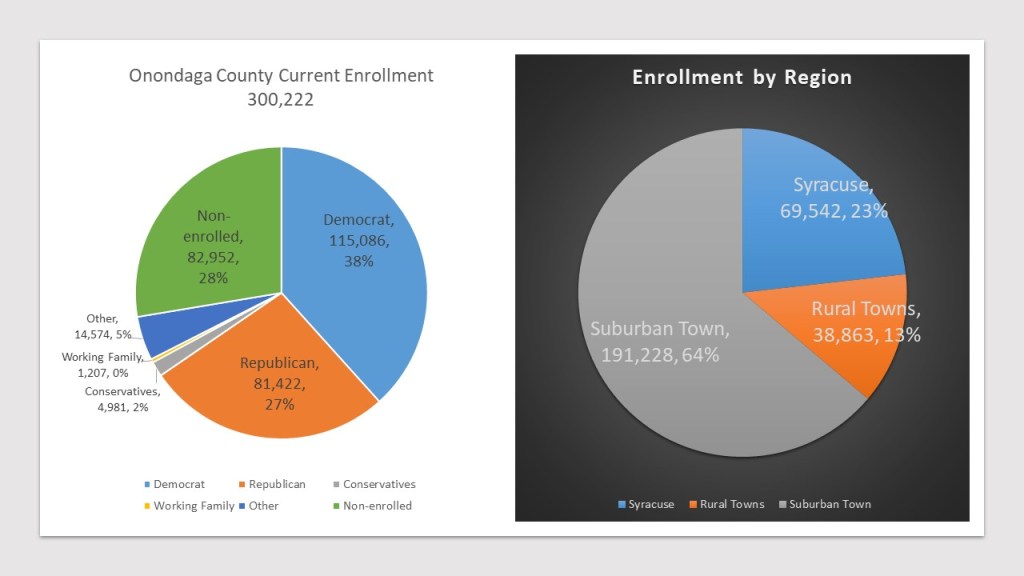
The current enrollment of Onondaga County is 300,222 down from our all-time high of 308,798 in June of 2021. This drop off is normal in the years following a Presidential election as voters tend to not update voter registration becoming inactive and new voters fail to register. The Democratic share of Onondaga County has is at 38%. The GOP share is currently just over 27%. The Non-enrolled earlier this year for the first time actually overtook the GOP enrollment and is now at just over 28%. The three distinct regions of Onondaga County show where the population lies as well. The rural towns make up a large land mass but have just 13% of the voting population. The City of Syracuse gets a lot of attention in terms of cultural significance to our county but makes up just 23% of the population. The vast majority of our county live in the Suburban large towns which house 64% of the voting population.
As we look at these three regions it is clear why Democrats are emerging as a plurality and the GOP are falling to third place. The dominance in the City of Syracuse continues with Democrats having four times as many voters as the GOP and the non-enrolled doubling the GOP. But even in the suburban towns Democrats have a plurality with a growing and significant lead over the GOP and the non-enrolled are just behind. Only in the rural towns does the GOP hold a significant, and growing, numerical edge. However, the smaller population there can not make up for the huge losses in Syracuse and loss of ground in the suburbs. Next week I will further breakdown the towns into regional subgroups to analyze them further.
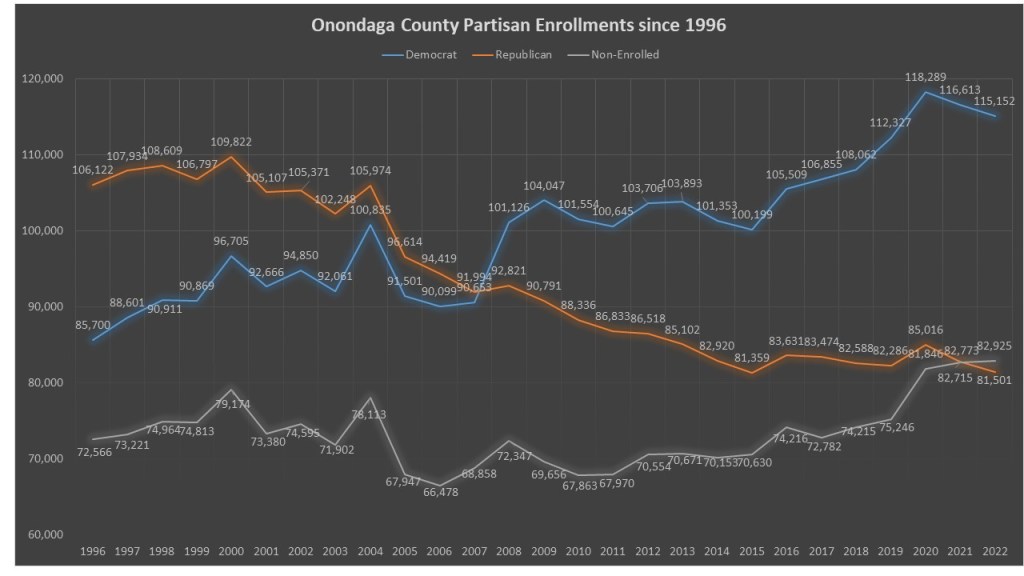
Though Democrats have had significant growth since 1996, there is sign that there may be stagnation in that growth. One of the fallouts from the Trump candidacy of 2016 in the northeast was a large growth in Democratic population in his 4-year term while the GOP struggled to keep pace. We certainly saw that in Onondaga County from 2017-2019 as Democrats gained each year and the lost ground. In 2020 both parties saw surges in enrollment for the presidential but are now on a 2-year decline. This could be normal decline as voter population has declined as well. However, the non-enrolled population has grown consistently since 2015. That pace did not match the Democratic growth until 2020 where the N/E growth grew substantially and continues to grow as Partisan enrollment has declined. As registrations pick up later this year, we will get a better sense of if this is an anomaly, or a trend.
The emerging Democratic plurality in the county has not always led to electoral success. Though turnout is an issue in odd numbered years, Democrats have not always been able to put together winning coalitions in even years as well. President Biden won this county by almost twenty points in 2020, however the congressional race between John Katko and Dana Balter was a nail biter with Katko having a small 2.52% plurality in the vote. Complicating that race was the presence of a third-party candidate Steve Williams on the WFP line due to a fluke in filing paperwork. We see in 2018 Dana Balter actually won Onondaga County by 2.14 points without that third party presence and likely would have in 2020 as well. Governor Cuomo in 2018 won our county by 6.07 points but not with a majority, though in Governor years there are always an inordinate number of third-party candidates that siphon votes from the major parties. In the same year though Democrats lost the Sheriff race by over ten points against incumbent Gene Conway.
This year there are several County Wide candidates that will be looking to try to mobilize the Democratic plurality and win races. We have 2 County Court judge seats and Sheriff on the ballot this year. Onondaga County will also be critical to the Governor, Supreme Court, and congressional races as well. It will be important for Democratic chances in those races to not only mobilize Democratic population but win or break even in the ascending non-enrolled population.
Dustin Czarny, an elections commissioner in Onondaga County, said his office received a hand-delivered copy of the petition from Renna. It included claims of problems with the county’s voter rolls.
“It is hard to respond to the specific allegations in this ‘audit’ because it lacks any specificity whatsoever,” Czarny said in an email.
“The group is opaque in its membership and the ‘examples’ they provide are not tied to any specific voter,” Czarny said. “In many cases the group provides only vague assertions and I lack the ability to pull up specific examples.”
The group claimed that 1,781 Onondaga County voters do not have an address listed in the public election records.
In response, Czarny said every active or inactive voter in the county’s database is tied to a residential address. But a small percentage of voters have physical addresses that are not released to the public because of protective court orders, he said. Other addresses may not be listed for military and overseas voters, who are still eligible to vote in New York.







 Dustin M. Czarny