Its registration week in New York and I talk about the ways you can register for vote. Important deadlines to remember: October 13th deadline to register online through Mydmv (must have a dmv account) Go Here: https://dmv.ny.gov/ October 14th deadline to register for first time in person or by postmark. Go to onvote.net to download forms. October 19th deadline for change of address for previously registered New York Voters to be received by Boards of Elections. I also talk about the absentee lawsuit, redistricting issues around the state, and the FOIL issues in Onondaga County and beyond. Enjoy.
Subscribe to dustinczarny.com for all election news and content updates
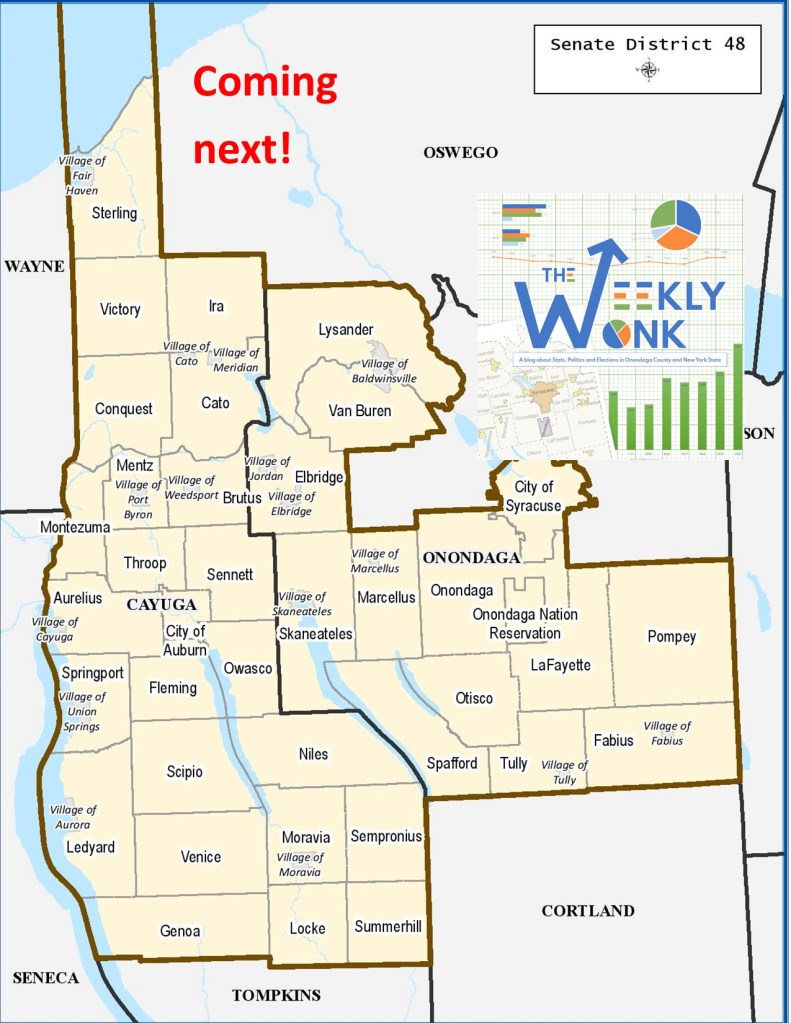
Welcome to the #weeklywonk. This is my weekly blog about statistics, registration data, and election law on my website, dustinczarny.com. This is a rebrand of my #wonkywednesday and #sundaythoughts columns I have been writing since 2020. In merging these two side projects together I am hoping to be a little more regular in my production. I have also not tied myself to a particular day to release these columns, hoping to release them weekly on the weekend. This way I can have more time to gather the statistics and resources that I want to devote to these articles. This week I examine New York Senate District #48.
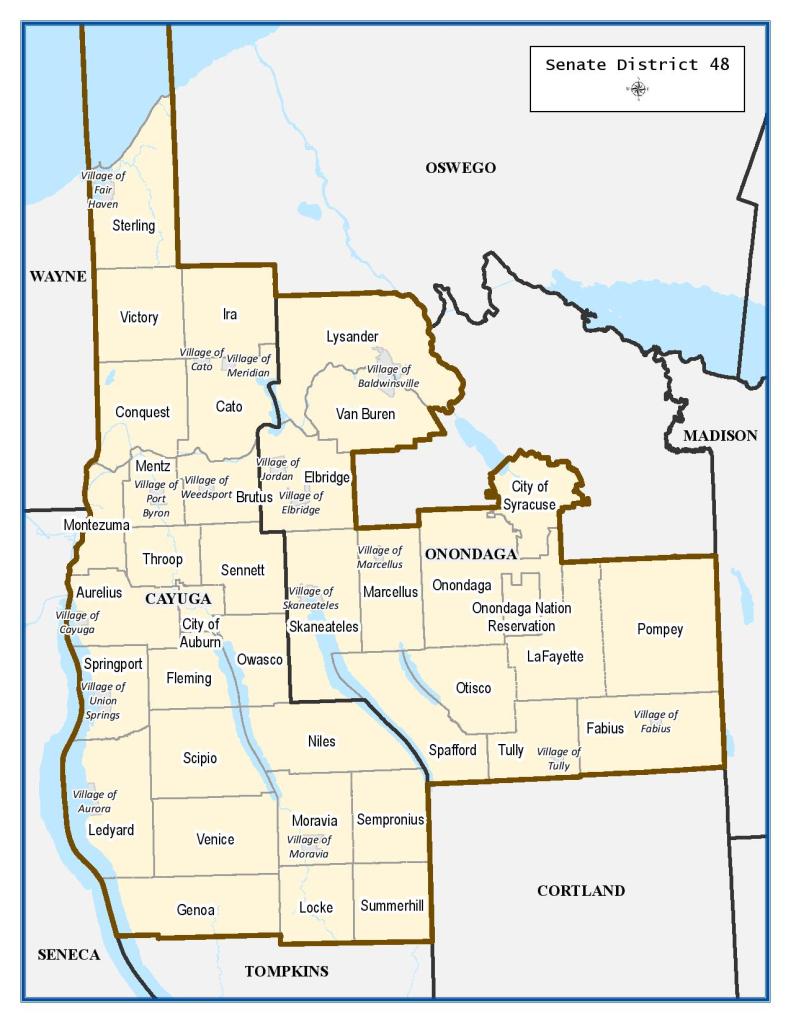
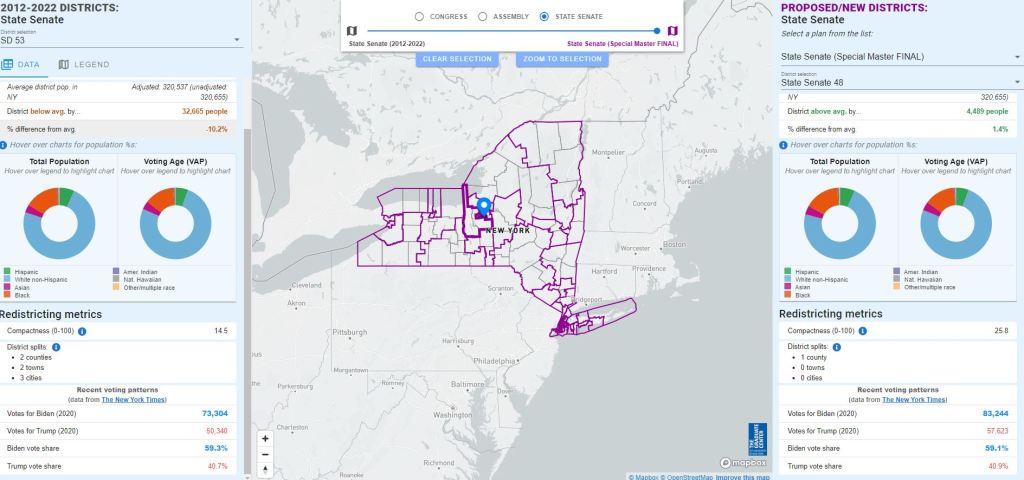
Redistricting brought a great deal of change to the New York Senate districts. While Senators May and Mannion avoided having to run against each other, their districts went through transformative change. Senator Rachel May represented the old #SD53 which morphed into the new #SD48. There were some similarities in the old district, mainly the City of Syracuse and the southeast corner of Onondaga with the towns of Fabius, Lafayette, Pompey, and Tully. However, the northern towns of Salina & Cicero as well as the eastern portion of the district with Madison County and a small portion of Oneida was removed. The new district goes west, it added the “DeFrancisco Peninsula” of the City of Syracuse as well as the southern and western tows like Onondaga, Otisco, Spafford, Marcellus, Skaneateles, Elbridge, Van Buren, and Lysander. They also added the entire county of Cayuga including the City of Auburn.
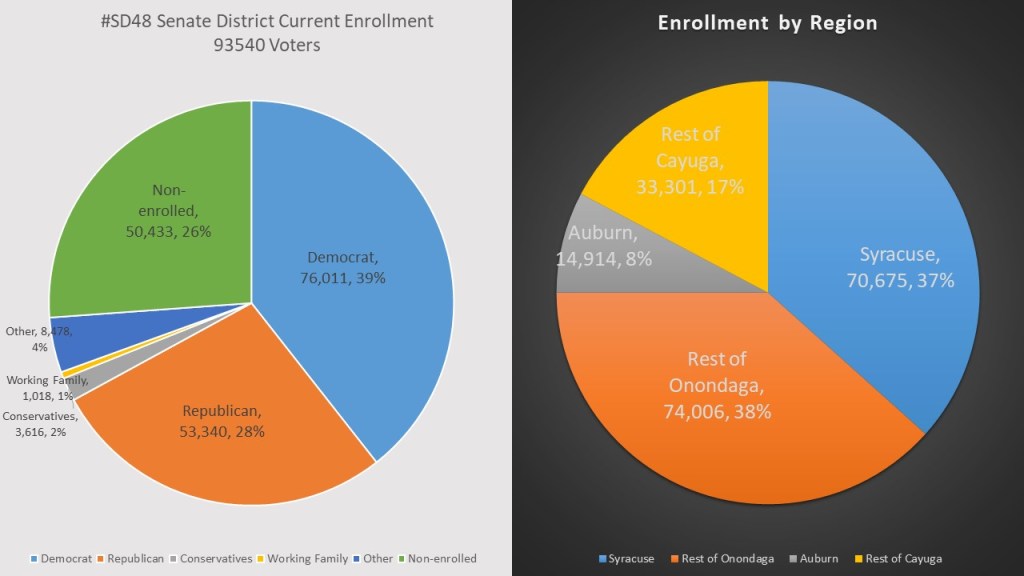
The new #SD48 is definitely a Democratic leading district. Democrats have the plurality of voters (39%) with 76,011 enrolled voters. Republicans are in second place (28%) with 53,340 voters. The Non-enrolled though is right behind (26%) with 50,433 voters. Regionally this district is best summed up into four different regions. The City of Syracuse is 37% of the district with 70,675 voters. The towns of Onondaga in the district are the largest region with 38% of the district with 74,006 voters. The city of Auburn makes up 8% of the district with 14,914 voters and the rest of Cayuga is 17% if the district with 33,301 voters.
The districts changed so much after redistricting it is almost worthless to look at the history of the district, but I will do so anyway. The old #SD53 district was a solid Democratic district. During its inception in 2012 and 2020 Democrats gained by 4,021 voters. The GOP lost 1650 voters. The Non-enrolled gained the most with 5,579 voters. Redistricting saw all three gains significantly with Democrats adding 7,820 voters, GOP adding 8,239 voters, and the N/E adding 6,968 voters. This is because the upstate districts needed to add significant population as the Census showed stagnation upstate seven growths downstate. Upstate districts, which were underpopulated in 2012 to cement GOP majorities, had to add population which means more voters as well.
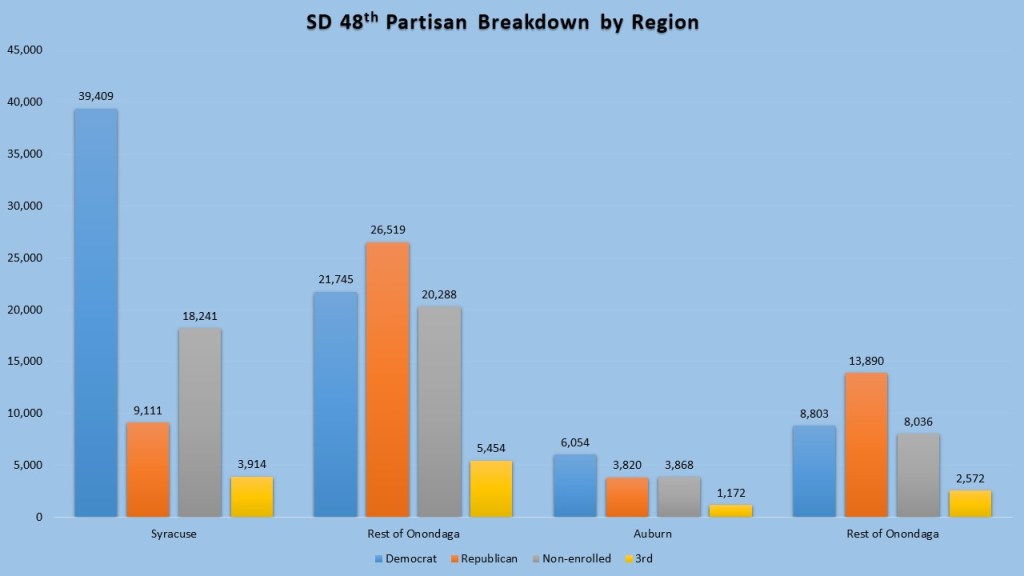
Of the four distinct regions of this district, it is clear that Syracuse has the most potential to carry weight in the district. Though it is second in voter population, the overwhelming partisan lean of Syracuse (+30,298 DEM) is what drives this district’s Lean Democratic ratings. The City of Auburn has a similar Democratic partisan advantage (+2,234 DEM) but somewhat less pronounced & much less population. Both Urban cores the GOP are in third place behind the N/E voters. The most populous region, the towns of Onondaga, does have a solid GOP Lean (+4774 GOP). So do the Towns of Cayuga (+5,087 GOP). Democrats though have solid second place finishes in these regions as opposed to the GOP in Democratic regions.
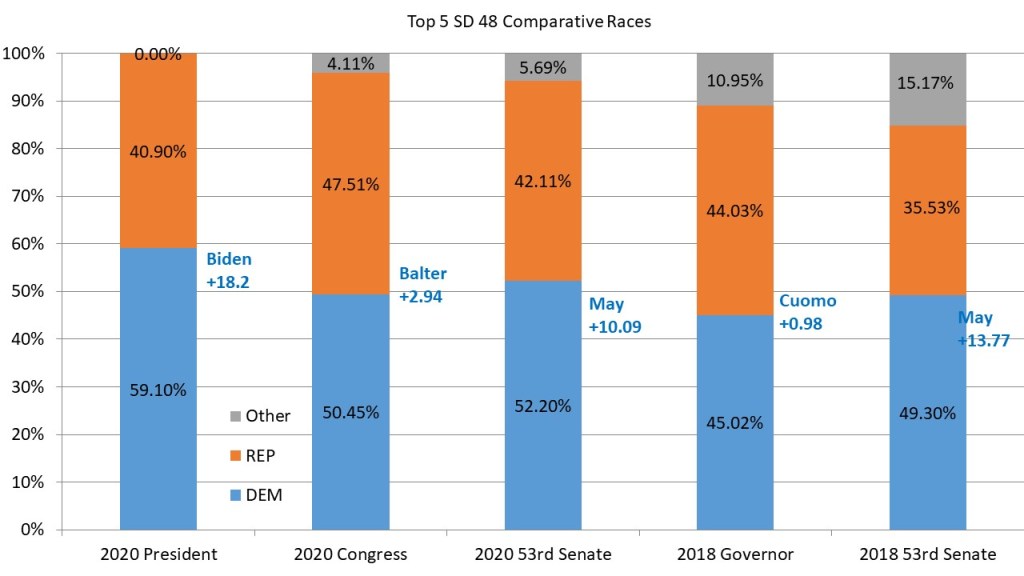
Since this is the first year of the new district, we do not have any true prior results on which we can rely. I am using a Frankenstein method to compile data and get an idea on how this district might perform comparing the 2020 Presidential and Congressional and 2018 Governor. If this district were in place in 2020 it would have voted for Biden by an overwhelming 18.2 points. However, the district only barely supported Dana Balter by 2.94 points and Cuomo by .98 points in 2018. However, in both races there were third party Democratic leaning candidates (Steve Williams on WFP in 2020, and Stephanie Miner on SAM in 2018) that could have split off Democratic votes.
Rachel May did win the old #SD53 by double digits both times she ran, 10.08 points in 2020, and 13.77 in 2018. She out polled both Cuomo and Balter in those races as well. According to NY Redistricting and you, the new #SD48 & old #SD53 can be expected to perform the same as Biden won #SD53 by 18.6 and won #SD48 by 18.2 points.
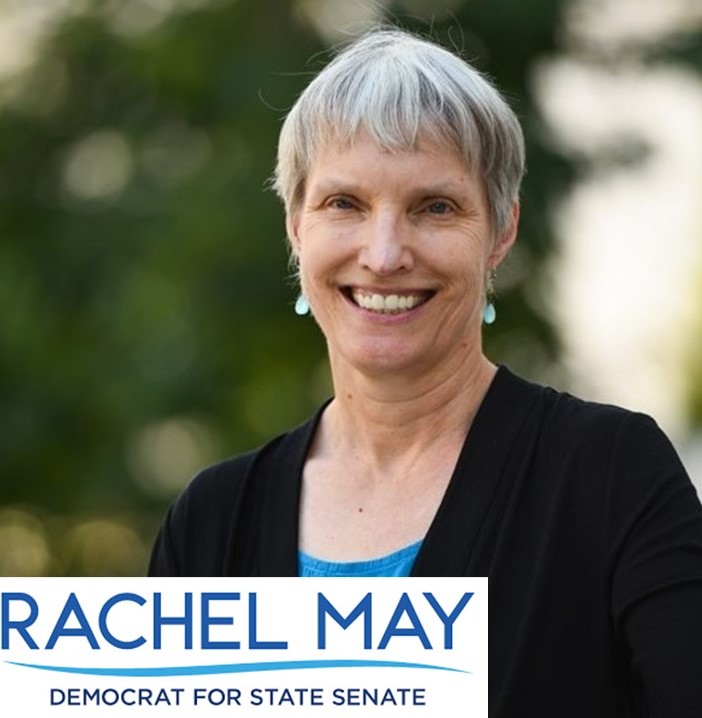
Senator Rachel May (D) is running for re-election in #SD48. She will appear on the Democratic and Working Families Party Line. She has served in the NY State Senate since 2018. She is running against Julia Abbott (R) who is a sitting Onondaga County Legislator. There is a third-party candidate on the Conservative line Justin Corretti (C) from the Auburn area.
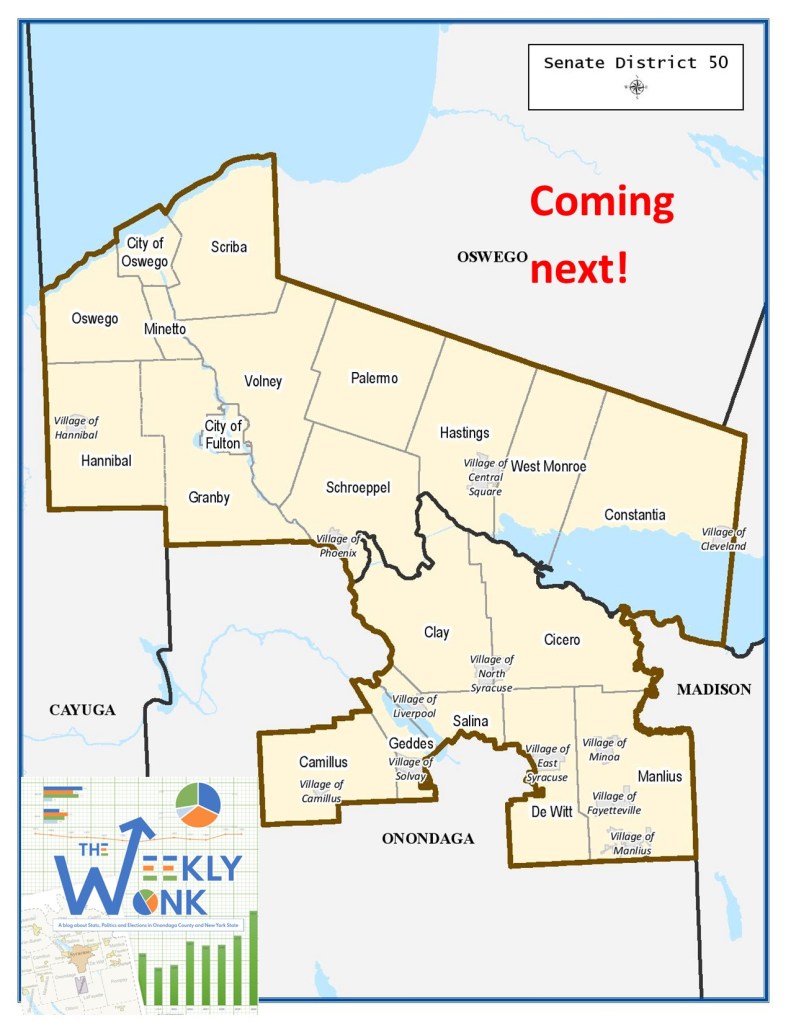
That does it for this edition of the #weeklyWonk. Next week I will continue my run finishing races on the ballots this year. I will start out with finish my look at the state legislature races with NY Senate district fifty as well as the towns of Manlius, Onondaga, and Pompey. Check back each week & subscribe to dustinczarny.com for all content and elections updates.
“Thursday, she brought to the Onondaga County Board of Elections a “notice of claim,” paperwork that preserves the group’s right to file a lawsuit, Elections Commissioner Dustin Czarny said.”
This story is just a tip of the iceberg as to what we at the Onondaga County Board of Elections, and election officials across the country have been facing. Since the certification of the 2020 elections, we have seen onerous and burdensome FOIA requests concerning the 2020 election. I believe in transparency, and I believe in the public’s right to know. I have fought for more open ness not only at my board but across the state. My position was, and remains simple, we have nothing to hide and shedding a light on bi-partisan election process should ease concerns and lead to acceptance of results. Before 2020 for the most part that philosophy has proven successful.
Unfortunately, with the election deniers from 2020 I have concluded this philosophy may never be successful. It is clear that they have reached the conclusion that the election was fraudulent, and no amount of data or hard evidence will ever change this. In face it is a self-sustaining belief because when given proof against whatever claim they make, they then either use the proof as further proof of wrongdoing or just move on to the next ridiculous claim.
As we move into the midterm election, nearly two years later, these FOIA requests have become more frequent. This is not an accident. Under New York State Law Boards of Elections can start to dispose of election data 22 months after the date of the election. This has led to a new frenzy of requests. However, those requests are being organized and spurned on by Reddit and 4chan forums that originate templated FOIA requests. Their stated goal is to “gum up” the works at Board of Elections offices and are using the fear and bias of their supporters against them to drive them into a frenzy.
If it were not so dangerous, I would almost feel sorry for these deniers. They are destined to be lumped into the same category as 9/11 truthers, bigfoot hunters, and ancient alien enthusiasts. They have allowed themselves to believe in their divine right to rule that they have driven themselves down a dark path. That path is littered with charlatans and partisans whose sole intent is not the truth but to use their followers to separate them from their hard-earned money and precious time. They do so to elevate themselves and not our country, and certainly not our democracy.
As for the Citizens Audit of New York I have looked over their original audit and now their new “Notice of Claim.” As with their original audit they make claims without giving proof of how they got to their conclusions. They do so in the name of protecting anonymity of the voters but in my opinion, it is to shield their wild claims from being refuted. I note that the 1850 birthdate claim is being repeated even though it has been thoroughly explained in the press and the media. Outside of dropping off documents and issuing FOIAs we have had no direct engagement with the NY Citizens Audit, and they have refused to provide proof of their allegations. They rely on quasi science from anonymous “experts” who make wild unsubstantiated claims about expected turnout to “prove” there is fraud. Losing an election is not proof there was fraud, it is proof your candidate did not connect with the public as much as they did you.
In the meantime, the Onondaga County Board of Elections will continue to follow the law and provide information as required. It has basically been a full-time job in my office just responding to this ever-increasing amount of FOIAs and I know we are not alone. Unfortunately, we expect this to continue, not just for 2020 but every election going forward. As long as there are followers that will further the work of charlatans and false prophets, I imagine every election will continue with these onerous requests. We will do our work as Election Officials to ensure fair elections, but it will be the taxpayers that will ultimately foot the bill for these post-election witch hunts.
On October 6, 2022 I was unanimously nominated for a 6th term as Elections Commissioner of Onondaga County Board of Elections by the Onondaga County Democratic Committee. Here is the speech I gave. Congratulations to our new officers Max Ruckdeschel (Chair), Prerna Deer (Secretary), and Dan Petrick (treasurer).
Subscribe to dustinczarny.com for all content and election news updates
Czarny said turnout in the region may not only be large, it may be definitive in that key congressional race as well.
“The margins in the House are, might run right through Central New York. It may be the seat that decides who controls the House, so I think we will see some intensity in turnout,” Czarny said.
I sit down with Judge David Murad. Judge Murad has been serving for 14 years n the Supreme Court in the 5th judicial district. We talk about his past 14 year, his accomplishments, and what it is like to run in such a large district. Enjoy. You can follow his campaign here:
Today I go into detail on the recently filed Lawsuit challenging absentees in new York. I give a brief history on the law changes that they are challenging, why those changes were made, and why this lawsuit is ill timed. Enjoy.
Subscribe to dustinczarny.com for all election news and content updates
“They’ve had plenty of time to bring this lawsuit,” [D]ustin Czarny, the Democratic elections commissioner from Onondaga County and the Democratic caucus chair for the New York State Elections Commissioner Association told Gothamist. “To wait until after absentee ballots have already been issued is going to cause chaos in the system.”
Welcome to the #weeklywonk. This is my weekly blog about statistics, registration data, and election law on my website, dustinczarny.com. This is a rebrand of my #wonkywednesday and #sundaythoughts columns I have been writing since 2020. In merging these two side projects together I am hoping to be a little more regular in my production. I have also not tied myself to a particular day to release these columns, hoping to release them weekly on the weekend. This way I can have more time to gather the statistics and resources that I want to devote to these articles. This week I finish my look back at the August 23rd Congressional and State Senate Primary with a breakdown of overall turnout.
Primary elections are routinely low turnout elections. Primaries that we consider having higher turnouts top out at 35 to 40%, which would be considered one of the worst turnouts for a general election. Most primaries settle in the 15-25% turnout range. With 16.64% turnout the best way to look at the August 23rd primary is it was an average primary election.
There were 302441 active registered voters for the August 23rd primary. 99,421(33%) voters were ineligible. Of the eligible voters (Democrats & GOP county wide and Conservatives in the #SD48) 33,778 voters participated in the election while 169,242 stayed home. This resulted in 16.64% turnout. Of those who turned out, 76% voted on Election Day, 13% voted Early, 10% voted by absentee, and 1% voted by Affidavit ballot. Sixty percent of the turnout were Democrats, 39% of the turnout GOP, and 1 % of the turnout Conservative voters. Adjusting for eligible voters the Democrats had highest turnout with 17.59%, the GOP 2nd with 15.89%, and conservatives had just 6.86% turnout.
In terms of raw voters this was one of the busiest primaries for the major parties. Since 2009 it is actually quite rare to have county wide primaries for both parties, let alone twice in a summer. The over 30k participants is the most for any primary % turnout was higher than the June primary and last year’s city primary. It is beaten in raw numbers only by the 2020 combined Presidential and local primaries with 38k voters and the massive 2016 Presidential which had nearly 75k voters.
Despite the raw turnout, this was really an average primary in rms of turnout percentages for both parties. For Democrats, the 17.59% turn out beats the June primary and last year’s city primary, but not it is definitely lower than most Democratic primaries. Of the sixteen primaries since 2009, the 2022 August primary is ranked seventh landing squarely in the middle of the pack. The GOP does not have primaries as often, this is only the ninth since 2009. Like the Democrats, the 15.89% turnout beats the last two primaries for the GOP. However, of the nine primaries it ranks fifth, again in the middle of the pack.
Regionally this primary broke down in the usual way. The overall 16.68% turnout was sixth out of seventeen of all primaries since 2009. The suburbs once again had a higher turnout than the city. Suburban voters turned out at 16.95%. City voters’ turnout at 15.81%. This is the normal pattern when the full county is activated for the primary. When the City is the focus of the primary with just small parts of the suburbs in local years then we see lower suburban turnout. When the full county is activated, like nearly ever general election, suburban voters’ turnout for higher rates.
That does it for this edition of the #weeklyWonk. Next week I will do a 5-week run finishing races on the ballots this year. I will start out with both Senate Seats #48 & #50 as well as the towns of Manlius, Onondaga, and Pompey. Check back each week.
Subscribe to dustinczarny.com for all content and elections updates.
Dustin Czarny, the Democratic elections commissioner from Onondaga County and the Democratic caucus chair for the New York State Elections Commissioner Association, said it was “chilling” to see this lawsuit filed right before the election.
He noted the absentee ballot canvass law was passed last June, signed into law last December, took effect in January and was in place, without challenge, for both the June and August primary elections. The COVID-19 pandemic excuse for absentee ballot applications has been available for voters since March 2020.
“They’ve had plenty of time to bring this lawsuit,” said Czarny. “To wait until after absentee ballots have already been issued is going to cause chaos in the system.” He said his county has already had 55 absentee ballots returned as of Thursday, with more coming in each day.