Zoom with Czarny is back. After a 6 week break for the election I am back with my weekly interview segment. Today I speak Jeff Wice of the NY Law School. Professor Wice is an expert on redistricting and he gives us an update on the NY State redistricting process as well as some thoughts on Onondaga County and Syracuse NY redistricting. I hope you enjoy.
Wonky Wednesday: Onondaga County November General Election Turnout Data.

Welcome back to #WonkyWednesday. Each week I do a deep dive into the election and registration data that makes up the electoral landscape of our home, Onondaga County. I have been on a two-month hiatus as the November general election required my undivided attention. However, I will be starting this series anew and the next few weeks we will look at the 2021 General Election and a facet of data so we can understand how Onondaga County voted this last year. The first data set we will look at is the most determinative factor of any election, turnout.
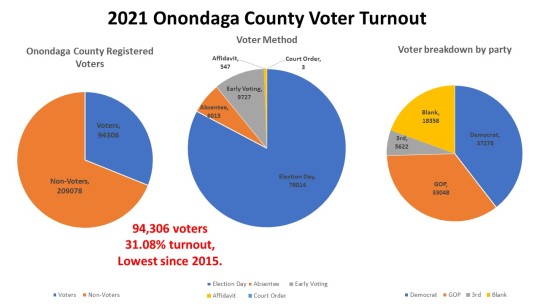
As we can see from the data, turnout was abysmal in Onondaga County in 2021. Just 94,306 voters turned out to vote in the General Election and a remarkable 209,078 voters stayed home. That is just 31.08% turnout and the lowest turnout in Onondaga County since 2015. Voters in Onondaga County continued to diversify the way they vote as well. While the overwhelming majority, 78,014, voted on Election Day, 9,727 voted Early and 6,015 voted by absentee, 547 voted by Affidavit, and 3 voted by court order. These are increases since the last local election in 2019 and in the coming weeks I will dive more into the alternate voting methods. Not surprisingly more Democrats, (37,278), voted in 2021 than GOP, (33,048), Blank/Non-enrolled (18,358), and 3rd Party voters (5,622). This order follows the enrollment order in Onondaga County, but the rates are much different.
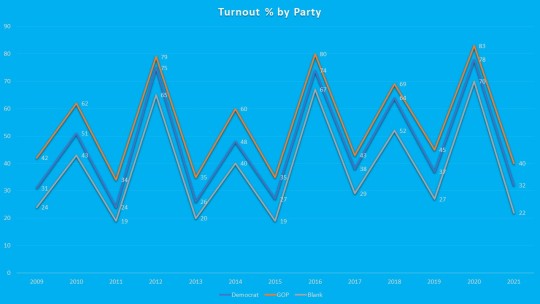
Republicans continue to turnout in higher percentage rates than all other parties in every election on record since 2009 (this is the date I have readily available data on record at the Onondaga County Board of Elections). In 2021 no part had stellar turnout percentages. The GOP did lead in voter turnout at 40%. Democrats, though outnumbering GOP enrollment and raw turnout, were only able to turnout 32% of its enrollment. This 8-point deficit from the GOP mimicked the same deficit we saw in the last local election, 2019. While Blank voters always trail the two major parties, the 10-point deficit from Democrats and 18-point deficit from the GOP is again basically the same as in 2019 though at lower rates. The lack of participation percentages by Democrats and Non enrolled in local elections is one of the reasons we see a blue county like Onondaga struggle to elect Democrats outside the City of Syracuse on a consistent basis.
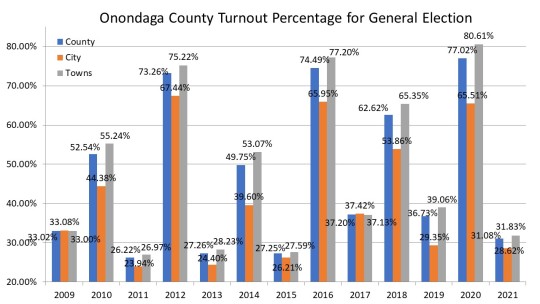
After a 4-year trend of rising turnout in comparative elections, culminating with the highest turnout in percentage and raw vote totals in Onondaga County history in 2020, turnout cratered overall in 2021. The County posted its lowest turnout rate since 2015, and the lowest turnout rate in a mayoral cycle since 2013. This is notable since the mayoral election was unchallenged in 2013 with Stephanie Miner running unopposed. In 2021 the City of Syracuse turnout rate of 28.62% lagging behind the Towns at 31.83%. In 2017 and 2009 with competitive mayoral races the city equaled the turnout rate of the County and surrounding towns. In 2013 without a mayoral race, it trailed towns by just over 3%. Despite a three-way race for mayor in 2021 the city turnout more reflected the 2013 race trailing again by 3%. This certainly accounts for some of the lack of turnout however the Towns still had a pathetic turnout rate as well, again their lowest on record since 2015.

The City of Syracuse gets a lot of media focus, specially during mayoral years. It is important to remember though that the city is only a little over 31.1% of the population of Onondaga County, and just 23.2% of the voter enrollment of Onondaga County. The lower enrollment rate along with historically lower voter turnout usually means an exceedingly small percentage of the actual cast votes. In 2021 that was on display with just 20,174 of the voters coming from the City of Syracuse representing only 21.4% of the votes cast.
This concludes my #wonkywednesday for this week. Over the next few weeks, I plan in-depth review of the 2021 Onondaga County General Election. My series will look at Early Voting, Absentee & Affidavit Voting, Democratic Gains and Losses, and Enrollment percentages of the adult population of Onondaga County. There may be a few redistricting articles thrown in as Onondaga County and the NY State Redistricting maps are approved and released over the next 3 months as the City of Syracuse is targeting September of 2022.
Commissioner in a Car: Getting ready for 2022
Today I outline what the BOE will be doing over the next few weeks to get ready for March Village elections, redistricting, and the June 2022 primaries. I also outline my plan as I start up my Wonky Wednesday and Zoom with Czarnys next week as the Election Hiatus is over and its onto 2022!
Final Onondaga County races decided by hand count – WRVO
“When people ask me next year whether their vote counts, these are the races I will point to,” said Democratic Elections Commissioner Dustin Czarny in a tweet on Monday. “Your vote matters!”
McMahon vetoes Onondaga County redistricting map – Spectrum News
County Executive Ryan McMahon has vetoed a controversial redistricting plan for Onondaga County, according to Democratic Elections Commissioner Dustin Czarny.
Commissioner in a Car: The election is put to bed but County redistricting, not so much.
Today’s Commissioner in a Car I talk about certifying the November general Election. I also discuss what will happen post election over the next few weeks to get ready for 2022. Finally I touch on the veto of the County legislative maps.
Onondaga County district maps headed to court unless McMahon vetoes, lawmaker vows – Syracuse.com
Dustin Czarny, the county’s Democratic elections commissioner and a member of the redistricting commission, said the division of towns like DeWitt and Geddes into multiple districts is a problem. That’s especially true in light of state legislation adopted this year emphasizing that districts should not “unjustly divide communities of interest.
Too many of the new maps tie together disparate communities with little in common, Czarny said. In two districts, for example, parts of Syracuse are linked with parts of DeWitt, “reducing the opportunity for minority representation and needlessly dividing both City and Dewitt communities,’’ Czarny wrote in comments asking McMahon to veto the maps.
My 11/18/21 letter to Onondaga County Executive Ryan McMahon urging a veto of the proposed legislative maps.
Mr. County Executive,
For three years, the people of Onondaga County have been asking for a more transparent and less partisan redistricting process that will result in fair maps. They petitioned the Onondaga County Legislature and City of Syracuse Common Council in 2019 to replace their partisan processes and put citizens in charge of truly independent redistricting commissions. The City of Syracuse and an overwhelming majority of the County legislators promised to do so. The City of Syracuse fulfilled their promise; however, the Onondaga County Legislature did not enact meaningful legislation to reform the redistricting process.
This inaction set up our county to repeat the past mistakes and deliver a flawed potentially illegal product. The Onondaga County Legislature and chairman of the County reapportionment committee compounded that mistake by choosing to rush the current process, effectively prohibiting the community input, in-depth analysis of demographic and voting data, and public scrutiny required to yield a fair map. This rush was entirely unnecessary. The County Charter clearly states the legislature could take up to six months after the delivery of data from the decennial Census to appoint the members of the commission. Instead, the legislature chose to initiate the Commission within a month and provided only 72 hours to find commissioners willing to serve. The County Charter clearly gives the reapportionment commission 3 months to redraw the lines. The Chair of the commission unilaterally demanded the work be done in less than a month. The County Charter allowed the legislature 3 months to then consider the maps. The County Legislative Chairman once again decided to accelerate the process calling a special session of the legislature 10 days after receiving the maps forcing a party line vote to approve them. This rushed process is entirely unnecessary because no map adopted by the Commission will take effect before the 2023 election cycle.
Throughout this entire rushed process, the public has been united in calling for more time and a bi-partisan resolution to this important 10-year decision. The failure to heed their warnings has resulted in a flawed map that divides communities and fails to consider the impact on the voting strength of communities of color, quite possibly in violation New York state law and the federal Voting Rights Act.
The Commissioner failed to give the public adequate time to review and analyze the maps, let alone an opportunity to provide the kind of thoughtful feedback this weighty process demands. Two public hearings were held before any draft maps were even released. The other three public hearings were held within 72 hours of their release. During this time the Redistricting Commission’s chair, Mr. Hulslander, could not meet even his own deadlines for releasing the maps. Despite an agreement to release the data underlying each map at least 24 hours before the October 27th Committee meeting, the Republican Commissioners did not release their map until just 90 minutes before and even then the data was incomplete. For the November 3rd voting meeting Mr. Hulslander set a deadline of Friday October 30th at noon for final maps. This was just two hours after the final public hearing. Even so Mr. Hulslander once again failed to meet his own deadline as the GOP continued to change the data underlying their map until hours before the November 3rd meeting. This failure to adhere to even their own rushed deadlines—let alone objectively reasonable deadlines—kept the public from having an opportunity to weigh in and point out flaws that need to be addressed.
The Reapportionment Commission and Legislative leadership made no attempt to negotiate or compromise their proposed maps to accommodate input from Democratic Commissioners or the public. The map that sits before you today is not substantially changed since it was initially introduced on October 27, in spite of the overwhelming criticism from the public hearings. The maps submitted by the Democratic Commissioners, Sharon Moran and myself, were offered as a first draft meant to be altered and negotiated in response to feedback from other commissioners and the public with the intent of reaching a compromise, consensus map. We asked for more time to get more public input. We were refused. We asked for actual negotiations between commission members on a compromise map. We were refused again. We believe, and still do, that a negotiated map that reflects the equal participation of all commissioners participate and, most importantly, addresses the need and concerns of the community will be a better path forward than adopting this clearly flawed map.
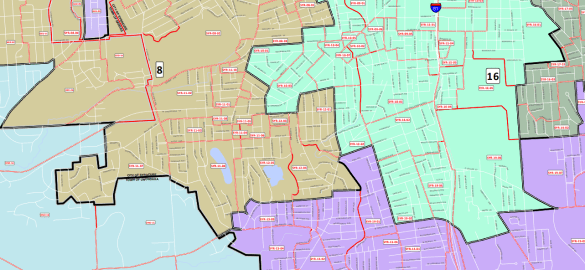
This map is flawed. Inside the City of Syracuse, this map cracked the only majority-Black district in the County Legislature into white-plurality districts without any explanation. This map pairs city districts in 7 & 17 with portions of Dewitt reducing the opportunity for minority representation and needlessly dividing both City and Dewitt communities. This map pairs inner city districts with the Town of Geddes in district 8. District 15 connects the valley of Syracuse with the University and Westcott neighborhoods, communities that have little in common. They create an essentially new inner city district in 9 connecting the little Italy section of the North side to Lincoln hill neighborhoods using a one-block connection.
The maps are equally flawed outside the City of Syracuse. They needless divide the Town of Dewitt into 4 different legislative districts as well as divide the town of Geddes into three when both towns could fit into a single legislative district according to their population. They combined Liverpool and Solvay into a sprawling district 4 that wraps around Onondaga Lake merging two disparate communities. They eliminated the village of Manlius from District 10 and split the neighborhood of Nedrow in half to merge into district 12 dominated by rural sparse communities with little in common. District 13 combines the Towns of Elbridge and Van Buren by skips over the western portion of Camillus to dip into the eastern portion creating a meandering non-compact district.
All of these concerns were brought to the commission’s attention and were dismissed by Chairman Hollander as coming from “Democrats”. You yourself have dismissed these concerns as being presented in an “organized fashion”. I reject those sentiments. Analyzing a redistricting map is a sophisticated and complicated process. It requires sophisticated methods. It requires time. It requires organization. In a county where Democrats constitute a large plurality of registered voters, we shouldn’t be discounting citizens’ feedback on consequential legislative redistricting based on their party affiliation. Elected leaders in Manlius, Dewitt, and Syracuse have joined with organizations like Common Cause, the League of Women Voters, and the NAACP in rejecting both the process and the partisan maps before you today. Two Republican legislators joined with six Democratic legislators in asking for more time and more negotiation. The only bi-partisan agreement that has been reached is that we should start over and reject this partisan map that divides our communities for naked political gain in favor of a thoughtful, transparent, and fair process.
In your 2019 election you claimed “we are all in this together”. It is time to live up to that campaign slogan. There has been near unanimous condemnation of both the process and the flawed maps it has produced. You should listen to the voices of County residents, reject this map, and send it back to the reapportionment commission with a directive to attempt to negotiate consensus maps with another round of public hearings. I believe there can be solutions to the divides that bring a better result for Onondaga County and allow us to better serve the public good, rather than our own partisan wishes. It is now solely in your hands to reduce this partisan tension and demand better. I hope you make the right choice.
Sincerely,
Dustin M. Czarny Onondaga County elections Commissioner (D) Reapportionment Committee Member Syracuse, NY
Onondaga County absentee votes flip some races, strengthen others – WRVO
“Marcia Ferguson was down on election night, she was down by one vote for town councilor out in Geddes and now she’s the head by 36 [votes],” said Czarny. “So that race flipped.”
Onondaga County Board of Elections continues absentee ballot recount – CNYCentral.com
“We had a lot of races that were within the absentee ballot margin, so we had some observers here and that always slows down the process, but we expect to be finished up sometime tomorrow.”
 Dustin M. Czarny