In my first candidate interview of the 2023 cycle I welcome back Onondaga County Comptroller Marty Masterpole joins me to talk about his re-election campaign. We talk about the first campaign, his first four years dealing with Covid, the aquarium, the jail, and more. Enjoy.
For content and election news updates subscribe to dustinczarny.com
This week is the start of Designating petition filing week. This is one of the busiest weeks of the year for Boards of Elections. I also talk a bit about the Trump indictments today and how this relates to elections. Enjoy.
Subscribe to dustinczarny.com for all content and election news updates
Welcome back to the #WeeklyWonk. Each weekend I release an article on a subject relating to elections in Onondaga County and New York State. Often these articles will have detailed stats to consume but sometimes they will be a recap of a prominent issue or on relevant election law. I am turning my eye to the 2023 elections. This week I take a break from looking at the political subdivisions and focus on a work item from the Onondaga County Board of elections. Today I look at the Town of Salina, a town that Democrats should be doing better in but are not.
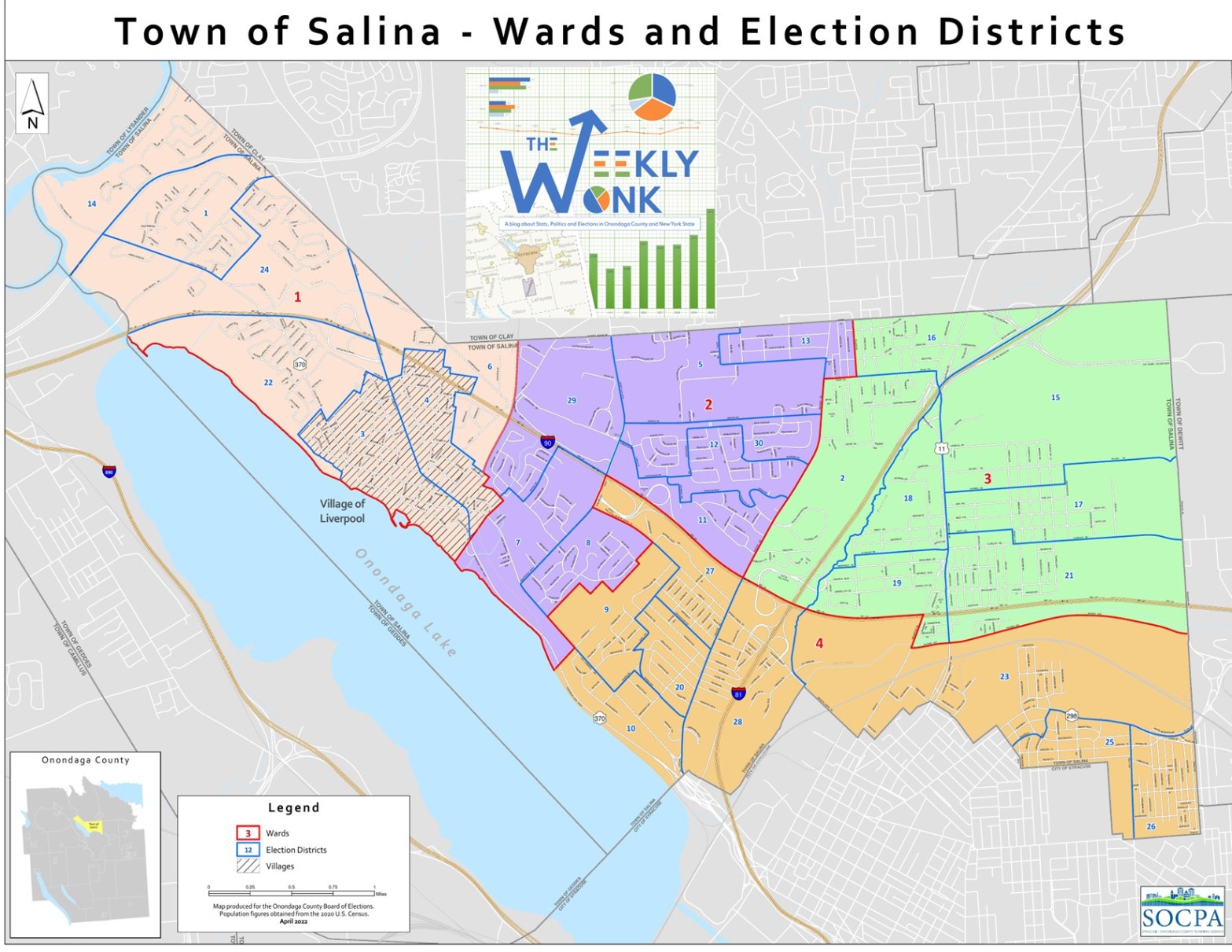
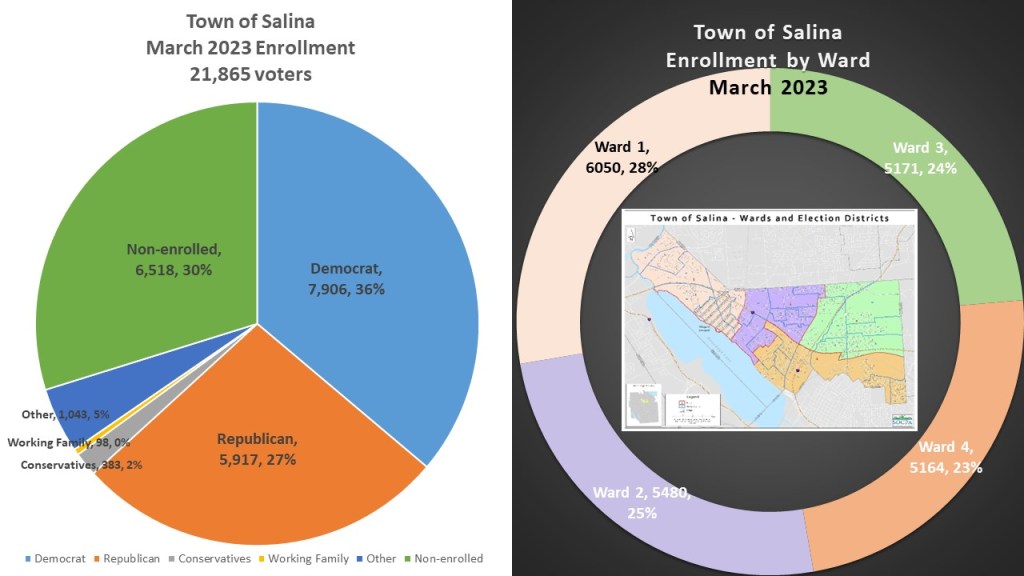
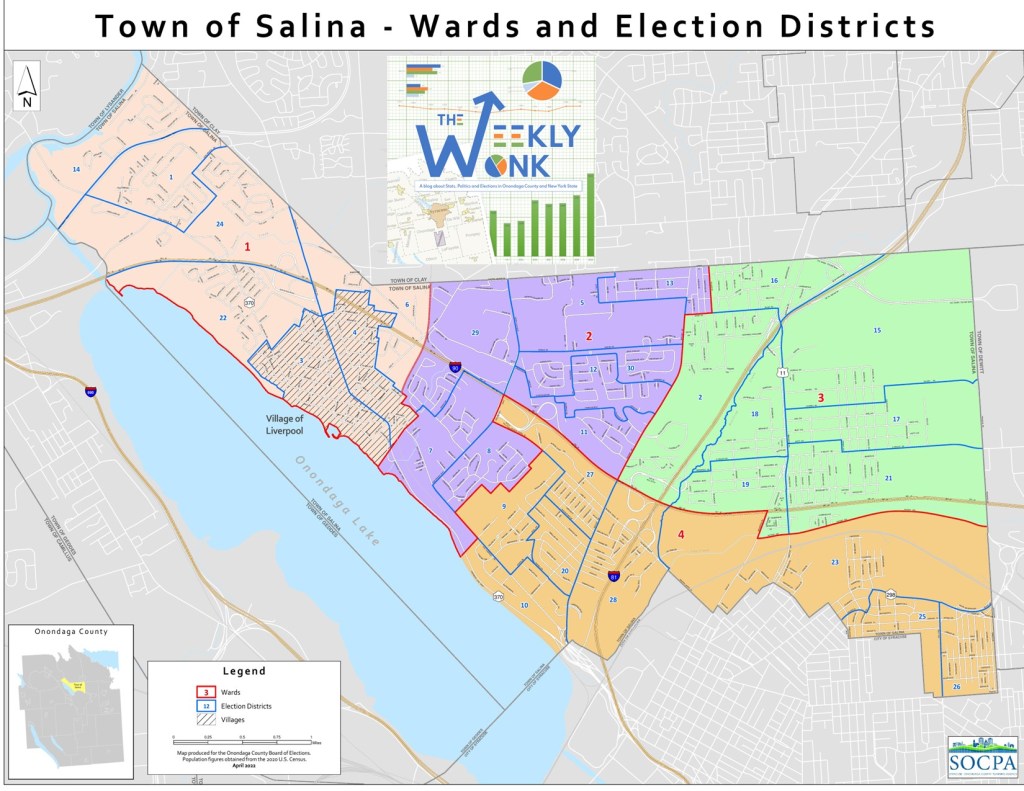
The Town of Salina sits in the northern suburbs sandwiched between Clay and Syracuse. The town of Salina is the opposite of last week’s investigation, the Town of Spafford. The Town of Salina is one of the larger towns in terms of active voters in Onondaga County with 21,865 voters. It is a town that looks like a Democratic town but underperforms on the local level. The makeup of Salina is 36% Democrat (7906 Voters), 27% GOP (5916 Voters), and 30% non-Enrolled (6518 voters). The GOP has been overtaken by the non-enrolled voters and that should be a sign that Salina should take a blue turn. The Town of Salina is one of only two towns that are broken up into wards, meaning they elect their town boards in predetermined areas rather than town wide. There are four town wards in Salina which coincidentally go down in size in terms of Active voters. Ward 1 has 6050 voters (28%), Ward 2 5480 voters (25%), Ward 3 5171 voters (24%), and ward 4 5164 voters (23%).
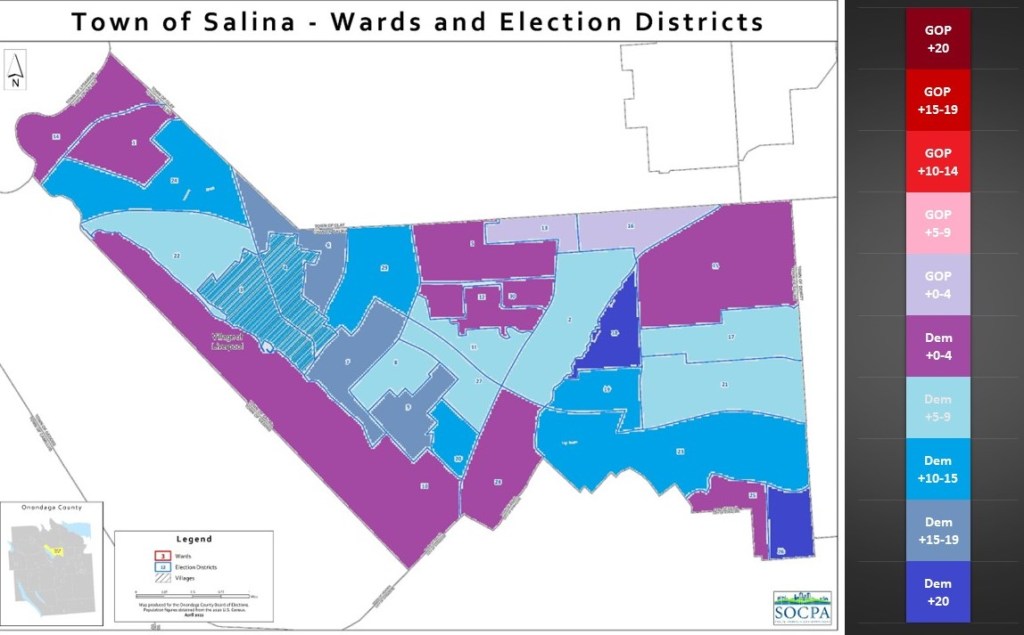
In a new feature I am bringing to the #weeklywonk this year I am doing a heat map for each political subdivision. I will be looking at the current partisan makeup of each individual ED and heat mapping its partisan lean based on the advantage for the Democrats and GOP. Only two eds, ed Salina 13 & 16 have GOP advantage, and only by less than 1%. Eds 1,5,10, 12,14,15, 25, 28 & 30 have Democratic enrollment advantages of less than 5% making them borderline eds. Eds 2, 8, 11, 17, 21, 22 & 27 have slight Democratic advantages between 5 & 10%. Eds 3, 19, 20, 23, 24, & 29 hove solid Democratic advantages between 10-15%. Eds 4, 6, 7, & 9, have strong democratic advantages between 15-20%. Salina even has 2 eds 18 & 26 that have overwhelming Democratic advantages over 20%.
Since 2009 The Town of Salina has followed the county, where Democrats have made gains, that accelerated in 2016, and the GOP has had a slow steady decline. Since 2009 the Democrats have gained 790 Democratic voters. The GOP on the other hand during that time frame has lost 1059 voters. The Non-enrolled has been the biggest gainer, garnering 1281 more voters. Democrats saw their biggest gains between 2015 and 2020 and have held steady since. The GOP lost dramatically between 2009 and 2015 and then held steady during the Trump years but may be on the decline again. The non-enrolled have had steady gains since 2009 but saw a great deal of their gains since 2020.
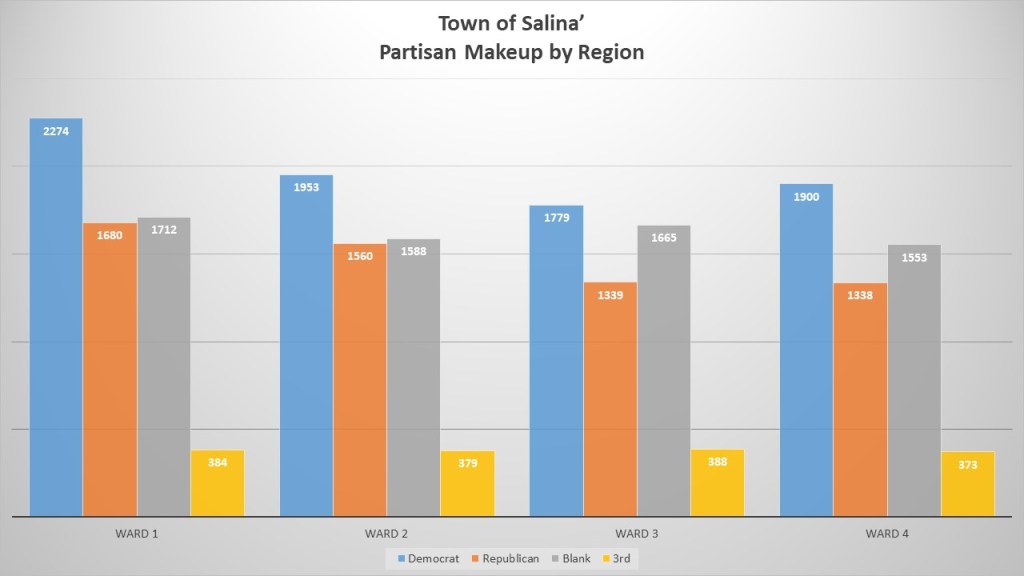
The wards in Salina all have solid Democratic enrollments, yet all wards are represented by the GOP for the first time in a generation. The 1st and second districts are where Democrats have had some recent success. Up until 2021 Democrats have held onto the 2nd district councilor. The 1st and 2nd district were very close elections in 2021. While Democrats have better numbers in Ward 1 and Ward 2, the non-enrolled are solidly in 2nd place in Ward 3 & 4.
Looking at the growth of voters since the last redistricting cycle, 2012, we see that the wards grew at about the same rate. Once again, they line up in numerical order as the first ward gained 584 voters. The 2nd Ward gained 546 voters. The 3rd Ward gained 484 voters. The fourth ward gained 342 voters. The Town of Salina decided not to change their districts in this last cycle, however it is doubtful they will be able to do that again in 2030. After the 2020 census all four districts fell within the 5% New York State population guidelines. However, since the two most populous districts, wards 1 & 2, are growing faster than the others, if that pattern holds, they will be forced to make changes after the 2030 census.
The Town of Salina Democratic advantage has grown by 7.12% since 2012. Wards 2 & 4 had the same growth in Democratic advantage by 7.52%. The biggest growth comes in Ward 1, which includes the village of Liverpool. Ward 1 grew by 11.04% since 2012. Ward 3, which is in the northeastern corner of Salina Democrats have grown at the lowest race, only gaining by 1.81%.
When we look at the comparative races, we see a Town that votes Democratic much like the rest of the county. However, when it comes to local races Democrats have not been able to gain a foothold, and in face have lost ground. In 2022 the Town of Salina voted for Governor Hochul’s by 52.75%, just 1.03% worse than her win in Onondaga County rate of 53.78%. In 2021 the Town of Salina voted for Anthony Brindisis for Supreme Court by 50.28%, Brindisi was off by just .32% of the county result rate of 52.50%. In 2020 Salina voted for President Biden 56.73%, though 2.15% points behind his Onondaga County win of 58.88% which is the worst performance among our comparative races. In 2019 Salina voted for Democrat Mark Kolinski for County clerk by just 46.59% losing 1.14% of his Onondaga County rate of 47.73%. Salina seems to run just behind the Onondaga County rates from the major elections, however in local elections the GOP outperforms its registration. In the 2021 open seat for Salina Town Supervisor the GOP candidate Nick Paro had a decisive win with 56.53% of the vote and a 15-point win.
In 2023 the Salina Town Democrats are currently passing petitions for Supervisor and 4 Town Board members, and Town Justice. The town of Salina could be where Manlius was in 2015, at the bottom with no representation and then take over town government in the next few years. However, it will take ground level work and an infusion of members willing to get involved. You can get involved with the Salina Town Democrats by contacting Chris Shepard, the Town Chair at syrvmguy@hotmail.com.
That is, it for this week’s edition of the #WeeklyWonk. Next week I will dive into the Town of Camillus, the only other town with a ward system, however it fills its candidates by caucus. As always go to dustinczarny.com and subscribe to get all your content and election news updates. I run that website, along with these series of articles, as part of my voter education. I never take ad money or charge subscriptions paying for the site with my own personal funds. Subscribe here.
For my March Czarny Seminar I go over the ways to file petitions and make objections on petitions. There are quite a few changes for 2023, as well as some last minute extensions for filing designating petitions check it out.
Subscribe to dustinczarny.com for all content and election news updates
The NY Senate and Assembly has passed a bill to extend the filing deadlines for designating petitions from April 6 to April 10th because of Passover. However the last day to collect signatures is still April 6th. The general election polling place list has been released at onvote.net. Lots of voters in new polling places. See why on the pod.
Subscribe to dustinczarny.com for all content and election news updates.
(Today I sent a letter to Governor Hochul, Majority Leader Stewart-Cousins, and Speaker Heastie as they finalize the 2023 New York State Budget. For transparency’s sake I am posting it here.)
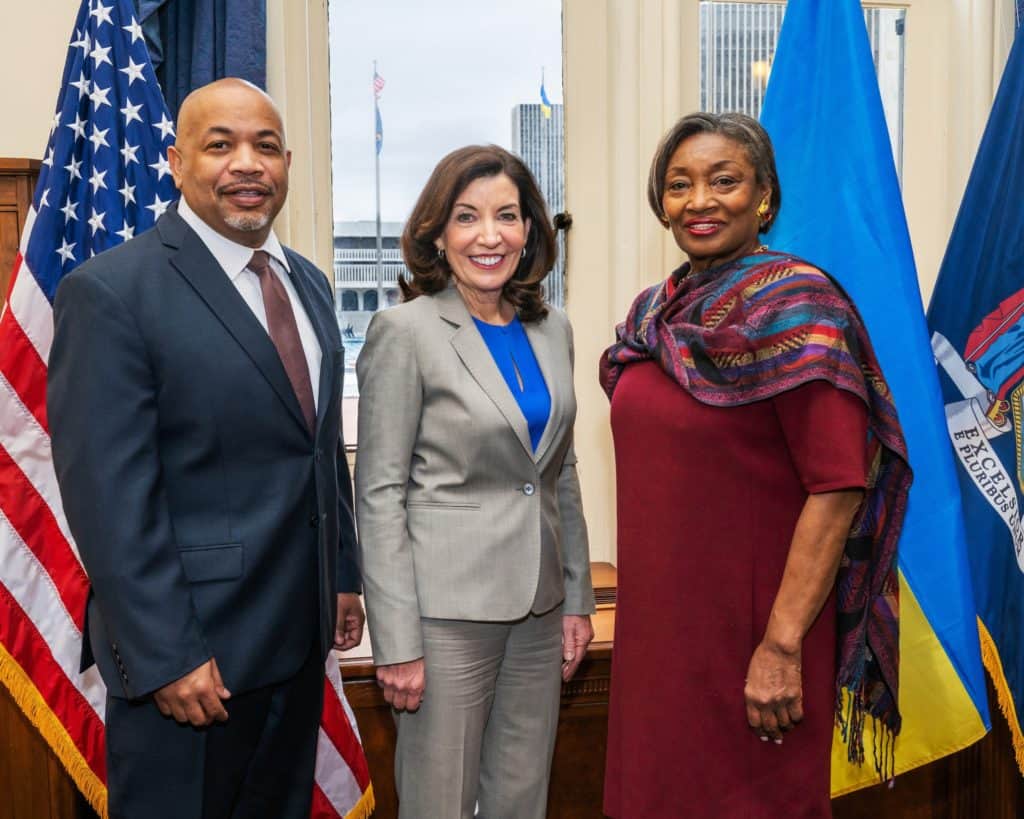
Governor Kathy Hochul
Majority Leader Andrea Stewart-Cousins
Speaker Carl E. Heastie
NYS Capitol Building
State St. and Washington Ave.
Albany, NY 12224
March 27, 2023
RE: Funding request from the Democratic Caucus of NYS Elections Commissioner Association
Dear Governor Hochul, Majority Leader Stewart-Cousins, and Speaker Heastie,
I am writing on behalf of the Democratic Caucus of the New York State Elections Commissioner Association. As you enter the final phases of budget talks, I would like you to urge you to remember County Board of elections need funding this year to prepare for the 2024 election cycle. The executive budget, the senate budget, and the assembly budget all have various levels of funding for local County Boards. Our caucus appreciate that New York State recognizes that county Board of Elections need assistance. All three budgets reauthorize existing grants, fully fund the State Board of Elections, and sets money aside for reimbursement of the prepaid absentee costs.
Both the Senate and Assembly one-house budgets have gone beyond the Executive budget. The Assembly has included $10 million in Aide to localities. The Senate Budget goes further with $15 million in Aide to localities and $15 million in capital funding. Furthermore, the Senate Budget includes two program bills that are high priorities for both my caucus and the NYS Elections Commissioner Association. S644/A1258 providing minimum staffing requirements for Boards of Election & and S611/A919 which mandates all Elections Commissioners to be full time.
The Board of Elections have faced many hurdles over the last few years and has risen to the challenge. Since 2019 we have implemented election reforms such as Early Voting, Electronic Pollbooks, Universal transfer of registrations. Implementing a cure system to prevent accidental disenfranchisement of absentee voters over technical deficiencies. We have met the challenge of modernizing our absentee counting procedure with pre-canvassing of absentees.
We are implementing online and automatic voter registration this year along with a new 10-day voter registration deadline that will surge our registration rolls as well as the data entry work of local boards. We will also be instituting changes to affidavit balloting which will add to the workload of the post-election process. We have done all that in the middle of a multi-year pandemic that challenged the very nature of our mostly in-person voting system and put the health of our election workers at risk. While no system that is made up of human workers is without its flaws, our Boards have risen to the challenge, and kept our electoral system afloat in New York.
Now is the time to invest in our local Board of Elections. We need both Aide to Locality funding and Capital funding to continue to meet the goals of this legislature that you have laid out for us. The Aide to Locality funding will help us recruit and train staff in 2023 to meet the upcoming challenges of the new registration requirements as well as staff up in time for the 2024 Presidential year which will see 2 primaries and many experts predict one of the largest turnout elections in generations. Capital funding will help us transition from older equipment that is still in use. Many counties still use precinct level scanners that are up to 15 years old. This year next generation precinct scanners will be certified by the New York State Board of Elections. Providing funding in this budgetary cycle will allow Boards to make purchases to be ready for 2024. We believe that Boards of Elections are in similar circumstances to 2019 when the legislature authorized $10 million in Aide to Locality funding and $25 million in Capital funding.
Finally, we urge the legislature to adopt two program bills in the NY Senate Budget. S644/A1258 providing minimum staffing requirements for Boards of Election & and S611/A919 which mandates all Elections Commissioners to be full time. These bills have bipartisan support amongst the New York State Elections Commissioner Association and are laid it in their legislative agenda as well as the Democratic Caucus list of priorities. Passing these bills will bring parity to local county boards of elections as we prepare for 2024. Defining minimum staffing levels will make sure every county in New York State has the proper staffing at their local Board of Elections to continue to meet our obligations to voters. Having full time commissioners is necessary with the modern political Calendar passed in 2019. There is no more off time at local Board of Elections and full-time commissioners will not only make sure our work is done, but it will also make it easier to find qualified and adequate replacements as commissioners retire.
The Democratic Caucus looks forward to continuing to work together with our legislative partners to modernize the New York State electoral system. I wish you well as you finalize the New York State 2023 budget and will work with you on further electoral reforms in the 2023 legislative session. Thank you for all you do for New York State Voters.
Sincerely,
Dustin M. Czarny
Democratic Caucus Chair, NYS Elections Commissioner Association
Welcome back to the #WeeklyWonk. Each weekend I release an article on a subject relating to elections in Onondaga County and New York State. Often these articles will have detailed stats to consume but sometimes they will be a recap of a prominent issue or on relevant election law. I am turning my eye to the 2023 elections. This week I take a break from looking at the political subdivisions and focus on a work item from the Onondaga County Board of elections. Today I look at the Town of Spafford, a surprisingly competitive small town.
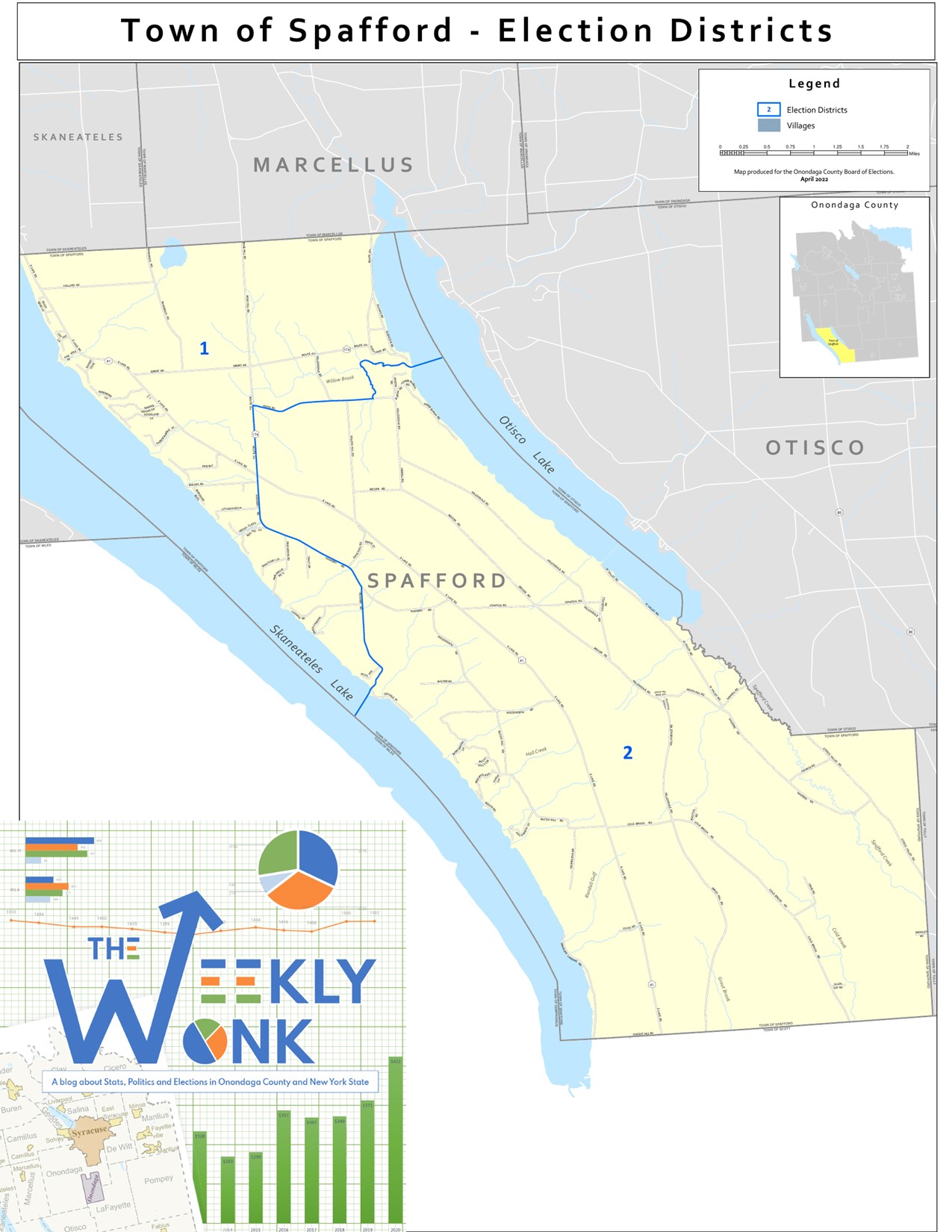
The Town of Spafford sits in the southwestern portion of the County. The Town of Spafford is the smallest town in terms of active voters in Onondaga County. On its face the town of Spafford is a solidly GOP town. The makeup of Spafford is 28% Democrat (370 Voters), 42% GOP (550 Voters), and 24% non-Enrolled (309 voters). While a solid GOP enrollment the Democrats have remained in 2nd place and not been overtaken by the non-enrolled. Because it is a small town it only has two election districts, a northern district ED 1, and Southern district ED 2. The northern ED slightly outnumbers the southern ED 698 voters to 613.
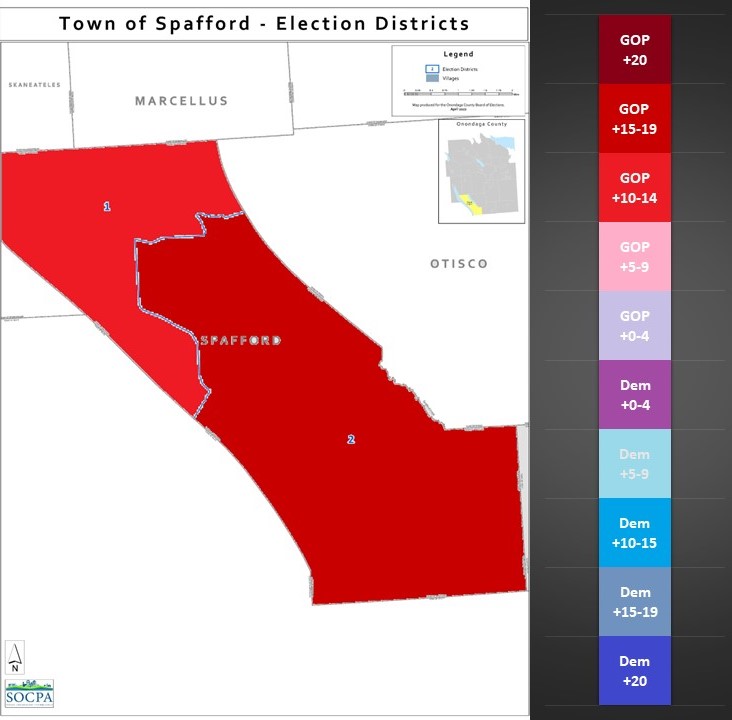
In a new feature I am bringing to the #weeklywonk this year I am doing a heat map for each political subdivision. I will be looking at the current partisan makeup of each individual ED and heat mapping its partisan lean based on the advantage for the Democrats and GOP. The town of Spafford has some partisan stratification between its eds but still solid GOP permeation overall. We can see in this heat map both election Districts are solid GOP districts. The northern district ED 1 is slightly better than the southern district ED 2. The GOP has a partisan advantage of 10.03% in ED 1, and 17.94% in ED 2.
Since 2009 The Town of Spafford has followed the county as a whole, where Democrats have made gains, but only in a steady slow way. Since 2009 the Democrats have gained 31 Democratic voters. The GOP on the other hand during that time frame has lost 78 voters. The Non-enrolled has been the biggest gainer, garnering 63 more voters. Democrats are slowly gaining on the GOP in this town and, but it looks more like the GOP is losing voters that are equally split between new Democratic voters and new non-enrolled voters.
The regions in Spafford are just the two Election Districts since it is so small. Not only is it small there is no real political subdivision in the town besides the election districts. They are wholly inside the 6th County Legislative district and there is no village inside its borders. As we noted in the heat map, the Northern district, ED 1 is the slightly less GOP heavy than the southern ED 2. Both Eds though show that Democrats, while trailing significantly to the GOP, are in 2nd place and not overtaken by the Eds. This is usually means they can partner with the non-enrolled voters in their town to form winning coalitions at times.
Looking at the growth of voters since the last redistricting cycle, 2012, we see that the regions grew at about the same rate. The Northern District, the population leader in 2012 and now, gained 49 voters. The southern district ED 2 gained 41 voters since 2012. The northern district is smaller in size and growing at a faster rate as well as having more voters to begin with. The southern district is growing but at a slower rate and is larger geographically being more agrarian than suburb.
The southwest of Onondaga County has always been a haven for GOP population, however there is some trending towards Democrats. Democrats improved on their partisan gap in Spafford by 8.55% since 2012. However, that growth is solely in the northern district ed 1. Ed 1 as it added voters and became more suburban like Democrats improved on their partisan gap by 16.94%. The southern district though saw a regression as the GOP improved on it’s partisan gap by almost 1%. This tract national trends on suburban gains by Democrats and rural gains for the GOP.
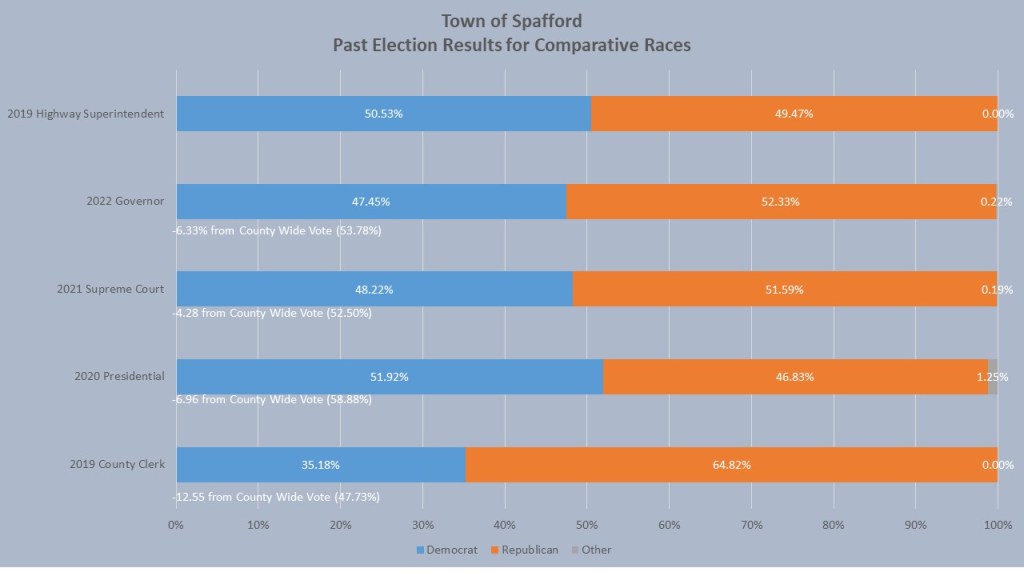
When we look at the comparative races, we see a Town that swings how it votes based on the election. Spafford is solidly more conservative than the rest of Onondaga County but less conservative than their voter registration gaps might indicate. In 2022 the Town of Safford voted for Governor Hochul’s opponent Lee Zeldin by 52.33%, Hochul dis 6.33% wors than her win in Onondaga County rate of 53.78%. In 2021 the Town of Spafford voted for Anthony Brindisis’ GOP opponent for Supreme Court by 51.59%, Brindisi was off by 4.28% of the county result rate of 52.50%. In 2020 Spafford surprisingly voted for President Biden 51.92%, though 6.96% points behind his Onondaga County win of 58.88%. In 2019 Spafford had its most decisive GOP vote of the comparative races voting for Lisa Dell by 64.82%, with Democrat Mark Kolinski losing 12.55% ahead of the Onondaga County rate of 47.73%. As I stated before Democrats have actually had success in Town government. In the last competitive head to head race Jody Fisher (D) won the Highway superintendent race by 50.53% in 2019 and ran unopposed in 2021. In 2021 Democrats came within a couple percentage points of sweeping both Town Board races.
In 2023 the Spafford Town Democrats are currently passing petitions for Supervisor, Highway Superintendent, 2 Town Board members, and Tax Collector. You can get involved with the Manlius Town Democrats by contacting David Hempson, the Town Chair at dhempson24@gmail.com.
That is, it for this week’s edition of the #WeeklyWonk. Next week I will dive into the Town of Salina, where Democrats despite large voter registration advantages, have been swept out of town office. As always go to dustinczarny.com and subscribe to get all your content and election news updates. I run that website, along with these series of articles, as part of my voter education. I never take ad money or charge subscriptions paying for the site with my own personal funds. Subscribe here.
This week I sit down with Erica Smitka of the League of Women Voters of New York State. We talk about the League’s history and connection to Central New York. We also go over their legislative and budget goals for this year. Enjoy.
“Hank Chapman and Robert M. Oley were unofficially declared winners in the four way race for Village of Manlius Trustee, according to Onondaga County Elections Commissioner Dustin Czarny.”
Today is village election day in 6 villages across Onondaga County: Manlius, Fayetteville, Jordan, Skaneateles, Baldwinsville and Fabius. Polls are open until 9pm got here for more information







 Dustin M. Czarny