Zoom with Czarny Joanna Zdanys of the Brennan Center

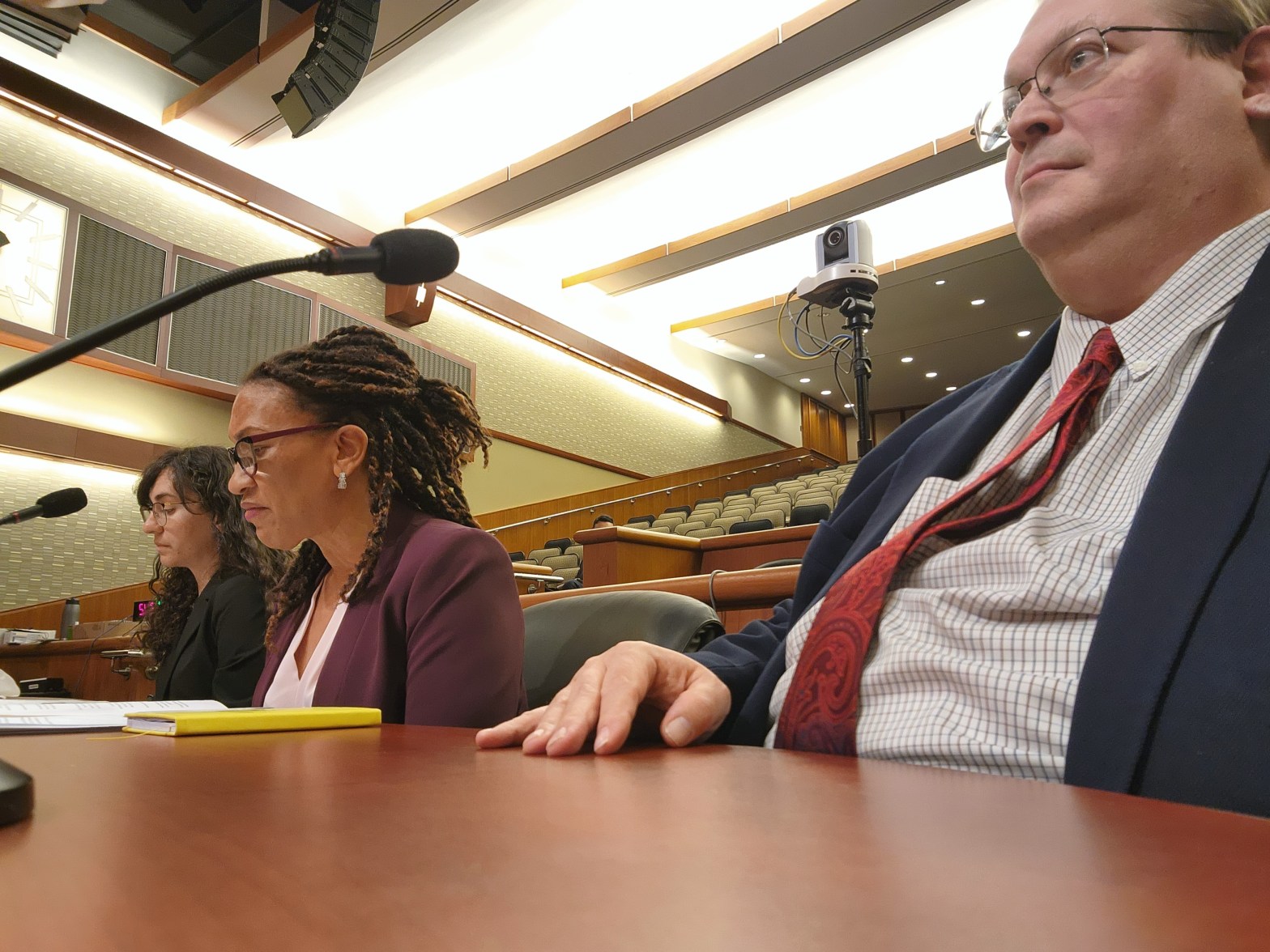
In this week’s episode I interview Joanna Zdanys of the Brennan Center for Justice. We talk about the push for funding the Public Campaign Finance board as well as the Brennan Center’s other work on making Democracy better in New York and throughout the US. Enjoy.

Subscribe to dustinczarny.com for all content and election news updates

Submitted Testimony to New York State Independent Redistricting Commission

The NYSIRC held a series of public hearings on their draft Assembly plan for New York’s 2024 elections. You can review their draft here.

Submitted Testimony to New York State Independent Redistricting Commission.

Draft Assembly Maps

March 8, 2023

I am submitting testimony today on the NYSIRC draft assembly plans to redraw NYS Assembly districts for the 2024 election.  I was unable to attend the live hearings in Onondaga County in February due to work obligations.  I have been the Democratic Elections Commissioner in Onondaga County since 2013.  I have also been intimately involved in redistricting on the local level in Onondaga County and the City of Syracuse.  I am submitting this testimony today as a resident of Onondaga County; however, I am drawing on my experience as elections commissioner and fair maps advocate.  For the most part I will center my testimony on the divisions proposed in Onondaga County.

The NYSIRC should take a least change approach to Redistricting from the existing Assembly Maps.

The original NYS Assembly plan differs from the other maps passed by the NYS legislature during the 2022 redistricting process.  Though the court has found that there was a process violation of the NYS constitution as the INYSIRC failed to submit second draft plans to vote on, they did not find the plans partisan in nature.  The Assembly plan received bi-partisan support in its vote in the legislature.  In practice in last year’s elections the minority party did not lose any seats, in fact the minority party gained seats in the 2022 election on the new lines. 

Given the absence of any proof of partisan intent or effect of the Assembly districts passed by the legislature in 2022, the NYSIRC should adopt a least change map.  New Yorkers have been confused by the tumultuous redistricting process in the NYS Senate and Congressional lines last year.  I believe the court realized this when adopting to send this back to the NYSIRC instead of adopting a special master.  The maps proposed in the draft map for Central New York is a radical unnecessary change to the NYS Assembly lines from 2022.  This will once again cause confusion in 2024.  If the court or evidence showed partisan intent in redrawing these lines, I would be in favor of a radical redraw.  Since it did not, I believe the changes to the districts in Onondaga County are unnecessary.

Division of Syracuse

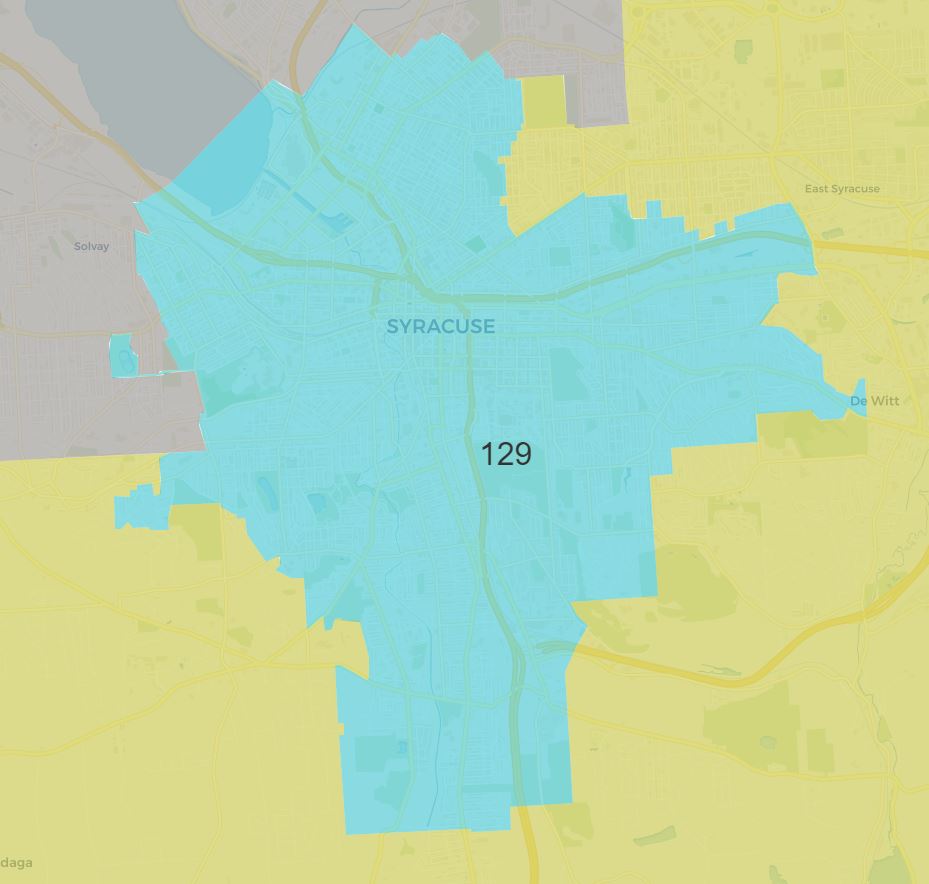
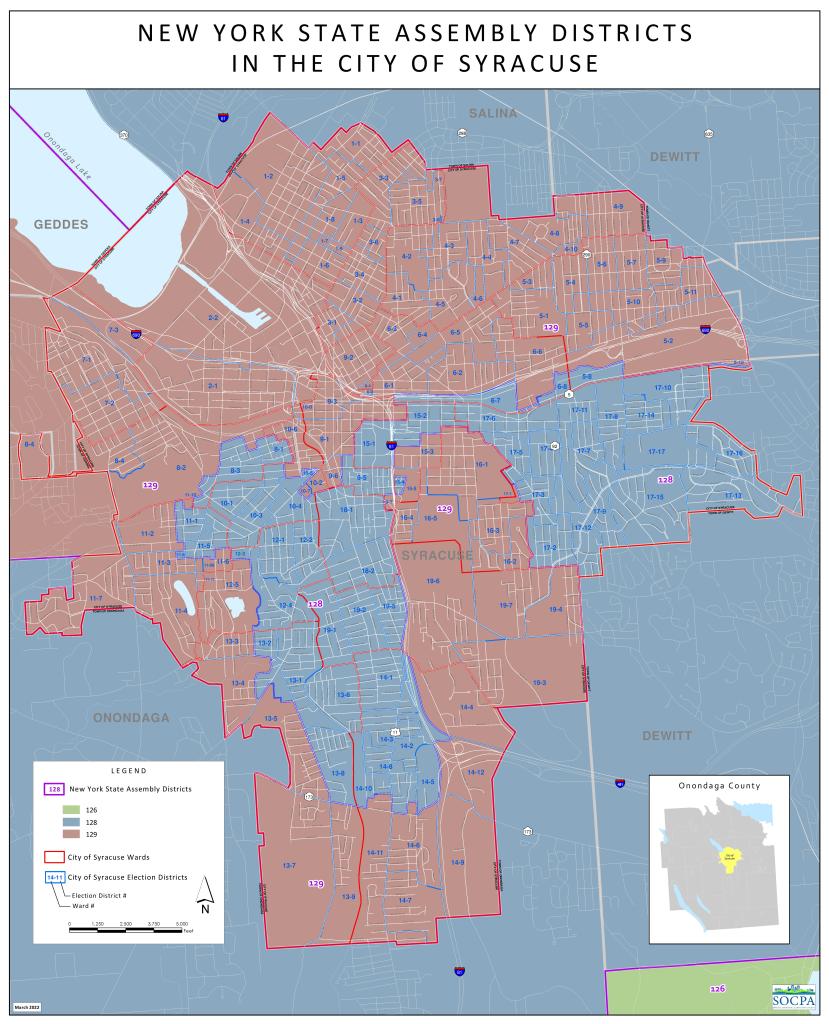
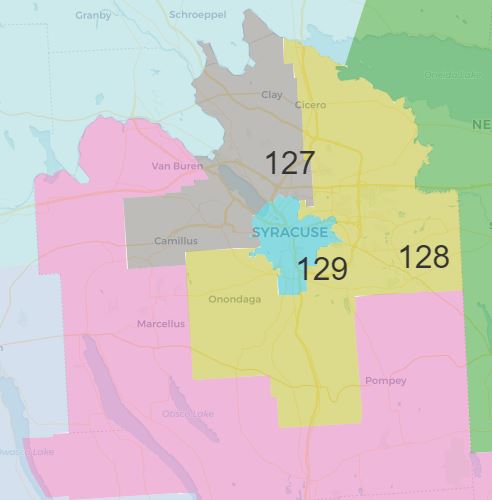
The NYSIRC map changes the way Syracuse is divided into two assembly districts.  The City of Syracuse must be divided into two different Assembly districts due to its large population.  For at least the last 20 years the City of Syracuse has been divided into two nearly equal portions population wise and paired with suburban towns.  The NYSIRC chose to handle this division by having one Assembly district wholly inside the City of Syracuse and then a small portion of the city paired with some suburban towns and some rural towns.  The division the NYSIRC made in Syracuse puts that portion of the city in a district so divided it could be lost in Representation.

Urban populations have drastically different needs than their suburban and rural counterparts.  It is much preferred to pair equal parts of Syracuse with the Towns that share borders with them, like Dewitt, Onondaga, Geddes, & Salina.  The new proposed 128 does pair the Eastwood portion of the City with Dewitt, however including Cicero & Manlius, exurban towns, and Lafayette a rural town, joins the city residents with disparate and different communities that will drown out the city residents.  The Town of Onondaga does share a border with the city, but it is on the complete opposite side of Syracuse than the small section of the city it is paired with.

While I believe the City of Syracuse is better served with being equally divided and paired with towns that share the borders, if the NYSIRC insists on taking a small portion of the city to par with these towns, the Southeast corner of the city in the 17th Ward would be a better match to share with the communities in Cicero, Dewitt, Lafayette, Manlius, and Onondaga.  If the NYSIRC wants to improve on the City of Syracuse division from the Assembly map it could look at a different division.  Instead of having one Assembly district take inner city neighborhoods with a small connection through the east side to the suburban communities while the other district loops around, the commission could use more of the neighborhoods in the east side or university area giving a more cohesive and compact shape to the districts inside the city.

Division of Towns traditionally paired together will split up communities of interest.

Unfortunately, outside the City of Syracuse the draft map by the NYSIRC also misses the mark.  While I commend the NYSIRC effort to keep towns whole in Onondaga County.   Removing Lysander from an Assembly district that has other neighbors in Onondaga County will in effect less those citizens voices as it is paired with rural smaller Oswego County which has different needs from their representative.  Splitting up the towns of Clay and Cicero ignores that they not only share the village of North Syracuse but will have common interests going forward with the introduction of the Micron development and the residents that will be coming here in the next ten years.  As stated in the section above, Lafayette being paired with larger towns and the City of Syracuse threatens to put that town as the odd man out in that district.

In conclusion the NYSIRC should scrap its draft map and adopt a least change Assembly map based on the bipartisan maps passed in 2022.  The maps in 2022 were not found to be a partisan gerrymander and elected representation that gave more power to the minority party in 2022.  Keeping the 2022 legislatively drawn map with minor changes is the best option so far into this cycle.  This would resolve the technicality found by the court while keeping the communities together that have already elected representation. 

The Weekly Wonk: The Village of Manlius

Welcome back to the #WeeklyWonk. Each weekend I release an article on a subject relating to elections in Onondaga County and New York State. Often these articles will have detailed stats to consume but sometimes they will be a recap of a prominent issue or on relevant election law. I am turning my eye to the 2023 elections. This week I take a break from looking at the political subdivisions and focus on a work item from the Onondaga County Board of elections. Today I look at the Village of Manlius who is having a special election this March.

The Village of Manlius is located inside the Town of Manlius.  The Village Board and Mayor have decided to hold their elections in the traditional March election period.  The Onondaga County Board of Elections have been running the Village of Manlius elections for over ten years.  It is only recently The Town of Manlius Democratic Committee started running candidates on the Democratic line in 2022 when a Manlius Village Judge to fill vacancy and is doing so again this year for the regularly scheduled village board election.  Thus, it is a great subject for my #WeeklyWonk series.

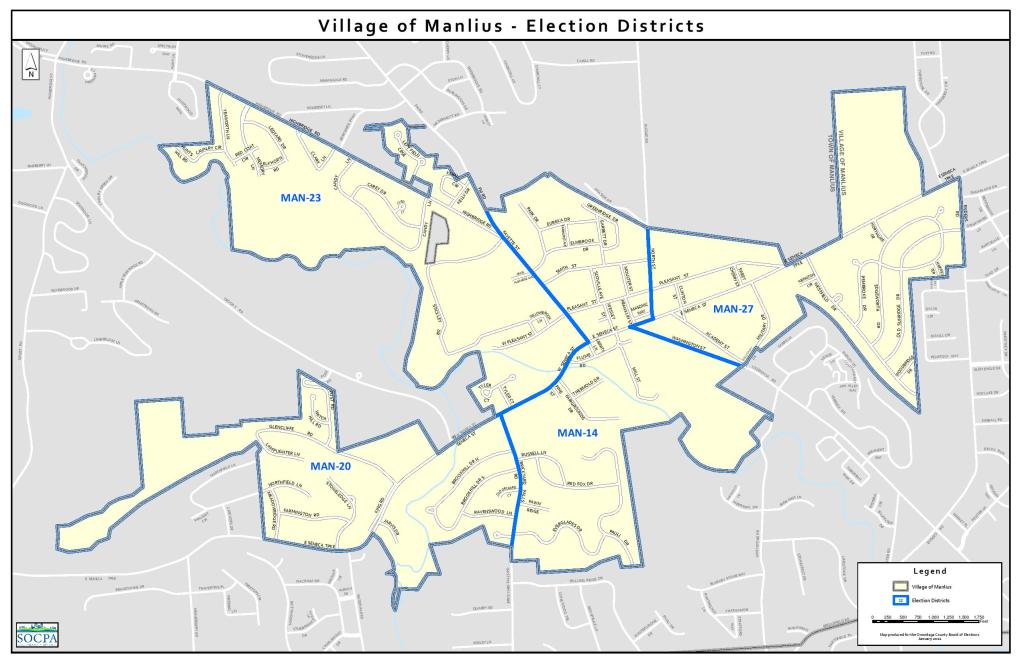
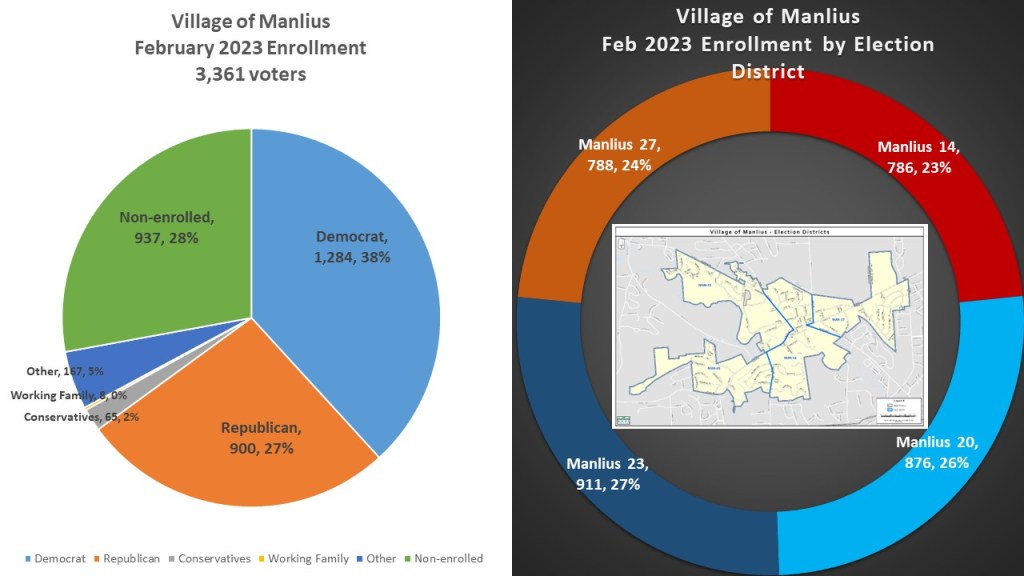
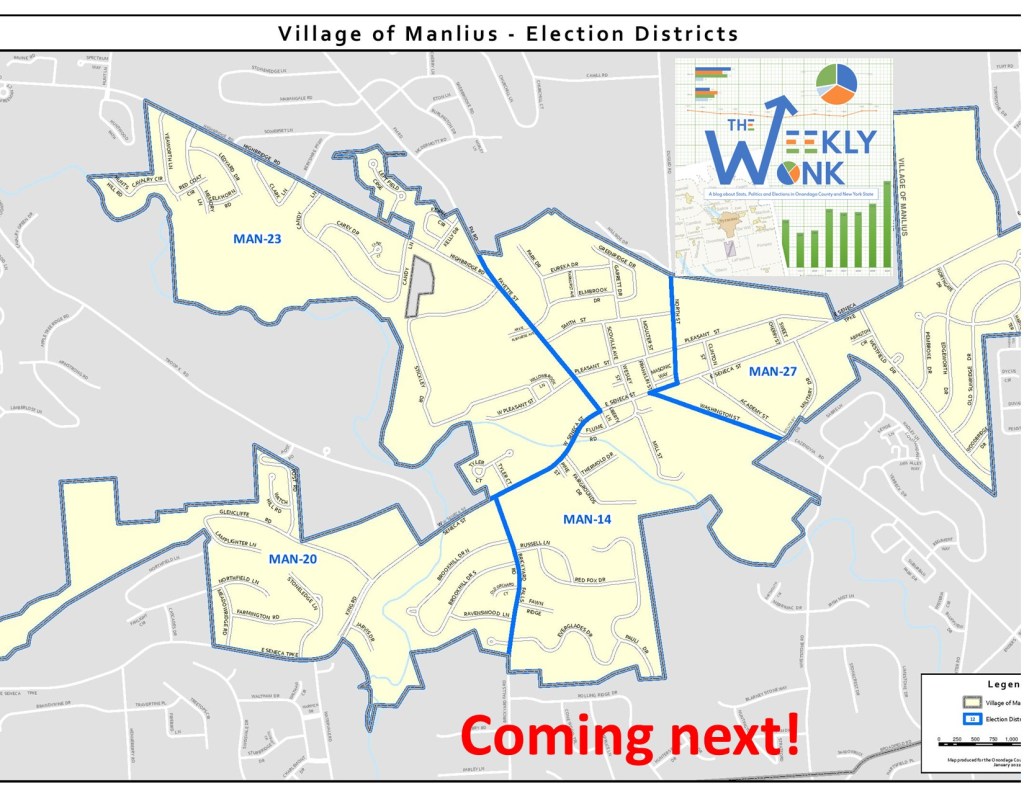
The Village of Manlius has 3,361 voters.  The Village of Manlius partisan breakdown shows a strong Democratic lean.  Democrats have 1284 (38%) of the active registered voters, 937 (28%) are registered as non-enrolled, and in third place 900 (27%) are registered GOP.  With non-enrolled outnumbering GOP and Democrats well in first place it is typical of the other strong Democratic communities in our county.  The village is split into four different election districts, Manlius 14, 20, 23, & 27.  They are remarkably similar in size, with the largest being Manlius 23 at 911 voters (27%) and the smallest being Manlius 14 at 786 (23%).

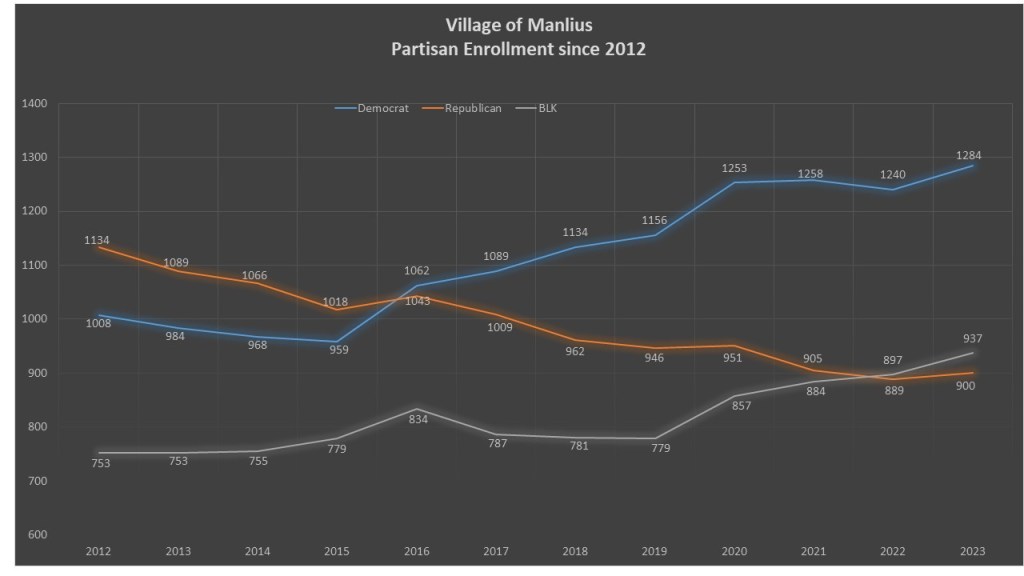
The Village of Manlius, like the other suburban communities, have undergone a transformation.  Once a dominant GOP village, the community was losing GOP voters on a steady pace until 2016 when the Trump election saw large party changes in suburban communities.  Since 2012 Democrats have gained 276 voters while the GOP have lost 234 voters.  Democrats had the most gains but the non-enrolled have seen a gain of 184 voters, and in 2022 they overtook the GOP as second in the village.

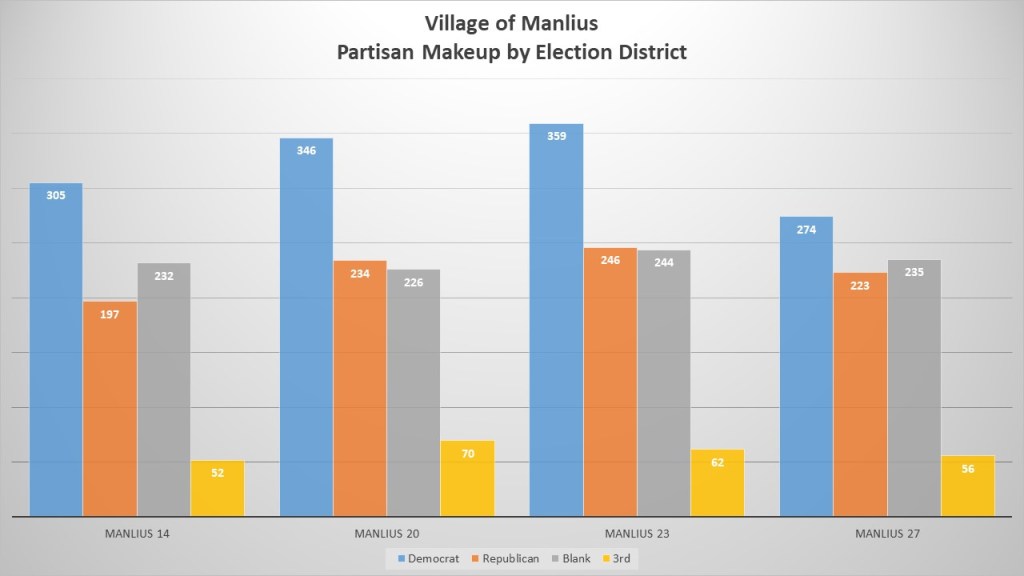
When we look at the four election districts in Manlius, we see a village that has strong Democratic communities in each corner.  Democrats have strong pluralities in each of the four election districts.    The strongest registration advantage is in Manlius 14 where the GOP is well in third place.  Manlius 20 & 23 have strong Democratic pluralities however the GOP are ahead, if barely, the non-enrolled voters.  Manlius 2 is the most even district with the smallest Gap between the GOP and Democrat but interestingly the non-enrolled have overtaken the GOP here as well.

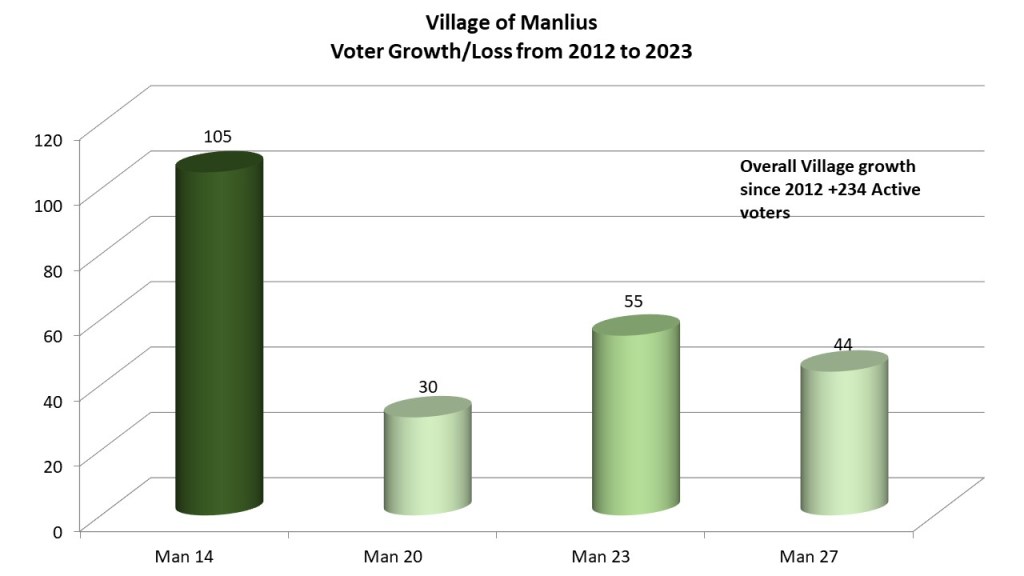
When we look at voter growth the village of Manlius has gained 234 voters since 2012.  The lions share of that growth has been in Election District 14 gaining 105 voters despite it being the smallest Election District.  This is followed by 55 voters in Manlius 23 which is the largest ED.  Manlius 27 has gained 44 voters.  Showing the least growth is Manlius 20 with only 30 votes.

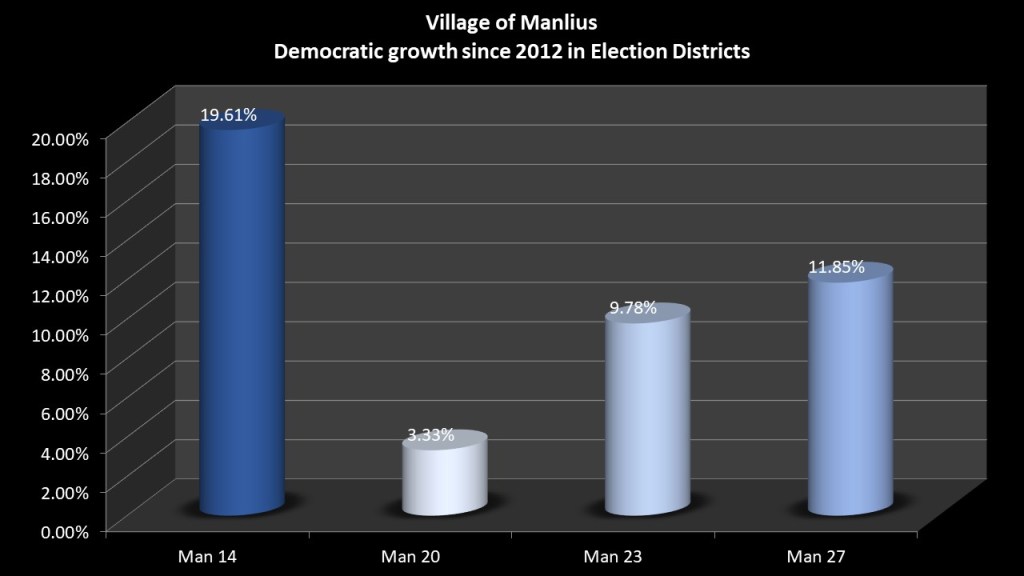
In terms of Democratic growth, we see a correlation with overall voter growth.  The ED that had the largest growth since 2012 also saw the most Democratic growth.  ED 14 has seen a growth of 19.61% in the Democratic plurality in the ED.  ED 20, which had the least overall growth, has seen only a 3.33% increase in the Democratic plurality.  Manlius 27 and Manlius 23 had similar Democratic growth and saw similar Democratic growth.  Manlius 27 saw a growth of 11.85% and Manlius 23 saw a growth of 9.78%.

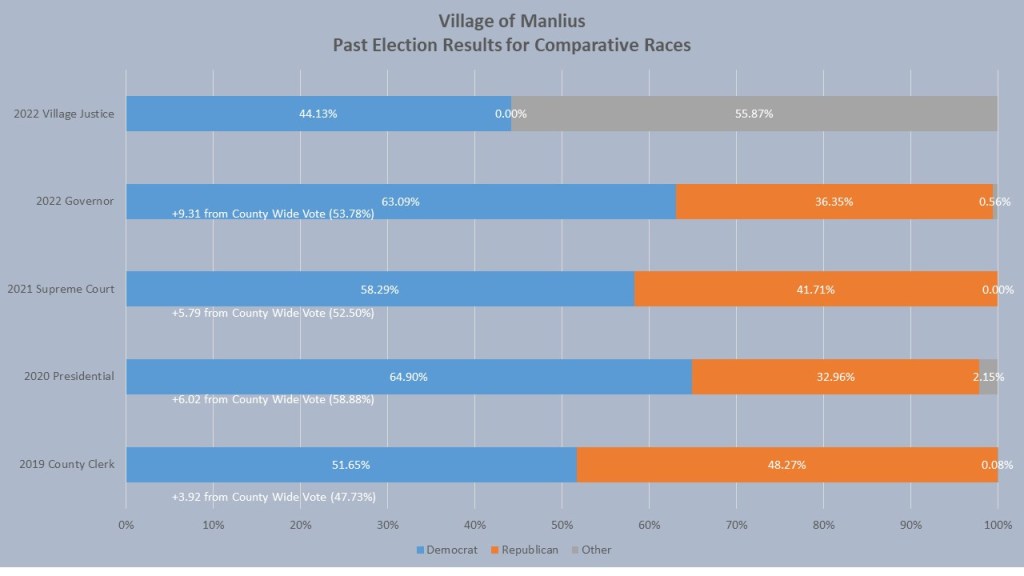
When we look at the comparative races, we see a village that solidly votes Democratic in November, but more evenly split when a March village election happens.  In the 2022 Governor’s Race the village of Manlius voted for Governor Hochul by 63.09%, 9.31% more than the rest of Onondaga County.  In 2021 the Village of Manlius voted for Democrat Ant%, 6.02% more than Onondaga County as a whole.  Despite losing Onondaga County, Mark Kolinski carried the Village of Manlius with 51.65% in the 2019 County Clerk race, +3.92% ahead of the countywide results.  The race for Village justice in March last year did not go the Democrats way with only 44.13% of the village voting for the Democratic candidate.  The GOP does not run candidates on their party line preferring to run on independent nomination lines and they won the 2022 Village justice race with over 55% of the vote.

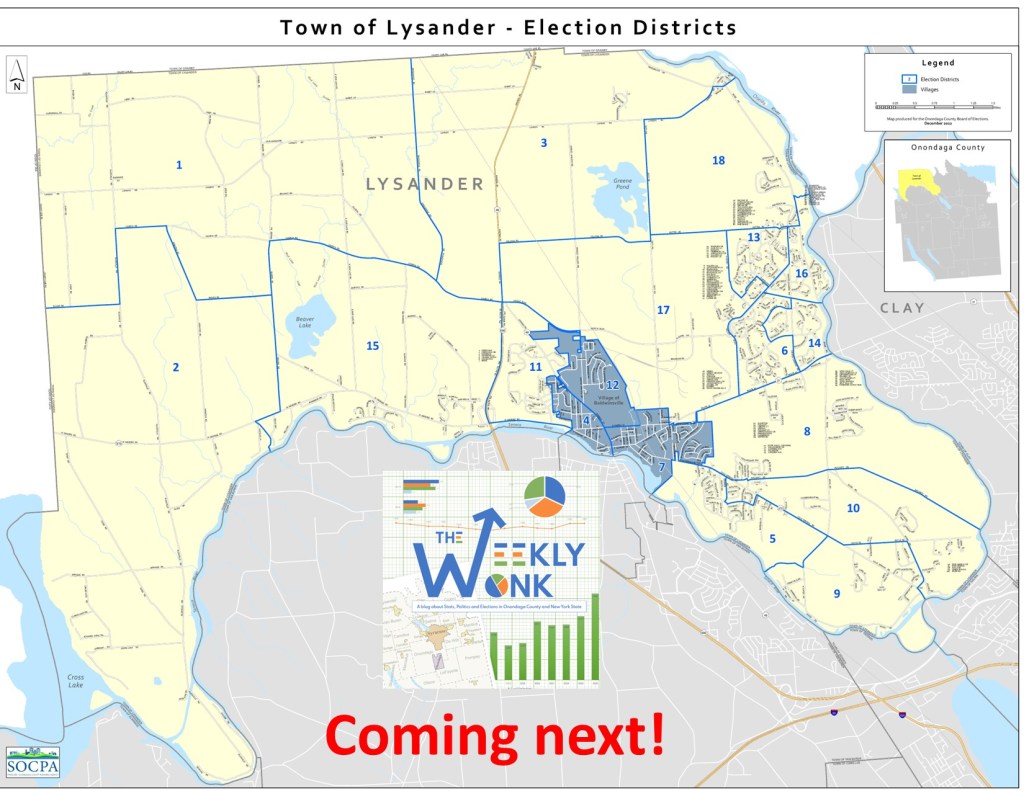
That is, it for my look at the March village elections in 2023.  Only the villages of Fayetteville and Manlius have Democrats running in this year’s March elections.  There are also village elections in Baldwinsville, Fabius, Jordan, and Skaneateles.  Those elections are run by the village clerk and the Democrats aren’t running candidates on their party line, so I am not analyzing them this year.  Next week I start to focus on the Towns of Onondaga County.  I will be starting with the towns that the Democrats are running candidates using designating petitions instead of caucus, Lysander, Manlius, Salina, and Spafford.  Next week we look at Lysander where Democrats have had recent success despite a heavy GOP enrollment.  Remember to subscribe to dustinczarny.com for all election news and content updates.

Zoom with Czarny: Ben Weinberg Citizens Union

In this week’s show I welcome Ben Weinberg of Citizens Union. His organization has recently authored a white paper on increasing turnout in NYC elections by moving them to even years. We also talk about how that might apply statewide. Enjoy.

Subscribe to dustinczarny.com for all content and election news updates

Supplemental Testimony before The New York State Assembly & New York State Senate

On February 15th I appeared as a panelist on the Joint Legislative Budget Hearing on Local Government Officials/ General Government. You can see my original testimony here as well as read my prepared remarks. Below is my supplemental testimony to answer questions that were under time constraints at the hearing.

Supplemental Testimony before The New York State Assembly & New York State Senate

Joint Legislative Budget Hearing on Local Government Officials/ General Government

Wednesday, March 1, 2023.

Dustin M. Czarny, NYSECA Democratic Caucus Chair

On February 15, 2023, I appeared before the Joint legislative Budget Hearing on Local Government Officials/General Government.  In the question-and-answer session several topics were discussed that time wasn’t allotted for full answers.  Here are my expanded answers on a few of the topics raised:

Even Year Elections (Senator Rachel May, Senator Rhodes, Senator Martins)

Stemming from discussion among several questioners I wanted to clarify my position on moving some municipal elections to even years.  The NYS Elections Commissioner Association as well as the Democratic Caucus that I chair has not voiced an official opinion on this proposed legislation.  Personally, I believe any move that will result in more voter participation is worthy of discussion. 

My first concern is on ballot length where logistically Throwing every elected office every two years could result in longer ballots and even two-page ballots.  However, that concern does not inherently prohibit my eventual support of this legislation.  I note that we actually have a ballot length issue in odd year elections.  There are generally more offices up in local years leading to longer ballots with further drop off in low turnout elections.  It does seem that moving some of those elections to even years could actually alleviate the ballot drop off issue.  It is also reasonable to believe that even with ballot drop off from the top of the ticket to the bottom that simply placing these elections in even years where voter participation can be well over 200% in odd years that more citizens would be making choices in their government is a benefit that would outweigh ballot length issues.

I believe that moving elections that service high number of voters should be targeted first for moving to even years.  Moving Countywide and County legislator elections first would actually even out the ballot length issues.  There would need to be constitutional changes for cities to move their elections and it may be worth waiting for that constitutional process to happen before moving towns and villages as well.  This way we could phase in these moves giving Boards of Elections time to implement the change.

Absentee Ballot Applications on Election Day (Assemblyman Jacobsen)

The NYS Elections Commissioner Association has given Bi-Partisan support for a mechanism that would allow Elections Commissioners flexibility to issue absentee ballots on Election Day, as proposed by Assemblyman Jacobson in A111.  Late emerging circumstances are a reality of our election process.  Currently on Election Day infirmed individuals have no explicit process to receive an absentee.  Giving commissioners the ability to approve Election Day absentee requests will allow those who have late unavoidable circumstances to still cast a ballot.

Full Time Commissioners (Assemblyman Jacobson, Senator Walczyk)

The NYS Elections Commissioner Association has given Bi-Partisan support for fulltime commissioners statewide.  Outside of NYC that have commissioners that meet monthly where executive director’s take the administrative leave, there are 17 counties currently that have part time commissioners ranging from Broome County with 120k voters to Schuyler County with 12k voters.  There are 40 other counties with full time commissioners, 26 of those counties fall into the same voter range as the 17 counties that have decided to have part-time commissioners. 

The modern elections commissioner must navigate heavier workflows and keep up with Electoral reforms.  In 2019 the political calendar changed moving the primary from September to June.  We also added in Early Voting and portable registration that same year.  In 2022 we added pre-canvassing of Absentee ballots that happen the 45 days preceding an election.  The implementation of online voter registration with the DMV in 2016 has increased our voter registration work and that will expand later this year with the new 10-day constitutional minimums and online and automatic voter registration. 

With all these improvements to out electoral system it has become necessary for commissioners to make daily decisions now more than ever.  Part time commissioners are often doing full time work for less pay and are leaving the profession.  We need full time dedicated commissioners to carryout the demanding job of our new political calendar.  Furthermore, fulltime positions will attract the best candidates to serve as elections commissioners and alleviate concerns over conflicts of interest created by the demands of finding other employment.

Voter Identification (Senator Rhodes)

We have limited voter identification in New York.  We currently require a voter to be verified upon registering to vote either through the Department of Motor Vehicles or Social Security Administration.  If a new voter is unable to do so, upon presenting themselves at the polls they will be required to furnish one of several pieces of identification.  After their initial voting experience we rely on the bipartisan checks at the polling places including signature checks to identify voters.  If a polling inspector believes a signature to be suspect, they can challenge voters and if they fail the challenge process an affidavit ballot that will be investigated post-election can be used.

This system has worked remarkably well.  By all independent accounts there is very little fraud in our system.  A 2014 study by the Washington post identified 31 credible instances of impersonation fraud from 200 to 2014, out of one billion votes cast.  In a 2017 study by the Brennan Center found that instances of voter fraud were so small it is more likely an American “will be struck by lightning than that he will impersonate another voter at the polls.”.  In fact the most high profile instances of recent voter fraud, such as voters double voting with dual residencies or the troubling instances in Rennsselaer county  revolve around absentee voting fraud.  Such fraud while unfortunate and rare would not be resolved by an in-person voter identification requirement.

Voter Identification, as implemented in every state that has required it, is suppressive in it’s very nature.  Often it acts as a barrier to younger, elderly, minority, and economically distressed populations.  There is usually a cost to voter identification creating an inherent poll tax for many eligible voters.  Also there are usually discrepancies in what is considered valid IDS, often state issued student IDS are not deemed valid but gun and hunting licenses are.  The Brennan Center has collected a comprehensive list of third party studies that show the suppressive nature of voting id laws.

Since In-Person Voting Fraud has been proven to be rare and a non-factor in US elections.  Voter ID has been shown to be suppressive in nature and cost prohibitive in implementation.  IN short, Voter ID laws are a solution pretending to fix a non-existent problem while creating many other problems that would have a negative effect on our electoral system.  It is not needed in New York in my professional opinion.

Urban falloff in voter participation (Senator Martins)

In response to Senator Martins question about a disparity in turnout in suburban and urban parts of his district, this is not abnormal behavior.  Urban populations tend to have many factors that have lower turnout.  Urban populations are younger and poorer than their suburban counterparts.  Both of those populations have many social and economic reasons that result in lower participation in elections.  Also lack of competition in urban areas can hurt their performance in a General Election.  High polarization has left cities being dominated by single parties and often after the primary election there are no viable general election races.  The same can be found in the most rural parts of our state as well.

This underscores the need for an investment by New York in funds for Voter Education.  This is a bi-partisan request of the New York Elections Commissioner Association and often left out of county budgets who fund our Bi-partisan Election Boards.  These funds can be targeted to traditionally low turnout populations to educate on polling hours, location, and ballot options for those voters.

Village Elections in the Fall (Assemblyman Brown)

I am a proponent of moving village elections out of the March and June calendars and into the November.  In my county we have encouraged 5 of our 17 villages to move elections to the November calendar.  Those 5 villages are about as different as can be.  We have a large partisan village that run on party lines (Solvay), 1 small partisan village in Elbridge that runs on party lines, one larger village in East Syracuse that runs on non-partisan lines, and two small villages Camillus and Tully that traditionally run on non-partisan lines.  In all 5 villages the move to November saved them 100% of their election costs and saw turnout increases from 25% to 900% in their elections.  None of the non-partisan villages were forced to run on party lines.  I reject the notion that smaller turnout electorates are somehow better at deciding their elected leadership.  In general the higher rate of turnout results in elected leadership that is more connected with all of their residents needs and supported by that same electorate.

I also believe it is unfair to village clerks to expect them to carry out the modern election reforms that we have in New York.  March and June Village elections run by village clerks are not required to have the absentee voting practices of pre-canvass and curing of ballots.  They also often do not have access to modern voting equipment and ballot design and have resulted in some of the While village elections run by Boards of Elections do result in better run elections and some access to absentee reforms for the village voters, other reforms are still absent.  March and June village elections do not have Early Voting and affidavit ballot voting.  Village voters deserve access to these reforms and is one of the reasons why Village elections should happen in November with other elections.

Dustin M. Czarny

Commissioner (D), Onondaga County

Democratic Caucus Chair, NYS Elections Commissioner Association.
Commissioner in a Car: Designating Petitions begin today.

Welcome to the official beginning of the NY political season as designating petitions start today. Volunteers are going around door to door to get heir candidates on the ballot. I tell you why in this podcast. Enjoy.

https://anchor.fmzoomwithczarny

Subscribe to dustinczarny.com for all content and election news updates

The Weekly Wonk: The Village of Fayetteville

Welcome back to the #WeeklyWonk. Each weekend I release an article on a subject relating to elections in Onondaga County and New York State. Often these articles will have detailed stats to consume but sometimes they will be a recap of a prominent issue or on relevant election law. I am turning my eye to the 2023 elections. This week I take a break from looking at the political subdivisions and focus on a work item from the Onondaga County Board of elections. Today I look at the Village of Fayetteville who is having a special election this March.

The Village of Fayetteville is located inside the Town of Manlius.  Villages The Village Board and Mayor have decided to hold their elections in the traditional March election period.  Normally their elections are on even years, just having a village elections last year.  That is also the first year the Onondaga County Board of Elections ran this village election, after a problematic ballot in 2020. There is a special election this year to fill a vacancy of a village board member this year. The Town Of Manlius Democratic Committee started running candidates on the Democratic line in 2022 and thus it is a great subject for my #WeeklyWonk series.

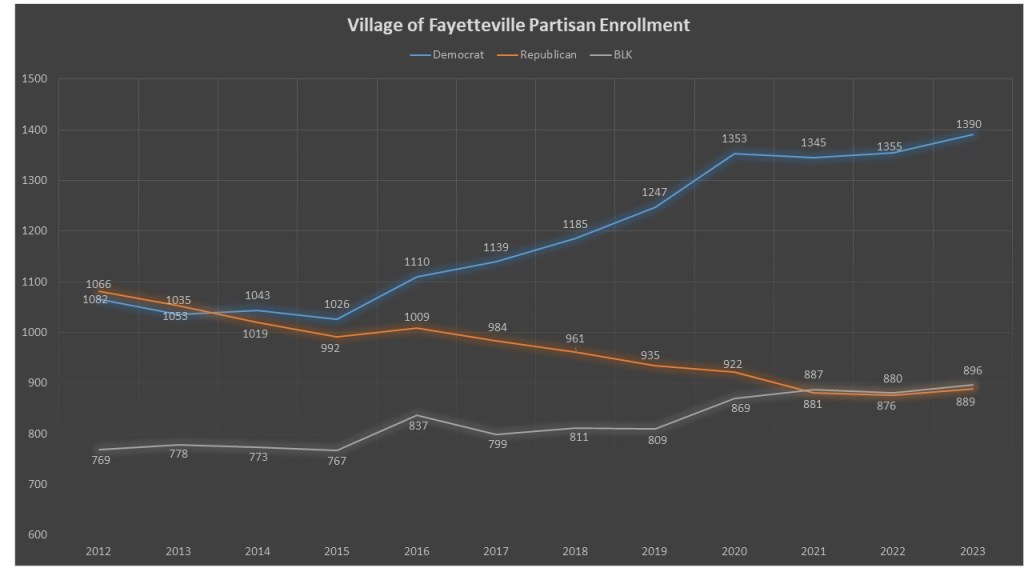
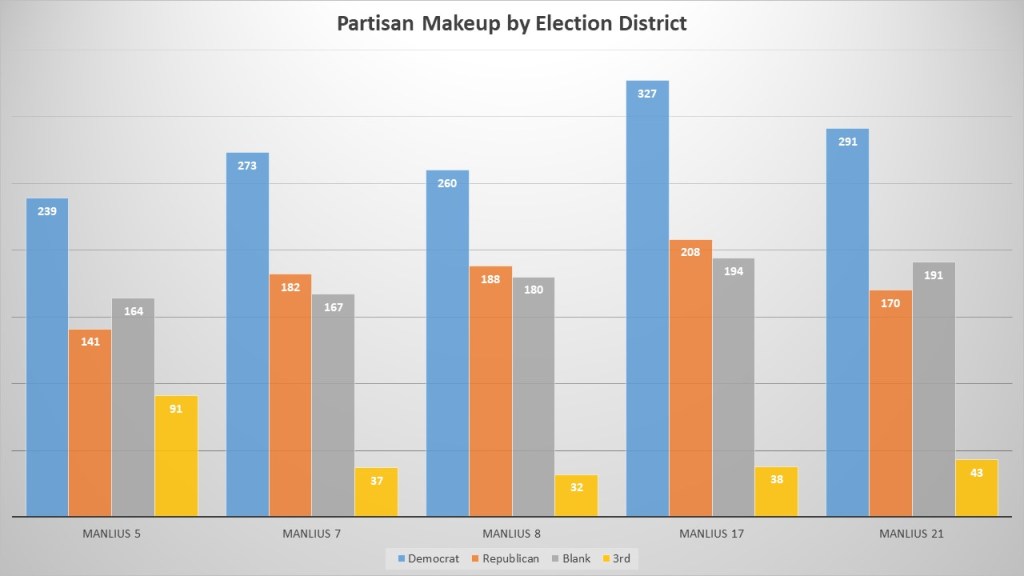
The Village of Fayetteville has morphed into a strong Democratic plurality community.  Democrats have 41% of the electorate. The Non-enrolled actually now outnumbers the GOP at 27% to the GOP 26%.  This type of enrollment advantage is probably why we see the Town of Manlius Democratic committee running candidates on partisan lines while the Town of Manlius GOP committee has decided not to.  This changes from village to village and we see the opposite in GOP run villages like Elbridge and Liverpool.  The Village of Fayetteville is made up of five different Election Districts, Manlius 5,7,8,17, & 21.  The largest voter population is in 17 (23%) and smallest in 5 (17%), with 7 (19%), 8 (20%), and 21 (21%) lumped in the middle.

In 2012 the Onondaga County Board of Elections started to place the villages inside election district boundaries after the redistricting year.  This allows us to run their elections if they wish as well as make it easier to track voter registration over time.  The Village of Fayetteville has experiences the changes we have seen in the Town of Manlius overall, a definitive switch to Democratic enrollment.  Democrats have gained 308 voters and the GOP has lost 177 voters since 2012.  The non-enrolled voter has gained 127 voters.

When we look at the election district partisan breakdown, we see that Democrats in enrollment dominate each ED as well.  Manlius 17 has the largest Democratic enrollment as well as partisan advantage to GOP.  Manlius 5 and Manlius 21 the non-enrolled outnumber the GOP as well.  But even in Manlius 7 & 8 have large Democratic enrollments now.

The Village of Fayetteville voter enrollment has grown moderately since 2012 gaining 258 voters or a growth of 7.66%. The 3 most Democratically leaning eds, Manlius 5, 17, & 21 also happen to be the ones showing the lions share of the growth since 2012.  Manlius 7 & 8, the more traditionally aligned eds, and Eds that were once GOP, are some of the smaller growths in voter population for the village.

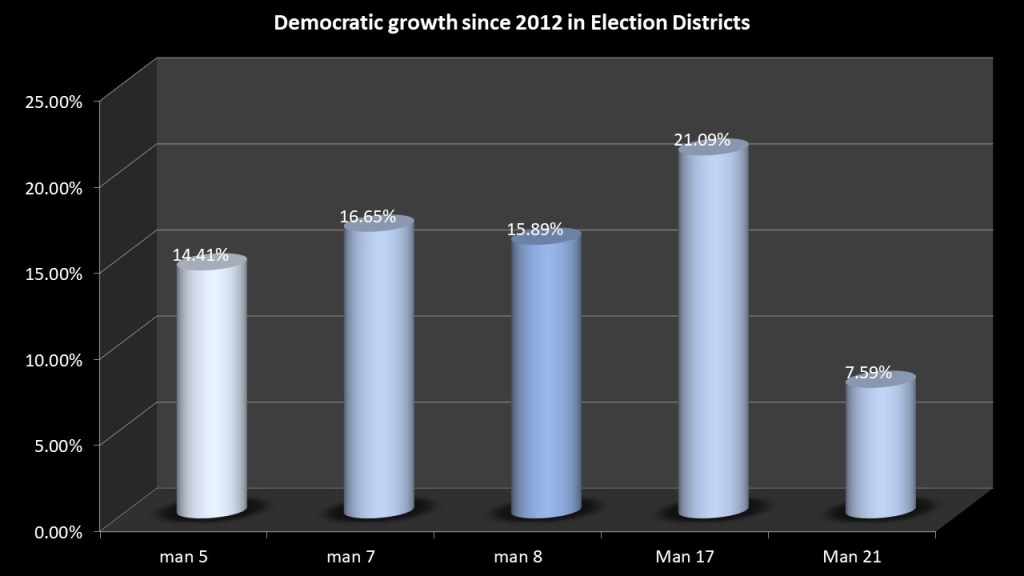
The Democratic growth in each ED is outpacing the voter growth in four of the 5 eds.  Manlius 21 was already fairly Democratic in 2012 so it the partisan advantage got better, but not dramatically so (Dem +7.59% gain). Manlius 7 (Dem +16.65% gain), 8 (Dem +15.89% gain), & 17 (Dem +21.09% gain) were GOP districts in 2012 and flipped to Democratic districts in 2023 showing the most growth.  Manlius 5 was a slightly Democratic district in 2012 and have become a solidly Democratic district now (Dem +14.41% gain).

When it comes to comparative races the village of Fayetteville performs as a solidly Democratic subdivision.  In all 4 of the comparative races the Village of Fayetteville outperforms Onondaga County as a whole.  In 2022 for Governor it gave Kathy Hochuli Democrat 64.30% of the vote, +10.52 points from her countywide win.  In 2021 it voted for Anthony Brindisi Democrat for Supreme Court garnered 60.30%, +7.80 points from his countywide win (though he lost in other counties). In 2020 Joe Biden won Fayetteville with 66.96% of the vote, +8.08% from his countywide win.  And in 2019 Mark Kolinski won Fayetteville with 55.03% of the vote, improving on his countywide loss by +7.30%.  The last village election is not included because it was a vote for two village board election with Democrats running 2candidates and a 3rd candidate running on a non-partisan line so it doesn’t compare well  However those results were Democrat & Fayetteville Neighbors party Mark Matt 583 votes, Balance Party Mike Small 518 votes, Democrat and Fayetteville Neighbors Party Casey Cleary 471 votes.  In the 2023 March Village elections there is only one candidate for the Town village Board petition, Democrat Jane Rice is running on the Democratic line and another independent Fayetteville Voices line.

That is, it for this week’s edition of the Weekly Wonk.  Next week I will focus on the Village of Manlius who is also having an election in March.  For my #weeklyWonks this year I will be adding in villages that have partisan elections in them as well as my individual look at the towns, county legislature districts.  So, stay tuned. Subscribe to dustinczarny.com for all election news and content updates.

Democrats on the party changing its presidential primary calendar – WXXI Connections

I appeared on WXXI Connections to discuss the Democrats changing their primary calendar. You can listen to this hour long program below where I gave some insight on why I believe this was a good move and answered host and listener questions.

https://www.wxxinews.org/show/connections/2023-02-24/democrats-on-the-party-changing-its-presidential-primary-calendar

Zoom with Czarny Dana Balter and Karen Wharton of Citizen Action NY

This week I talk to an old friend, Dana Balter, and new friend Karen Wharton of Citizen Action NY. We dive deep into the public campaign finance system that launched this year for NY Assembly, Senate, and statewide offices starting in 2024. Enjoy.

Find out more about Citizen Action NY at https://citizenactionny.org/

Subscribe to dustinczarny.com for all content and election news updates.

Commissioner in a Car: Enrollment reports are pulled…signature requirements coming soon

This week I talk about the work the County Board of Elections is doing to get signature requirements and enrollment statistics done in time for next week’s start of designating petitions. Enjoy.

https://anchor.fm/zoomwithczarny

Subscribe to dustinczarny.com for all content and election news updates