The Weekly Wonk: The Towns of Onondaga County

Welcome back to the #WeeklyWonk. Each weekend I release an article on a subject relating to elections in Onondaga County and New York State. Often these articles will have detailed stats to consume but sometimes they will be a recap of a prominent issue or on relevant election law. I am turning my eye to the 2023 elections. Each week I hat will have races in them this fall. Today I am focusing on the towns of Onondaga County.

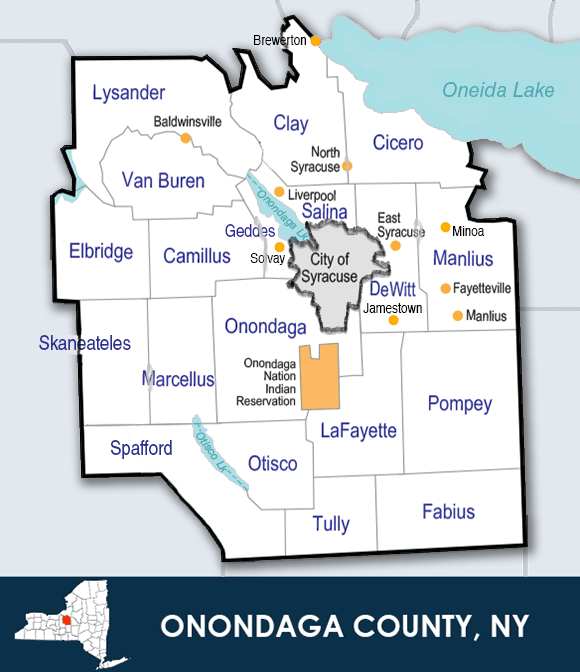
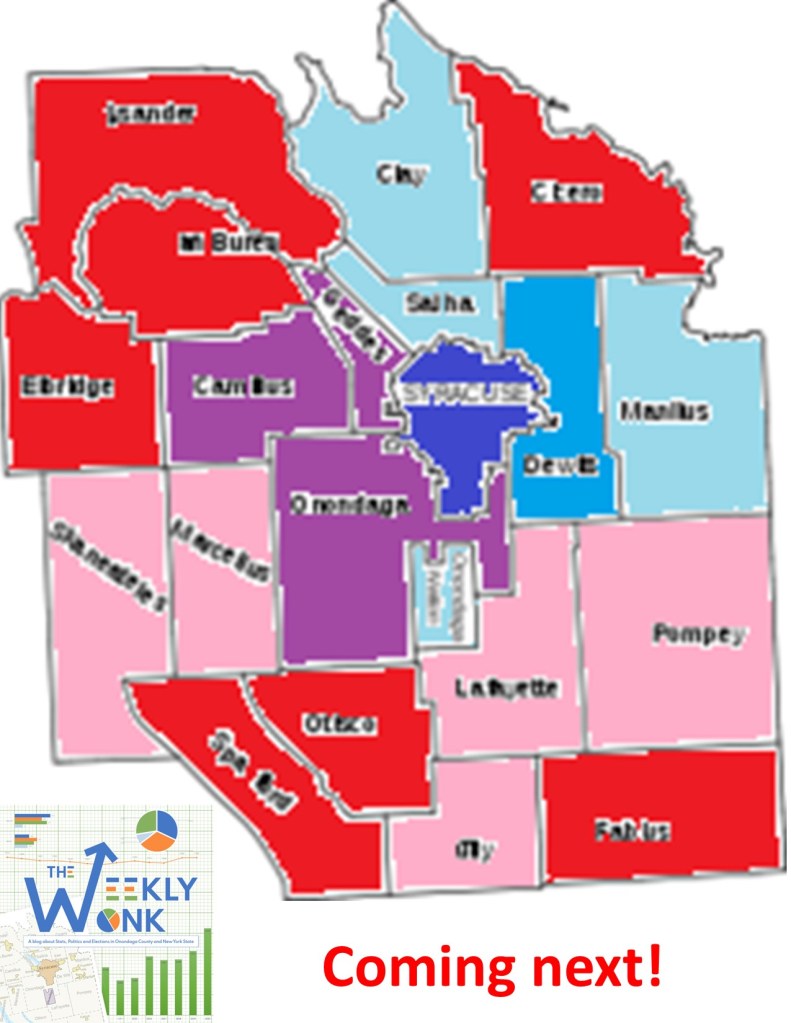
While the City of Syracuse is the primary focus of cultural and political news in Onondaga County, the towns are the most dominant force in county wide politics.  While Syracuse is mostly blue and pretty predictable, the towns have a variety of demographic makeups and sizes.  We have reliable blue towns like Dewitt and Marcellus that perform much like the city, strong Democratic support up and down the ticket in both local and federal years.  Towns like Clay, Geddes, & Salina that regularly perform well for Democrats in Federal years but have lagging support for local candidates. The rest of the towns generally have little support for Democratic candidates, even in federal years.

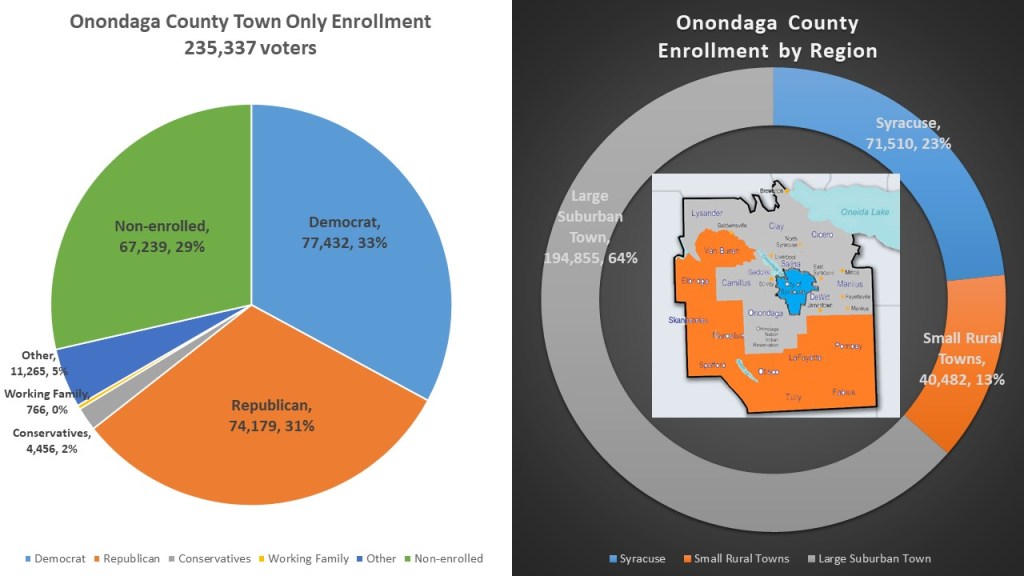
235,337 voters live outside of the City of Syracuse, roughly 75% of the voting population of Onondaga County. It is surprising to many that outside of the City of Syracuse Democrats do have a plurality of voters.  33% of the non-Syracuse voters are Democratic, 31% Republican, and 29% Non-enrolled.  Last week I broke the county into five different regions based on geography. For this week’s column I will be looking at the towns based on Demographic makeup.  In essence we have three types of communities in Central New York.  The City of Syracuse is the urban core of our county.  The “Large Suburban Towns” have over 10k voters and generally take on a more suburban feel.  The “Small Rural Towns” have under 10k voters and have a more agrarian makeup. Of course inside each town there are areas that fit both definitions so this is just a way to look at the makeup.  The Large Suburban Towns are generally in the center of our county surrounding Syracuse (Which has 23% of the voters) or the Northern Towns and make up 64% of the voting population.  The Small Rural Towns string along the southern and western borders and make up just 13% of the population.

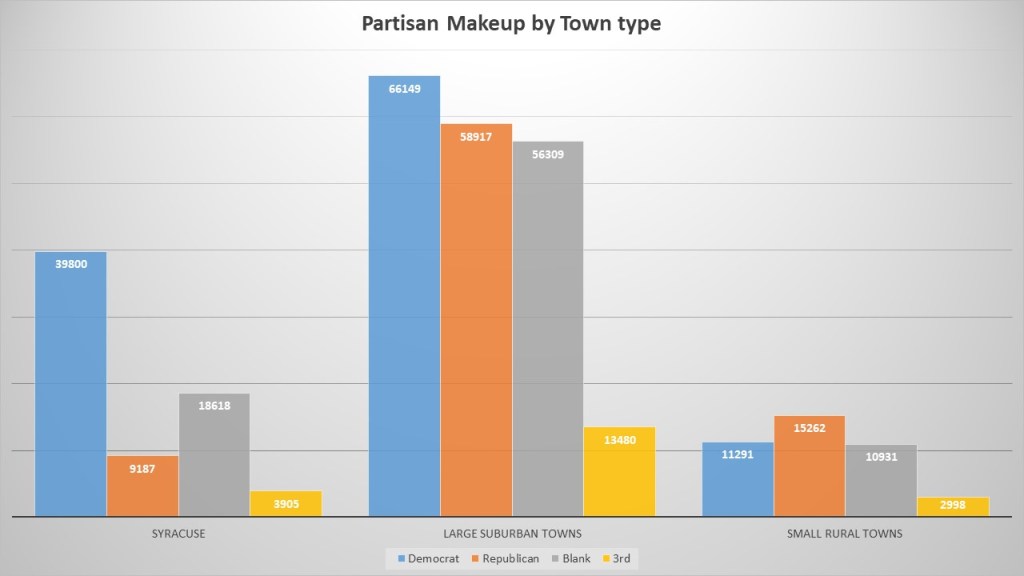
When we look at the Partisan makeup of the three regions of our county, we can see why Democrats have won the Onondaga County portion of twenty of the twenty-six races that had all of our county encompassed in it.  The City of Syracuse remains a dominant Democratic city with Democrats having nearly four times the number of GOP and Non-enrolled nearly doubling up the GOP.  The suburban towns on a whole also show a significant lead for Democrats with 7232 more voters and the non-enrolled is closing in with just 2,608 voters less than the GOP.  The GOP still have a decided edge in the small rural towns outnumbering Democrats by 3,971 voters and the non-enrolled trail the Democrats by just 360 voters.  The GOP dominance in the rural towns though is offset by the size and growth of the suburban towns and of course the City of Syracuse. 

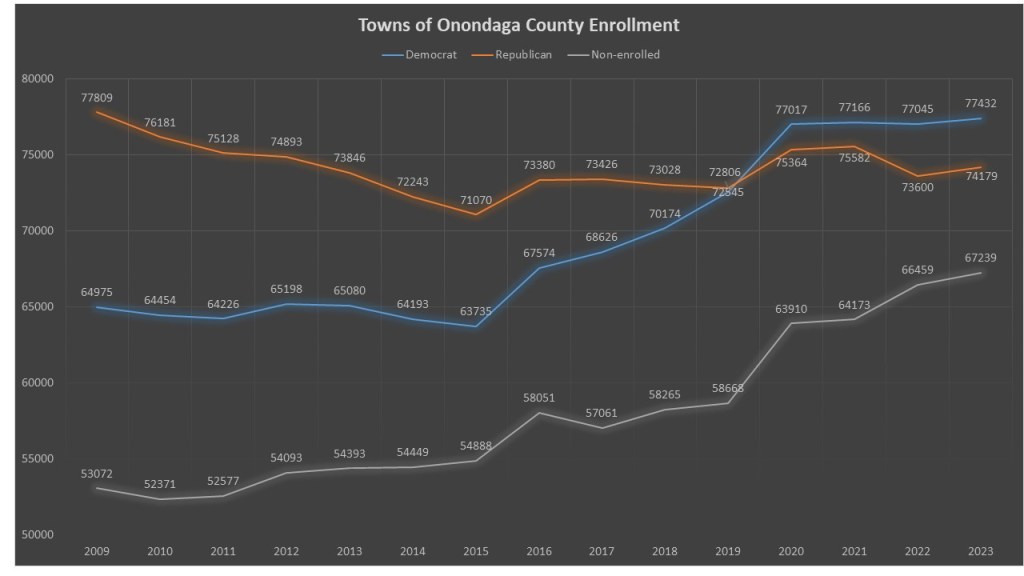
Since 2009 the Democrats have gained 12,457 voters, while the GOP has lost 3,630 voters. The Trump years definitely had its effect on the Central New York population. The growth of Democratic enrollment was most dramatically felt outside of the City of Syracuse. From 2009 to 2015 the GOP was losing voters and the Democrats for the most part were staying even.  However from 2015 to 2020 the Democrats had a dramatic increase in enrollment while the GOP actually stagnated for the most part.  Since 2020 the Democrats have remained stagnate while there has been some decrease on the GOP.  The most consistent rise has been the non-enrolled voters.  Since 2009 they have gained at a steady pace adding 14,167 voters.

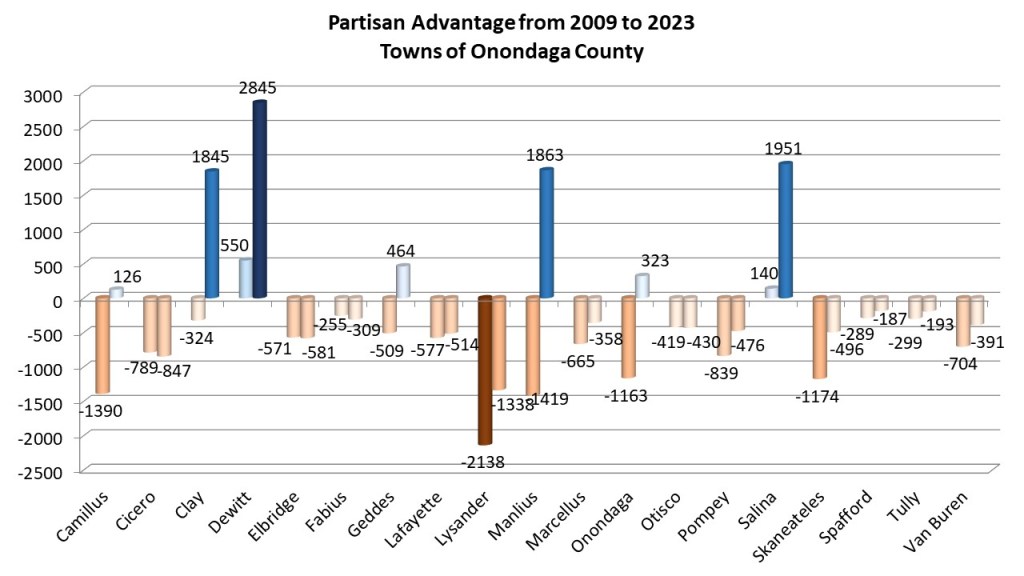
When we look at the individual towns and the changes from 2009 it highlights the gains Democrats have made are dramatic by localized in a few dramatic switches in large towns.  In 2009 only the Town of Dewitt had a small Democratic enrollment edge.  Now the Towns of Manlius, Salina, Clay, Camillus, Geddes, and Onondaga all have a Democratic plurality. Most notably is the large switch in Manlius, the 3rd most populous town shifting from a reliable GOP town to a reliable Democratic town.  In fact Democrats made numerical gains in all but Cicero, Elbridge, Fabius, & Otisco. 

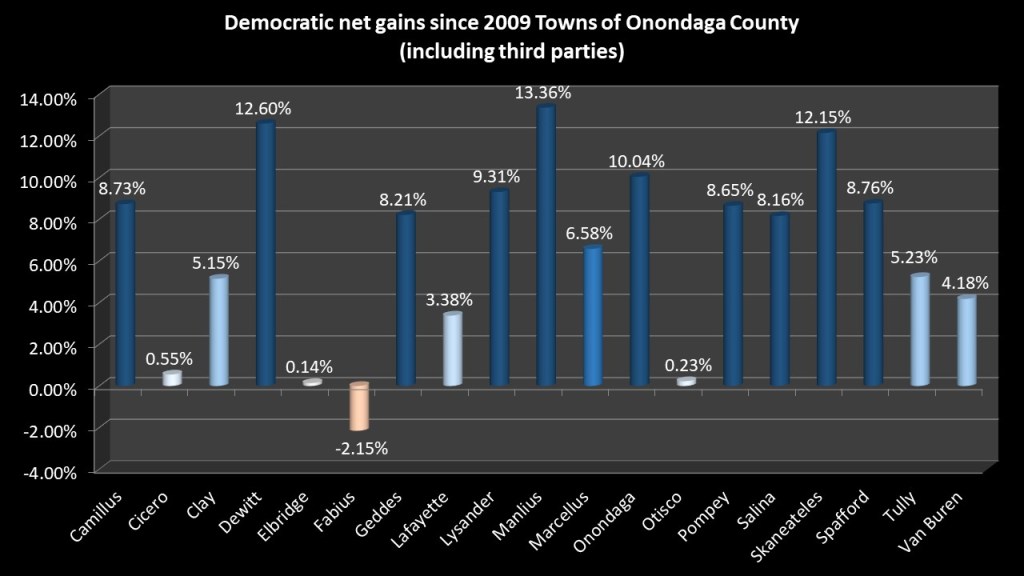
In towns though third parties have a dramatic impact, specially the Conservative party.  When you look at gains you have to include the Working Family Party registrants which are mostly aligned with Democrats, and the Conservative Party that mostly aligns with the GOP.  This chart shows the percentage gains inside each town when adding the third party in.  As towns grow and more non-enrolled voters grow the percentage of the Democratic faction has grown in 118 of the nineteen towns since 2009.  It is obvious that the Democratic towns of Dewitt & Manlius have large gains. It is also not surprising that the other towns that flipped Democrat such as Camillus, Clay, Geddes, Onondaga, & Salina are some of the higher gains as well.  What may surprise people is how much Democrats have increased their influence in solidly Red towns like Lysander, Skaneateles, Spafford, Pompey, and Marcellus.  Each of these towns have elected Democrats town wide recently even with a numerical disadvantage.  This growing influence certainly has helped. The only town that Democrats have not seen a statistical growth in influence if Fabius, however the growth in other red towns like Cicero, Elbridge, and Otisco are negligible.

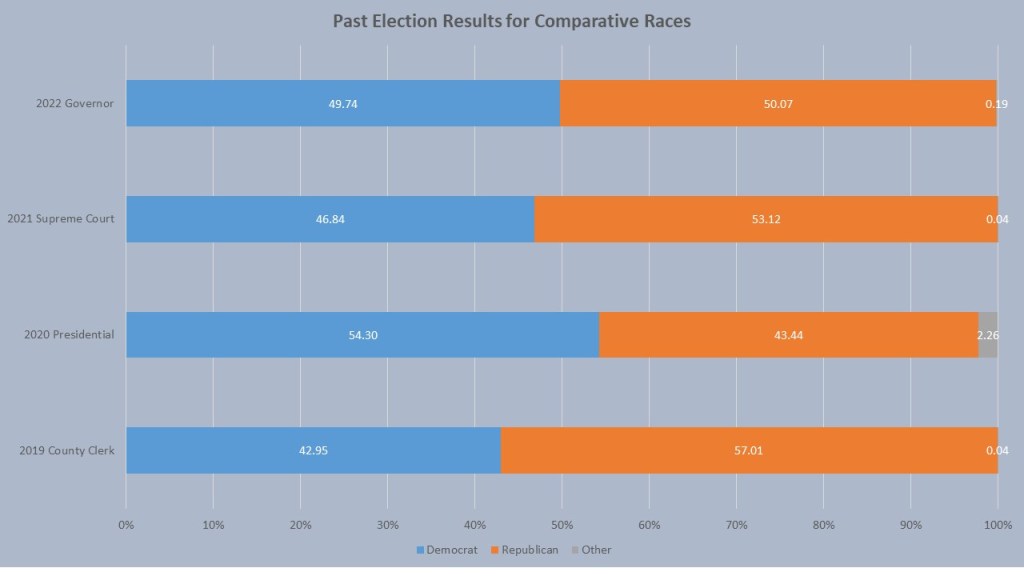
Finally we look at the four comparative races to give us a sense of how the towns as a group vote.  For the 2023 Weekly Wonks I am using one race from each of the last four years to demonstrate how a political subdivision can expect to perform.  For the federal years of 2022 and 2020 I chose the top of the ticket, Governor and President to show how a district can perform in high turnout years.  In the local years of 2021, I chose the most competitive race to give an idea, absent of individual campaign dynamics, the electorate might perform in odd years.  I chose a race in 2021 where the Democratic candidate carried Onondaga County (Brindisi for Supreme Court) and a race in 2019 where the GOP won Onondaga County (Dell for County Clerk).  I will try and throw in the most recent local race as well however no such race exists in just the towns.

Not surprisingly the Towns of Onondaga County reacted differently in each year and that can be accredited to turnout.  President Biden won with the largest margin of any competitive race in recent memory in Onondaga County and did so in the towns winning 54.30 % of the vote.  Governor Hochul ran basically even in 2022 in the towns picking up 49.74% of the vote. Brindisi was able to win Onondaga County by limiting his losses in the towns an winning 46.84% of the vote in 2021.  Mark Kolinski though in 2019 only won 42.95% of the town vote in 2019 and barely lost the County Clerk race.  It is pretty clear for a Democrat to win county wide they can lose the towns, but must win 45% of the vote and take advantage of the Town vote.

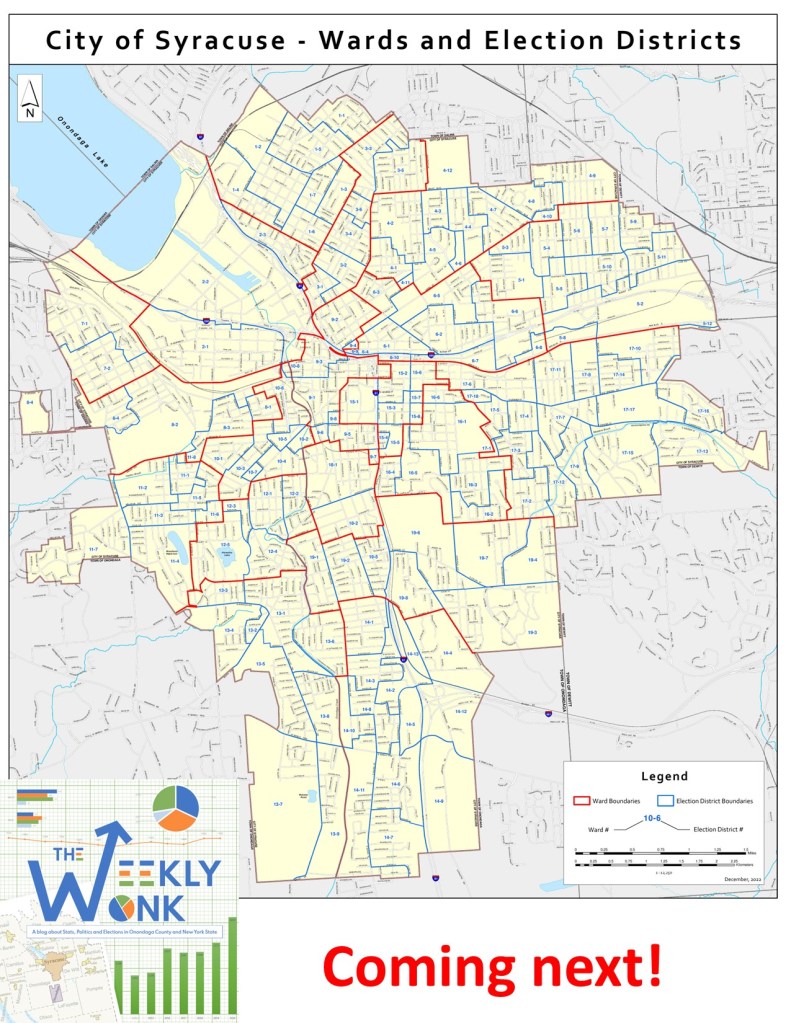
Next week I turn my attention to the City of Syracuse as a whole. Our registration vendor is currently applying the new common council and county leg maps and I don’t have statistics for those yet.  I plan to dedicate an individual Weekly Wonk to the changes in each of those once they are done.  Next week though I will focus on the City of Syracuse and toplines on the Wards inside the city.  Remember to subscribe to dustincarny.com for all election news and content updates.

Zoom with Czarny: Alec Lewis of O’Donnell and Associates

This week I speak to Alec Lewis of O’Donnell and Associates. Alec was recently employed by the New York State Senate Democratic Conference and shares some thoughts on NY state politics with the opening of the legislative session in New York and the State of the State. Enjoy.

https://anchor.fm/zoomwithczarny

Subscribe to dustinczarny.com for all content and election news updates

2023 NYS Elections Commissioner Association Democratic Caucus Legislative Priorities

(At last week’s NYSECA conference the NYSECA Legislative committee propsed a legislative package that was supported by both caucuses and with near unanimous support of the entire association. The Democratic Caucus of Commissioners have adopted all of these bi-partisan recemondations and hacve a few more we are making as a caucus in addition. Below is our official list of 2023 legislative priorities. This will be updated with bill numbers should they become available. We also have a list of other bills that members have asked us to support you can read here. )

Give Boards of Elections the ability to properly serve the voters of New York.

To meet the needs of our modern political calendar we propose the following reforms to Board of Election Offices to be passed as a singular package by the NYS Legislature:

  • Four-year terms for all boards of elections commissioners beginning the year after the gubernatorial election. (Bi-partisan support) (S6933/A4777). Read our Memorandum of Support.
  • Minimum staffing requirements set by the State Board of Elections for full time permanent employees for each Board of Election. (Bi-partisan support). (S644/A1258) Read our Memorandum of Support
  • Require all Commissioners in New York outside of the City of New York to be full time commissioners with salaries set based on a metric of County department heads within the host county, to be determined by the State Board of Elections (Bi-partisan support). (S611/A919) Read our Memorandum of Support

Since 2019, long awaited election reform has changed local Boards of Elections responsibilities without making the structural changes necessary for each county board to meet the needs of their voters.  Making these changes will allow County Commissioners the ability to strategically plan and bring year-round full-time management to the Board of Elections in every county.  In addition, each county will have the sufficient staffing needed to keep up with the increased voter registration and canvassing requirements they have been assigned under New York State Election Law.  All of these priorities have bi-partisan and near unanimous support amongst Election Commissioners.

Invest in our election system by providing the following funding streams in the New York State Budget.

  • Capital funding for replacement of aging voting equipment. Allow for reimbursement for any county that has replaced their voting fleet since January 2019. (Bi-partisan support).
  • Dedicated funding for voter outreach and media campaigns. (Bi-partisan support)
  • Properly fund the New York State Board of Elections and give the NYSBOE proper authority to promulgate regulations and enforce responsibilities outlined in state law. (Bi-partisan support)

County Board of Elections are desperate for dedicated funding to meet the technological needs required of the modern electoral landscape.  New precinct scanners, on-demand ballot printers, and electronic poll books have stretched the capital budgets of counties across New York.  We need dedicated funding to replace aging voting equipment annually.  We also need dedicated funding for media outreach and public education campaigns to inform the voters of all the changes in election law so they can properly cast their ballots.  Finally, it is essential that New York State properly and adequately fund the New York State Board of Elections.  They provide guidance to all County Board of Elections and must have the resources necessary to fulfill their ongoing responsibilities and provide oversight.

Provide flexibility for County Board of Election operations.

•             Allow for flexibility for designating non-enrolled inspectors to serve as Republican or Democratic inspectors. (Bi-partisan support)

Inspector recruitment in urban and rural areas is becoming problematic.  Adhering strictly to the partisan election inspectors is becoming unfeasible.  Allowing Boards of Elections to open some spots to non-enrolled or third-party voters may help ease the burden in hard to recruit areas.  Polling places should still be required to have at least 1 member of both major parties, but flexibility in staffing will allow for Boards to operate seamlessly throughout Early Voting and Election Day.

•             Grant County Election Commissioners independence and flexibility with respect to determining hours of operation. (Bi-partisan support)

Boards of Elections are unique entities.  They need flexibility to determine their own hours of operation to accommodate weekend and Early Voting as well as staying open on election deadlines.

Reform election law to provide clarity to better serve the election process.

Alter the Automatic hand recount in the following ways.

•             Reduce the threshold for triggering recounts in close elections to .25% and allow for alternative scan within the .25-50% range, while also reducing the minimum vote threshold to 10. (Bi-partisan support) S1014/A1259 Read our Memorandum of Support

•             Mandate the hand recount start after the final absentee canvass per regulations from the NYS Board of Elections. (Bi-partisan support)

•             Exempt all party position contests from the manual hand count. (Bi-partisan support)

The automatic hand-count has been in place for several election cycles.  We have learned that the precinct scanners are accurate.  Lowering the threshold for the hand-count will allow Board of Elections to only focus on the truly close races that have a chance of changing hands.  We must also stipulate that the hand-count should only start after initial certification allowing boards to properly prepare and sort ballots for counting.  Finally, we should exempt party positions from the hand count rule as these elections are routinely close but not close enough to switch winners and draw resources away from publicly held offices.

•             All cures should have a final received by date to allow for proper certification of our election on the last day of certification. (Bi-partisan support)

Absentee cures and the current timelines often can stretch beyond the certification date for the election.  To allow for proper certification and hand counting of close races we should have a final date for a cure to be received by the certification day for the election.

•             NY State should participate in cross state matching programs to keep our voter rolls accurate.

Accuracy of our voter rolls is paramount for running a successful election.  New York should participate in ERIC or another cross-state matching program so we can inactivate voters who have registered to vote in another state. 

•             Altering the highest municipality early voting law to lower the highest city threshold to at least 10,000 voters. (Bi-partisan support)

The alteration of the Early Voting statute to mandate an EV center in the highest City rather than municipality inside a county has created unforeseen issues.  Many counties have very small, incorporated cities that would mandate Early Voting centers away from more populous municipalities. Enacting a minimum voter threshold for a city will accomplish the goals of the legislature to make sure Urban areas have access to Early Voting while allowing counties with small cities to ensure more of their citizens get access to Early voting.

•             Encourage legislation denoting that all public offices within the state of New York be referred to in gender neutral terms on Primary and General election ballots. (Bi-partisan support)

In our modern world there is no need to still assign gender to political office.  This causes confusion when creating ballots, often having to place candidates in gender labelled positions that they do not identify with. Making all offices gender neutral will allow Boards of Elections make uniform ballots throughout all public offices.

Give Voters the resources they need to properly register and cast ballots.

Amend the New York State constitution by:

•             Restarting the Constitutional amendment on No Fault Absentees.

•             Restarting the constitutional amendment on Same day registration

Increasing the ability of voters to cast ballots by mail is an important priority.  Likewise, the ability to register to vote should be as flexible.  35 states and Washington DC have no-fault absentee voting.  22 states and Washington DC have same Day registration.  New York should start the years long process to amend our constitution to give voters a chance to choose these options in a high turnout election year.

•             Authorize the issuing of same-day absentee ballots in those instances when commissioners agree that health-related exigencies on or immediately prior to Election Day create hardship. (Bi-partisan support) A1111 Read our Memorandum of Support

Late emerging circumstances are a reality of our election process.  Currently on Election Day infirmed individuals have no explicit process to receive an absentee.  Giving commissioners the ability to approve Election Day absentee requests will allow those who have late unavoidable circumstances to still cast a ballot.

•             Designation Election Day as a non-attendance day for public school students. (Bi-partisan support) S2024A/A4294 Read our Memorandum of Support

It is harder to secure polling places with private institutions such as churches and businesses increasingly resistant to open doors.  In many communities the only HAVA compliant buildings with proper parking are schools.  Mandating a non-student attendance day on Election Day will balance the needs of protecting students while making these buildings available for the voting public.

•             Allow for Vote Centers on Election Day as well as Early Voting on a permissive basis. (Bi-partisan support) S5537A/A6939A Read our Memorandum of Support

With the adoption of on-demand ballot printers and electronic polling books we have the tools to take the next logical step in our Election Day experience.  We already allow voters to travel to the most convenient Early Voting center, we should allow, as a permissive reform, Boards of Elections to allow Vote Centers on Election Day. 

(Bi-partisan support) Indicates a common goal with the NYS Elections Commissioner Association overall Legislative Agenda as Approved  by bi-partisan Elections Commissioners in January 2023.

Subscribe to dustinczarny.com for content and election news updates
Commissioner in a Car: Recap of the NYSECA winter conference.

This week I recap the NYSECA winter conference last week. I also go over the legislative agenda agreed to on a bi-partisan basis that will be the focus of our requests to Albany this year.

https://anchor.fm/zoomwithczarny

Subscribe to dustinczarny.com for content and election news updates

The Weekly Wonk: Onondaga County 2023

Welcome back to the #WeeklyWonk. Each weekend I release an article on a subject relating to elections in Onondaga County and New York State. Often these articles will have detailed stats to consume but sometimes they will be a recap of a prominent issue or on relevant election law. I am turning my eye to the 2023 elections.  Each week I hat will have races in them this fall.  I start with my annual look at our home, Onondaga County.

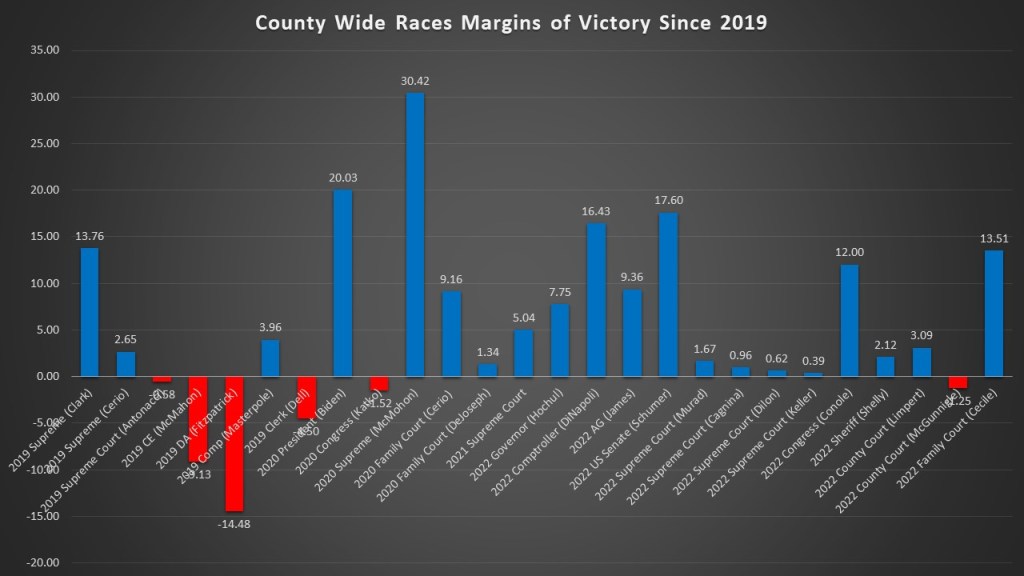
2023 is what is known as our County-wide office year.  Running County wide this year we have County Executive, County Clerk, District Attorney, and County Comptroller.  For years county-wide offices were solely the domain of the GOP, but Democrats have had recent success.  In 2019 Marty Masterpole was the first Democrat to win county wide office in decades and Bernadette Romano Clark won Onondaga County in her re-election campaign for Supreme Court and despite losing Julie Cerio carried the Onondaga portion of the district.  In 2020 President Biden easily won Onondaga County. Julie Cerio and Christie DeJospeh won both Family court seats and Rory McMahon won Onondaga County by a wide Margin helping him win election to Supreme Court.  In 2021 despite losing his Supreme Court bid, Anthony Brindisi won Onondaga County. 

In 2022 Toby Shelly also won Sheriff and Ted Limpert won County Court Judge and Julie Cecile won re-election for Family Court.  in 2022.  All four statewide offices, all four statewide offices Governor, Comptroller, Attorney General, and Senator carried Onondaga County.  Fran Conole for Congress and all four Supreme Court candidates carried Onondaga County in their losing campaigns.  All in all, Democrats have won or carried their Onondaga County portions of their contest in 20 of 26 races since 2019, and 4 of 8 in lower turnout odd years.  In fact one race, the 2020 Congressional could have gone Democrats way if not for a split race on the WFP line due to a technicality.

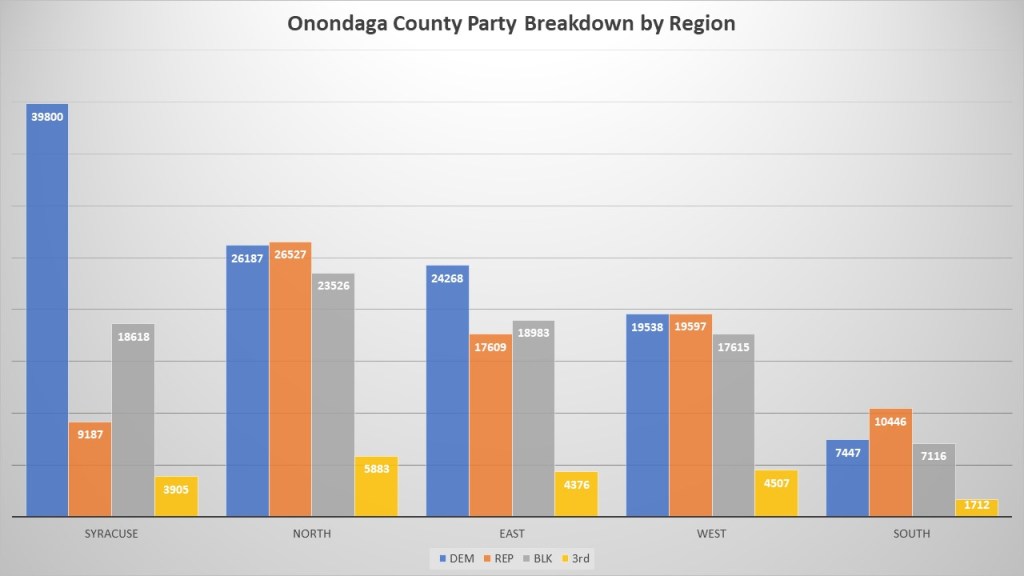
This is borne out by the current registration advantages Democrats have in Onondaga County.  Democrats have a significant advantage with 117,240 registrants (38%).  The GOP has 83,366 registrants (27%) but is actually 3rd in the county behind non-enrolled voters at 85,858 (28%).  Conservatives at 5,127 (2%) and Working Families at 1,277 (>1%) are the two other recognized parties.  They are dwarfed though by the 13,979 voters who are enrolled in now defunct parties or truly minor lines.  I classify Onondaga County into 5 main regions.  First is the City of Syracuse a major blue leaning city in the middle.  The Eastern Democratic towns (Dewitt, Manlius & Salina) that make up the biggest swath of Democratic voters outside the City of Syracuse.  The Northern Towns of Cicero, Clay, & Lysander that are more conservative leaning in local years.  The Western Towns of Camillus, Elbridge, Geddes, Onondaga, and Van Buren which swing from year to year and candidate to candidate.  Finally, we have the agrarian southern towns of Fabius, Lafayette, Marcellus, Otisco, Pompey, Skaneateles, & Tully that are some of the most consistently GOP dominated towns in our county. In terms of voter population the Northern towns have the most registered voters at 82,123 (27%) followed by the City of Syracuse 71,510 (23%), the Eastern towns 65,063 voters (21%), the Western Towns 61,257 (20%) and the southern towns 26,894 (9%).

Registrations in Onondaga County are once again nearing the all-time high.  I have data going back to 1996 from the State Board.   Our current Registration as of this last week is 306,847 voters.  Our all-time high is 308,296 voters going into the Presidential election of 2020.  We have yet to do our National Change of Address and mail check cards this year which could take significant voters off the rolls.  However we are seeing that the patterns of high registration rates we saw between 2016 and 2020 are holding true for this cycle.  It may be that the old patterns of falling registrations in between Presidential cycles are broken when the advent of DMV online registrations in 2016.  With general online voter registration and automatic voter registrations coming this year we could see a massive increase of registrations going into the 2024 election.

If we look at the history of Onondaga County in registration we see the dramatic change this county has undertaken.  In 1996 this was a solidly GOP county with a major Republican advantage.  In 2008 Democrats overtook them in registrations during the Obama election.  Since 1996 Democrats have gained 31,540 voters while the GOP has lost 22,756 voters.  The non-enrolled have gained 13,292 voters in that time frame.  The data indicates that Democrats are gaining with newer voters, whether younger or transplants while the GOP voter base is aging and moving out of the area or passing away.  In addition, since 2016 we have seen large shifts to the non-enrolled base, possibly from disaffected GOP.  In 2021 the Non-enrolled finally overtook the GOP county wide and is now firmly in 2nd place.

The regional breakdowns of Onondaga County show that Democrats don’t just have opportunities in the city.  There is growing influence in the suburbs as well.  Syracuse is by far the bluest of the county.  The Eastern towns is where Democrats also do well when running county wide.  The southern towns, though small, tilt so heavily red they are able to influence close county races.  The Western and Northern towns as a whole are swing towns when looked at collectively.  However next week we will dive into the individual regions we will see some towns are red and some blue and a few truly swing towns.

If we really look into the partisan spread of Onondaga County there is some interesting data.  We see that the Democrats were gaining in influence gradually in Onondaga County right up to 2008.  It then seemed to kick into second gear during Obama’s first term (2008-2012) growing by over 235%.  It started to stall in Obama’s second term (2012-2016) gaining just over 40%.  The Trump years (2016-2020) gave a jump start to the Democratic enrollment advantage growing by nearly 50%.  However, since 2020 Democrats have only grown their advantage by a little over 2% and there are signs of stagnation and even a slight dip as of late.

Finally its time to look at the comparative races for Onondaga County.  In this section I will see how a political subdivision does when compared to some races from the past few years,  The four control races I will use in every political subdivision are the 2022 Governor year (moderate Dem result), the 2021 Supreme Court (small Dem result), the 2020 Presidential (major Dem result), and the 2019 County Clerk race (small GOP result).  I also look at the previous results in races in the subdivision, so I added in the 2019 County Executive, Comptroller, and District Attorney results as well.  Here we see Onondaga County outpaced the average result in New York for the Governor’s race.  We also see that Biden crushed Onondaga County as well.  Higher turnout elections and the county tends to be blue.  However lower turnout elections does not necessarily prove doom for the right candidate.  Brindisi for Supreme Court in 2021 and Masterpole for comptroller in 2019 shows that Democrats can win.  Certainly McMahon’s county executive race is a solid GOP win, it was also the worst a GOP County Executive candidate has performed.  Likewise the 2020 County Clerk race shows a closer than expected result with the Democrat virtually having no campaign at all.  Finally the DA’s race has the widest margin for a Republican beating a Democrat in the last 26 county wide races, however it is also one of the smallest majorities seen in 2019 due to a 3rd party candidate.  This shows a possible opening for a Democrat who can also attract conservative support.

That does it for my first look at 2023.  Next week I will delve into the towns of Onondaga County as I take a look at the general performance of the voters outside the City of Syracuse.  We will look at the overall trends of the towns as a group and some insights to the regional and individual tendencies.  Subscribe to dustinczarny.com for all content and election news updates.

The Weekly Wonk: Onondaga County Election Day and Overall Turnout

Welcome back to the #WeeklyWonk. Each weekend I release an article on a subject relating to elections in Onondaga County and New York State. Often these articles will have detailed stats to consume but sometimes they will be a recap of a prominent issue or on relevant election law. I previously broke down each election in four parts but since the 2022 General Election did not get certified until December 21, 2022, I am a little behind. So, for the 2022 General I am breaking my lookbacks into two parts. Last week I did Part 1 Alternative Voting Methods (Early, Absentee & Affidavit voting). This week I conclude with Part 2:  Election Day and Overall Turnout.

We started General Election 2022 with 304,495 voters. Overall, 171,212 ballots were cast in the 2022 Election. That results in 56.23% turnout. This is the second highest mid-term election turnout since 2009 besting 2010, & 2014 but a little behind the record year of 2018. Overall, 65,995 Democrats showed up making up 39% of the electorate. They were followed by the GOP (55,936, 33%) non-enrolled (38,346, 22%), Other (7108, 4%) that are mostly former Independence voters, Conservatives (3,392, 4%), and Working Families (435, <1%). Its notable that the third parties of CON and WFP have much fewer registered voters who vote than votes cast on their lines.

Election Day voting was a remarkably different makeup than the alternative voting again this year. Democrats dominated Early and Absentee voting as we saw last week. The Election Day makeup was more even with 44,258 Democrats & 44,047 GOP checking in on Election Day both making up 35% each of the Election Day Electorate. They were followed by non-enrolled (28,862, 23%) and third-party voters (8,623 7%). There were more Election Day voters in 2022 (125,793) than in 2020 (121,044) despite significant lower turnout. However, that is because 2020 had a high percentage of EV and Absentee voters due to the COVID 1-19 crisis. If we ignore 202 as an anomaly this would be the third straight year that Election Day voting decreased as it was only 73.5% of the overall electorate. We are seeing that Election Day voting is decreasing among the populace in terms of percentage of the overall electorate of each election.

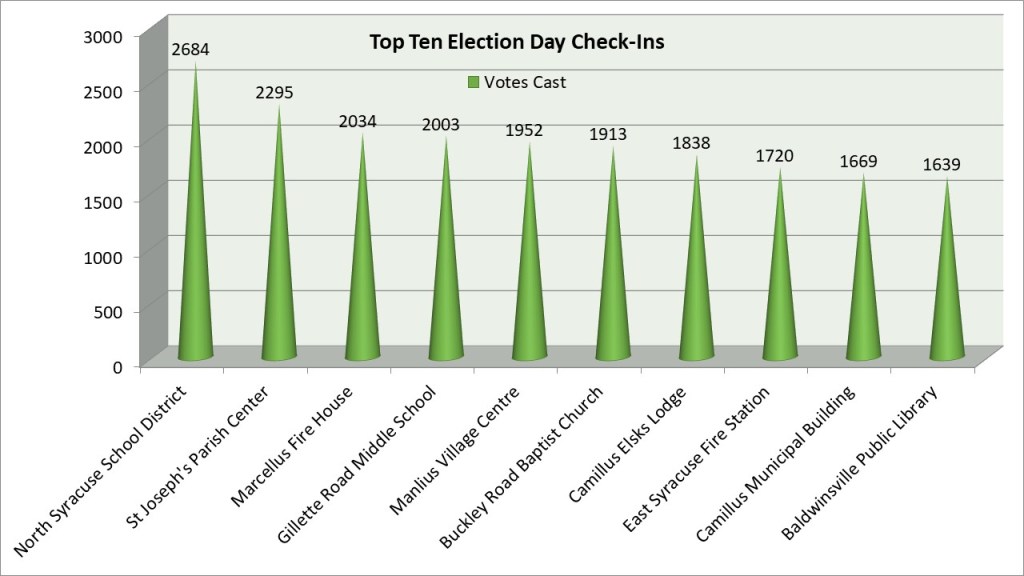
The top ten polling places on Election Day for the first time since I have been analyzing these elections are all in the suburbs. The North Syracuse School District offices was number 1 with 2684 check ins followed by St. Joseph’s Parish Center at number 2 with 2295 check ins. Both polling places were taking on extra voters due to losses of other polling places. We are looking at re-establishing more polling places to help them next year. Marcellus Fire House (2034), Gillette Road Middle School (2003), Manlius Village Center (1952), Buckley Road Baptist Church (1913), Camillus Elks Lodge (1838), E. Syracuse Fire Station (1720), Camillus Municipal Building (1669), & Baldwinsville Public Library (1639) round out the polling places on Election Day.

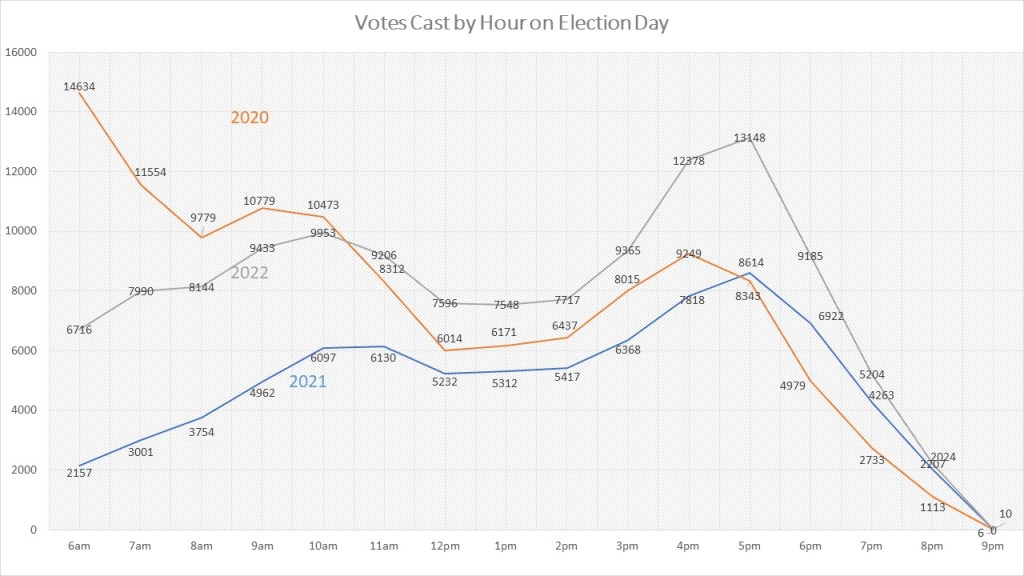
The hour-by-hour Election Day check ins for 2022 have the typical Election Day pattern. Starting off light in the morning then building to a small lunch rush. Then it dips again until the post work dinner rush which is the biggest portion of the day. It then drops sharply going into the close of polls at 9pm. 2020 of course was the anomaly with large voter check-ins in the morning. That paired with higher alternative voting percentages resulted in 2022 outpacing 2020 from 10am and after on Election Day. Luckily outside of moderate lines in North Syracuse our Election teams were able to process voters with little reported lines.

As we look at the regional breakdown for overall voting, we start to get a hint because Democrats had a decent election in Onondaga County, they could have been better. The City of Syracuse is the bluest area in Central New York. Despite the City of Syracuse only being about ¼ of the county its heavy blue makeup is vital for Democratic electoral chances. Unfortunately, only 41.31% of the voters of the City of Syracuse turned out. Compare that to 60.75% of the towns of Onondaga County turning out and we see a glaring difference. In fact, the 19.44% difference in turnout is the largest I show on record since 2009. Democrats will need to re-energize and implement a better GOP plan in the city to be successful.

It was not just regional issues hurting Democrats in Onondaga County, it was voter enthusiasm. Sixty-eight percent of Onondaga County GOP voters turned out in 2022. That is just under the turnout percentage they had last midterm. Democrats however had just 57% of their electorate turnout. While Democrats always lag the GOP in turnout percentage as the GOP electorate is older and more likely to turn out, the 11% differential is the worst since 2014. Even worse was the turnout % of non-enrolled voters who only showed up at 45%. The difference between them and the top spot of 23% was the worst since at least 2009. Democrats destroy their enrollment advantage by not turning out at the same rate of the GOP and when the non-enrolled do not show up as well it makes electoral victories harder.

With this #WeeklyWonk I end my look back at 2022. Next week I will start to look at the 2023 registration data. I will start out by looking at Onondaga County as a whole. 2023 is our County wide election year with County Executive, County Comptroller, County Clerk, and District Attorney are on the ballot. Tune in next week to see how the registration of our home looks as we start to get into the 2023 calendar year.

Subscribe to dustinczarny.com for all content and election news updates.

Lawsuit against Onondaga County legislative maps wins first major legal milestone.

On January 12, 2023 we won a major victory in our lawsuit against Onondaga County Legislative maps. The County has spent the last three months delaying our suit asking for it to be dismissed on a technicality instead of defending their illegal maps. Their motion has now been dismissed and we can now move to trial.

We still need help. As this lawsuit progresses we will have appeals and depositions. We can can win this suit with your help. Please donate what you can to our cause here: https://secure.actblue.com/donate/ocdcddf

Below is our press release, the order dismissing their attempt to stop our suit, and a page I have dedicated on my website for all things relating to this lawsuit.

FOR IMMEDIATE RELEASE

Friday, January 13, 2023

Contact: Max Ruckdeschel, Chair (315) 484-3120

COUNTY LEGISLATURE REDISTRICTING LAWSUIT ADVANCES“We will not stop fighting until the residents of Onondaga County have fair maps for their legislature.”– Max Ruckdeschel, Onondaga County Democratic Committee Chair

Syracuse, NY – The Onondaga County Democratic Committee (OCDC) applauds the ruling filed Thursday by Supreme Court Justice Joseph E. Lamendola that the redistricting lawsuit has merit and will continue. The lawsuit argues that the legislative maps drawn by County Executive Ryan McMahon and his staff and passed by the Onondaga County Legislature are illegal.

OCDC Chair Max Ruckdeschel said, “I am pleased that Judge Lamendola allowed all of our arguments against the current maps to go forward.  First, that they were not legally created because the county executive and his staff have no authority to draw district maps and propose them to the legislature for approval.  Secondly, that the maps as drawn are unconstitutional and do not follow the requirements of municipal home rule law. I look forward to the successful conclusion of this lawsuit with a ruling that the current maps are null and void.”

County Legislature Minority Leader Christopher Ryan said, “If you are of the opinion that Partisan Political gerrymandering has no place in the re-drawing of County Legislature District Maps, then you will agree that today is a good day. I am very happy to know that despite the County Executive’s effort to have our lawsuit dismissed, that effort was denied.  I’m optimistic to know that County residents that believe in fair and equitable representation will now have their day in court.”

Democratic Elections Commissioner Dustin Czarny said, “I am glad that the court is allowing our suit to progress to the merits.  The County has still not answered our suit and defended their maps.  That is because they are indefensible.  We are confident we will win this suit on the merits and the citizens of Onondaga County will get another chance to get fair maps.”

Throughout the purposefully rushed redistricting process, members of the Onondaga County Democratic Committee, along with the general public, warned the redistricting commission, the legislature, and Ryan McMahon that the maps were illegal.  Not only were they racially and politically gerrymandered to favor the Republican Party, but they did not attempt to keep communities whole, as required by law.  

Public comment at each hearing was almost universally against the maps and the process that created them, but the redistricting commission had no intention of ever listening to the public.  This was made obvious when the first public hearings were scheduled before there were even proposed maps to discuss!

Ryan McMahon knew that these maps were gerrymandered, illegal, and unconstitutional, but he rammed them through the legislature anyway because it benefitted himself and the Republican Party.

The citizens of Onondaga County need to know that the Onondaga County Democratic Committee is committed to seeing this lawsuit to its successful conclusion.

Subscribe to dustinczarny.com for all election news and content updates

Zoom with Czarny: Jeff Wice on NY redistricting

I once again welcome back my friend Jeff Wice on from New York Law School back to the program. As a national expert on redistricting we do a focus on the NY Assembly redistricting process and a round up of all redistricting cases around New York. Also there is a new theme song for Zoom with Czarny, tune in to find out why.

Subscribe to dustincarny.com for all election news and content updates

Senate Majority To Pass Legislation To Reform NY’s Local Boards Of Elections – Harlem World

Dustin Czarny, Chair of the NYS Elections Commissioner Democratic Caucus said: “The New York Senate’s continued focus on our Democracy is laudable and prescient in this time of election denial and voter suppression. The tradition of first day election reforms sets the tone for the rest of the session. These reforms will enhance the experience of voters, protect and compensate poll workers, and give campaigns and the public more information. These bills also give added responsibilities to Boards of Elections while also allocating resources to accomplish those goals and a better ability to hold us accountable to the public. I applaud the Senate for their work and look forward to their eventual passage in the Assembly.”

Subscribe to dustinczarny.com for content and election news updates