This week in lieu of my regular interview I do another Sunday Seminar. How to file petitions and Objections in 2022. Learn the basics of petition filing and subsequent objections to get ready for the first filing period in a little over a week. Enjoy.
Like and subscribe to dustinczarny.com for all content and election news updates
Welcome back to #WonkyWednesday. Each week I take a deep dive into the electoral and registration data that make up Onondaga County and New York State. Over the next few weeks I will be investigating the City of Syracuse. Usually I dedicate #wonkywednesday articles to races happening in the current year, however there are no races in Syracuse this year. I am continuing my run of Syracuse articles to highlight the Syracuse Independent Redistricting Commission will be holding 4 more public meetings over the next 6 weeks to develop their draft redistricting plan. This citizen led redistricting process depends on you to give input before they redistrict the five common council districts that make up our city. At the end of this article, I will post the next meeting times so you can attend. This week I am focusing on the most populous Common Council District, Common Council #1.
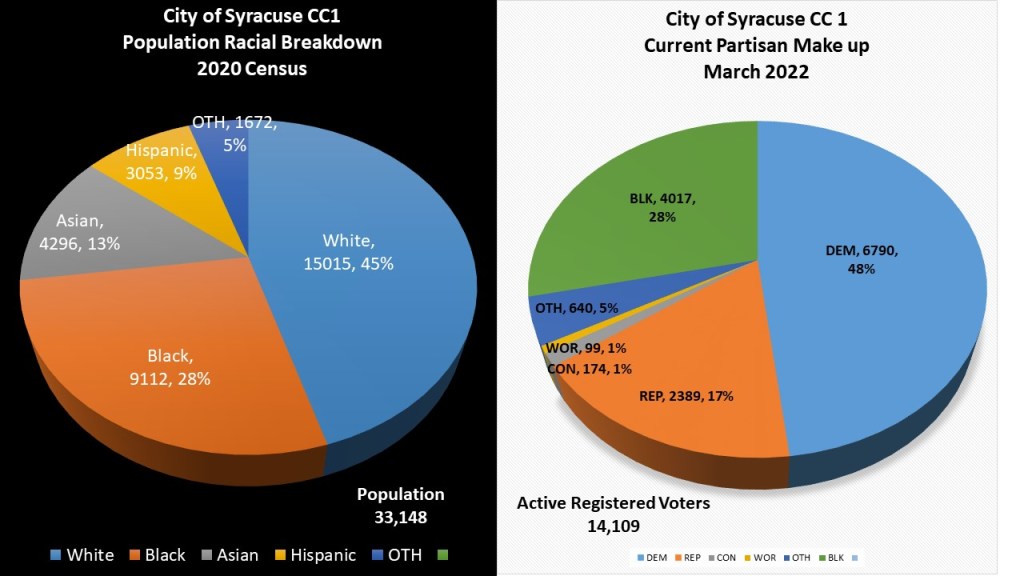
In the 2020 Census the 1st Common Council district was reported to have 33,148 residents in the 2020 Census. This is well over the average and a result of large Demographic changes on the North Side as well as the failure to redistrict at all in 2010. The racial makeup of the Common Council 1 according to the census is 45% white, 28% Black, 9% Hispanic, 13% Asian and 5% other. This district, because of an influx of new American refugees and a growing Asian community stands out in its racial makeup. It is the only common council district where ethe Asian community outnumbers Hispanic bringing it to #3 in the racial breakdown. Voter registration wise it is 48% Democratic, 17% GOP, 28% Blank or non-enrolled. This also stands out as different than other common Council districts as it is the only district where Democrats have failed to get over 50% in the enrollment.
Though Democrats have not been able to break the 50% mark in this district, their advantage over the GOP is on the rise in this district. Democrats have stayed flat in registration for the most part since 20009, rising and falling with the Presidential years with just 50 more voters than they had in 2009. The GOP though has lost 1061 voters since that time. The non-enrolled continues their trend inside the City of Syracuse being the fastest growing group gaining 431 voters since 2009. All registrations are currently on the decline which is normal in a post presidential year, we should add voters as the midterms and approach to the next Presidential year in 2024 are underway.
The first Common Council district stretches over 6 different wards inside the city. It has parts of the 1st, 3rd, 4th, 5th, and 9th ward. The only ward totally enclosed in the district is Ward 6. As we can see by the registration breakdown the 4th ward portion has a plurality of the vote followed by the 6th and then the 3rd. No wards have a demonstrably different enrollment advantage though the highest concentration of GOP voters is in the 4th ward portion which is the Sedgewick Farms neighborhood.
For our #wonkywednesday articles this year we will be using 5 races to compare how the subjects of our articles perform. We will be using the Presidential, State Senate, and Congressional races to see how our subject performs in a high turnout federal year. We will also use last year’s Supreme Court Race for a base on how the voters in the district react in a low turnout year. For the City of Syracuse, I am including last year’s mayoral race as well. The 1st Common Council district is still a reliably Democratic performing district in both high and low turnout years. All the results in this district in the comparative races the GOP does better in this district than any of the other five. In 2021 Jennifer Schulz won the 1st district seat switching it to Democratic hands for the first time in 6 years. This district seat is considered the only swing seat in the common council
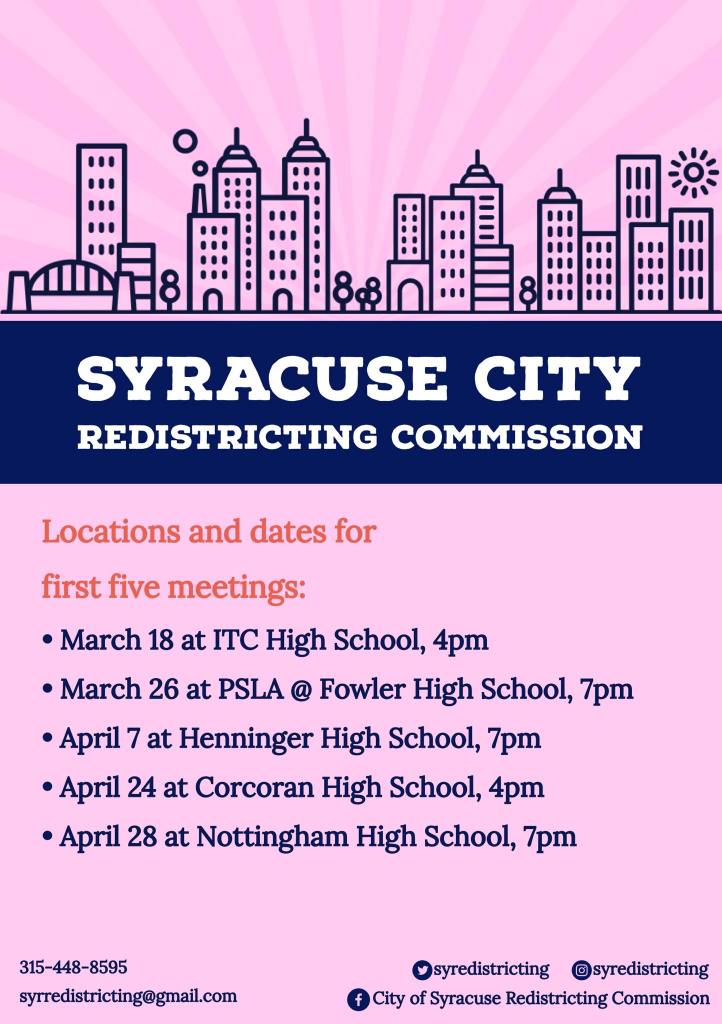
The City of Syracuse Independent redistricting Commission will meet 4 more times over the next six weeks to hear from the public on what they want from their new districts. They will be holding hearings at each of the city high schools. The first redistricting was held on Friday March 18th at ITC High School, and you can watch the live stream from Fairmaps CNY here. The next four meetings will be March 26 PSLA at Fowler High School 7pm, April 7 at Henniger High School at 7pm, April 24th at Corcoran High School at 4pm, and April 28th at Nottingham High School at 7pm. You can give testimony about what you would like to see in your city for the next ten years. Over the next few weeks we will delve into each of the 5 current districts.
“This is putting us on the map,” Onondaga County Democratic Elections Commissioner Dustin Czarny said. “This is the first city in New York to do this. First city east of the Mississippi to do this.”
In an era of redistricting controversy, this process is exciting to some like Czarny who served on the county Redistricting Commission, which resulted in district maps that Democrats in the Legislature threatened to sue over.
“We saw what happened with the county redistricting. We saw what happened with the state redistricting. Processes that seem to be doomed to fall. Hopefully, this process will be an example people will see to take politics out of redistricting and make it about what the people want,” Czarny said.
In this week’s Commissioner in a Car I give an overview of the City of Syracuse Redistricting process that is underway. I also talk about upcoming election events like petitioning in April. Enjoy.
Subscribe to dustinczarny.com for all content and election news updates
Dustin Czarny, the Democratic Elections Commissioner for Onondaga County, said population imbalance is a problem across the board. Czarny, who displayed the current maps at the meeting, said the area around Syracuse University’s South Campus is an extreme example.
“It’s a very transient district, where students only reside in their sophomore year, but you have several thousand. It’s very hard to figure out where to put it,” he said.
Czarny also pointed out there isn’t a district with a Black majority, even though the city’s population is X% African American, a concern echoed by many attendees.
For transparencies sake I am releasing my written testimony to the Syracuse Independent Redistricting Commission (follow link for future hearing dates), I am also posting a video of the redistricting hearing. It is important to note I have no voting power on this commission and my suggestions are made as a City resident and not on behalf of the Onondaga County Board of Elections as a whole. The commission itself will draw draft maps and my maps should only be seen as a way of starting conversation. I encourage all City residents to come to the meetings and share your thoughts. Finally I also released the high res pdfs of the maps and data files at the end of the testimony.
Syracuse Independent Redistricting Commission
Public Input Sessions March 18, 2022
Written Testimony
My name is Dustin Czarny I am the Democratic Elections Commissioner of Onondaga County, co-founder of Fair Maps CNY, and most importantly a Syracuse resident and native. I have had the honor to live in Syracuse for most of my life and the pleasure of living all over this city. I have resided in 4 of the 5 council districts during my lifetime. I grew up in Eastwood and currently live by Lemoyne college which is the 5th council district, in my twenties I had apartments on Court Street in the 2nd Common Council district, Oak St. in the first common council district, and on Hubbell Ave in the third common council district. Though I have not had the occasion to live in the 4th common council district I did work downtown for over two decades and aspire to one day be a downtown resident in my retirement.
In 2010 while serving in the Miner administration for the City of Syracuse I was asked by then Common Council President Van Robinson to advise on the census data and redistricting that needed to happen inside the city. Unfortunately, that advice never come to fruition. The City of Syracuse Common Council decided not to change any of the districts, or more accurately decided not to decide. At the same time Onondaga County Was undergoing a massive redrawing of districts that ultimately Turned out to be a political gerrymander that our county is still living with. I knew then what I believe now, there must be a better way.
This citizen led effort in the City of Syracuse is a culmination of ten years’ worth of activism, and planning. I am so happy to have had a part in bringing this possibility to the attention of City Leaders. They gave up power to take a chance on a better way to do redistricting. Common Council President Helen Hudson was a one-woman force moving this project to completion. Former Councilor Khalid Bey and current councilor Michael Greene supported this project with legislation. Mayor Ben Walsh and City Auditor Nader Maroon devoted city resources to give this project a great chance for success. Susan Lerner of Common Cause, Chris Ryan of the Onondaga County Legislature, and Joe Barry of the Syracuse Corporation Counsel office, and Pereine Wasser of Fair Maps CNY provided expertise and activism during the charter change and subsequent enabling legislation. Finally, the voters of the City of Syracuse overwhelming supported this project with 75% of them voting to change the charter to permanently make this happen.
So now before you is the task to not only redistrict Syracuse in a fair and transparent way, but to set an example that other communities can look to take politics out of redistricting. I believe you will meet this challenge and that is why I am happy to come before you today not as Elections Commissioner, but as a citizen of Syracuse, and give thoughts about some examples of changes that could be made to our districts to make them better. I am submitting this written testimony as well as maps and data to buttress my oral testimony on March 18th, 2022, to start discussions on how we can reflect our communities and our values as an inclusive and welcoming city in this once in a decade decision. I also want to thank Onondaga County planning, specifically Edward Hart, for help in putting together the maps and population estimates in my testimony.
Where We Stand Today
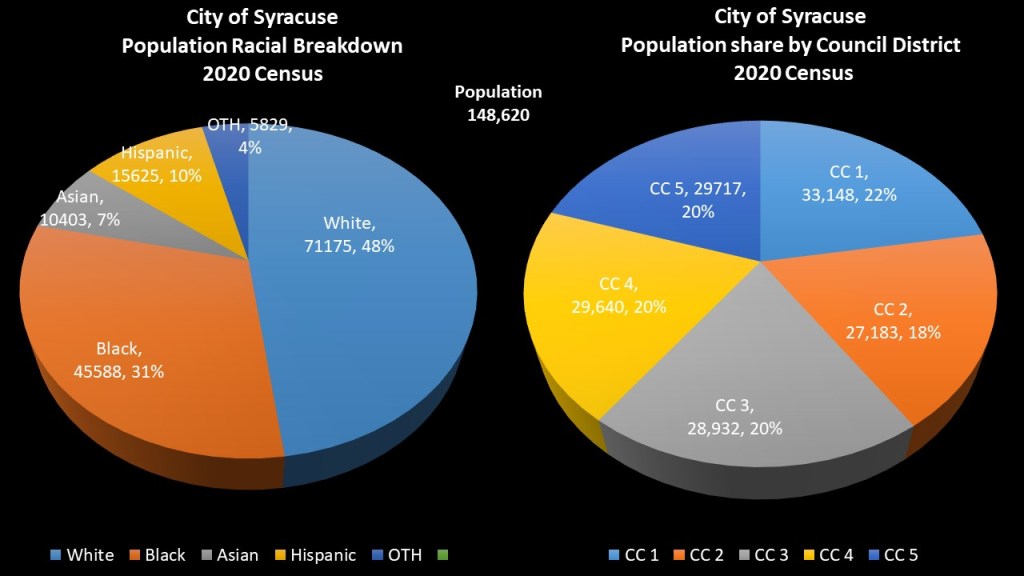
The decision not to adjust the districts in 2010 has had consequences. The emerging New American community in the north side of Syracuse has grown at a dramatic rate since 2002. This has put district 1 way out of proportion to the other districts. Under current NYS law these districts can not continue as the difference between the top district (CC1 33,148) and bottom district (CC2 27,183) is almost 18%, well over the 5% difference called for by law.
In addition, the growing student population at Syracuse University has radically changed the racial makeup of common council district 4. Traditionally this district has been seen as a black plurality district and an opportunity for someone of color to be elected to the Common Council. Syracuse has a rich and diverse history of electing candidates of color to our common council both city wide and inside various districts, but the fact there now are no black plurality districts in our common council districts is a cause for concern. The current maps do offer 4 minority majority districts but outside of common council district 4 the margin is hyper thin and cannot be truly consider minority opportunity district.
Least Change Concept
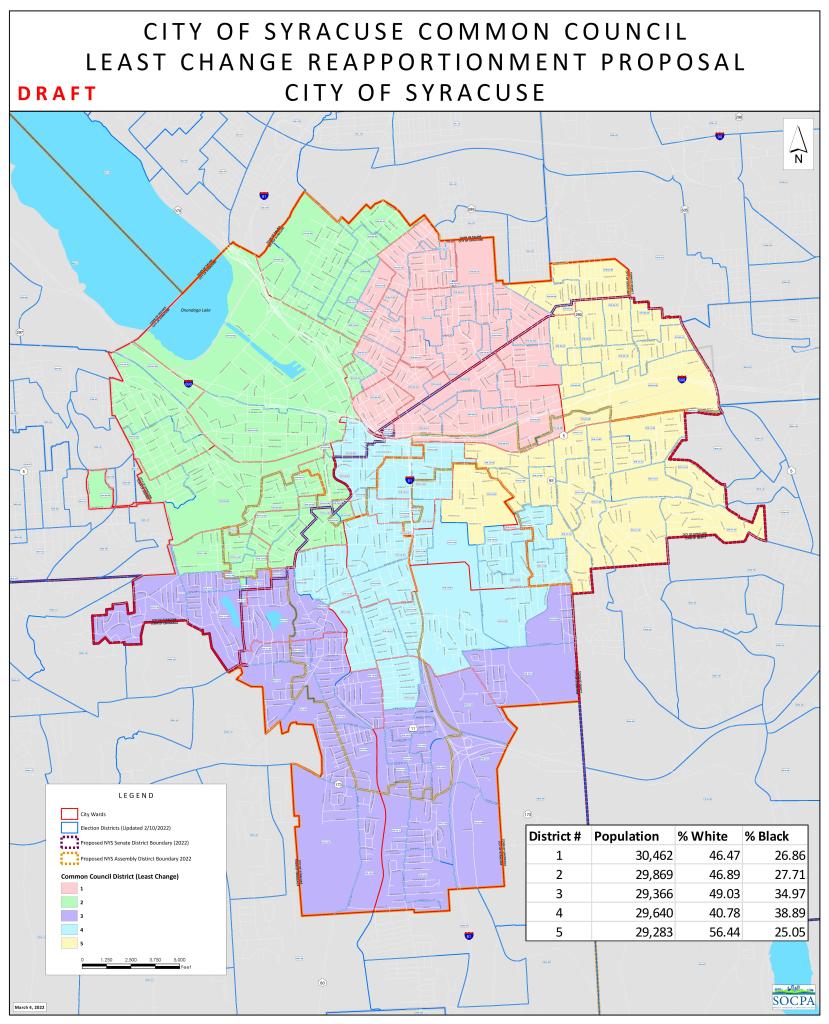
It may be the wish of tis body to offer as little change to the current districts as possible. There are valid reasons for doing so. These districts have been in place for nearly 20 years and the citizens are used to the borders. It would also be very simple to make small changes and balance out the population to comply with New York State law. If the commission decided to do that, I offer this least change concept for consideration.
To achieve a more balanced population we can move Ward 1 Election Districts 6,7, & 8 from Common council district 1 to common council district 2. In addition, we could move 19th Ward District 4 from the 5th common council district to the 3rd. By doing so the population deviation would only be 5.9& from the top (CC1 30,462) and bottom (CC5 29,283). While this concept will solve the population imbalance for the City of Syracuse it will not address any other concerns in my opinion as the racial and community makeup of the districts will remain the same.
The Quadrant Concept
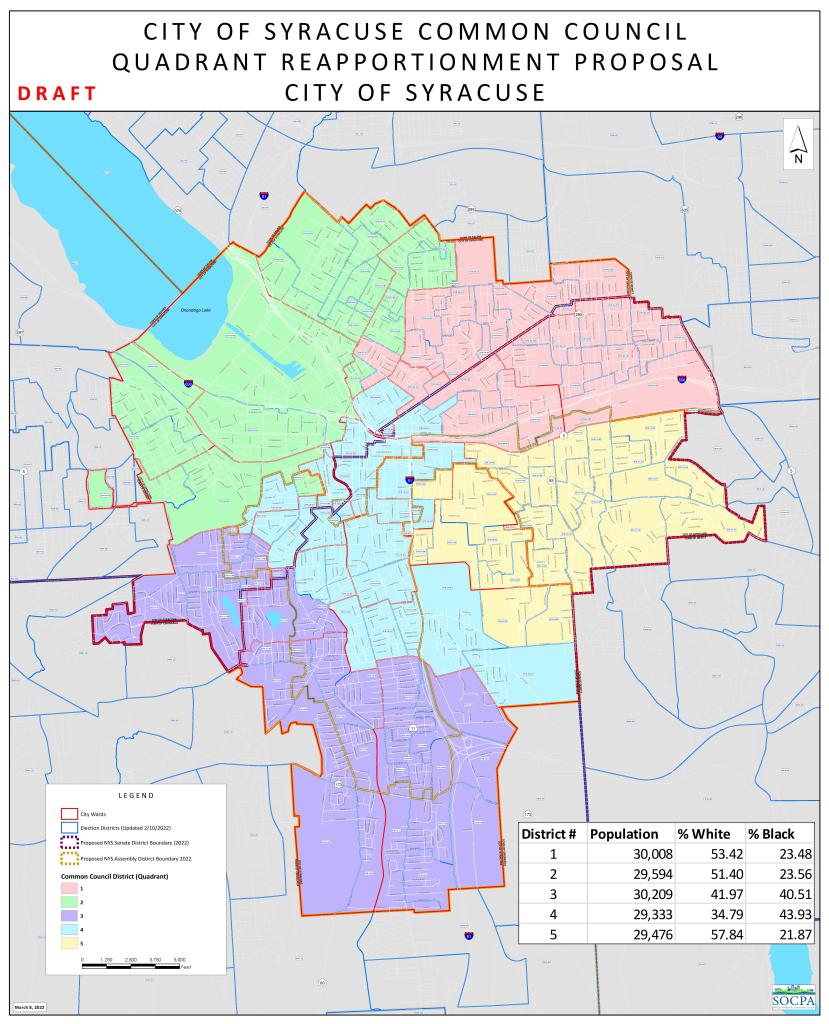
If the commission were to wish to make a more substantial change to our districts, I would like to suggest what I call the Quadrant concept. Our current districts cut through communities and ignore natural boundaries such as commercial roads that could help define the districts themselves. This also makes it harder for individual counselors to serve more diverse needs of a district. The City of Syracuse already has 4 councilor at-large office holders. They are tasked with looking over the city, district councilors should look over the needs of their district. That job would be easier if they represent like-minded communities.
In thew quadrant concept I envision 5 different districts with different needs. Common Council 1 would unite the neighborhoods of Lincoln Hill, Eastwood, and Strathmore. These communities already interact with each other and share Henninger Highschool as a common scholastic focal point. Common Council District 2 would unite the North Side Little Italy community with Tipp Hill. These communities are relatively small and different from the bordering communities around them. Using the commercial corridor of Destiny USA to join them makes a district that is not much different than the current 2nd district but keeps the North side whole inside the district as well as Tipp Hill.
Common Council District 3 would be focused on Strathmore and the Valley district allowing the representative to focus on the southwest side of Syracuse. This district would create a minority majority district and in time could become another black plurality district as the demographics of the city continue to change. Much of this district also shares Corcoran High School as a focal point. Common Council district 4 would focus on the center of the city creating a solidly black plurality district and uniting some of the poorer neighborhoods of our community. By uniting them in one district we will give those voices power in government instead of splitting their voices into different districts. Much of the district share ITC or Fowler as a High school focal point tying the families together.
Finally Common Council district 5 would be the east side district uniting the college communities of Syracuse University and Lemoyne. The emerging student rental community is now split into 3 separate common council districts. This highly transient university neighborhood combined with the Bradford Hills portion of the east side share Nottingham High School to bring families and students together.
If this concept were put in place the population deviation would only be 2.9% and well under the 5% state guidelines. We would have two minority majority districts with one being a black plurality district. Two other districts would only be a slight majority white, and demographics could overtake those districts overtime as well.
One alternate to the quadrant concept has to do with the 4th and 3rd common council district. The South campus community in Ward 19 district 3 poses a large problem for redistricting, these students represent a large portion of the population but only stay in that community for one year as the move on south campus into other housing as they enter their junior and Senior years. We must account for this population which is not as diverse as their neighboring areas. If the committee wished to have a higher black plurality in common council 4 the south campus community could be included in Common Council district 3 and the neighborhoods around Onondaga Street in the 11th ward could be included in Common Council district 4.
If these concepts were put in place the population deviation would only be 2.1% and well under the 5% state guidelines. We would have two minority majority districts with one being a solidly black plurality district. The second minority majority district though would only be slightly minority. Two other districts would only be a slight majority white, and demographics could overtake those districts overtime as well.
Election District, Ward Line, and Assembly and Senate Line Considerations
Finally, I wanted to address some concerns I have as an election administrator. I did the maps above using data compiled for the Onondaga County Reapportionment Commission, of which I was a member. That Commission made the decision to try and do the changes based on existing election district lines. The hyper short time frame and lack of consultants and investment led to this decision. The Syracuse Independent Redistricting Commission has time and consultants to dive into the block level data. You do not need to adhere to individual Election District lines. If you make changes the Board of Elections will draw new Election Districts in 2023 to accommodate them.
I do as you keep in mind Ward lines as well as Assembly and Senate lines. These are unmovable lines that the local Board of Elections has no control over. Keep this in mind when you are considering the borders of your districts. IF a border crosses these lines, we must make a new Election District to accommodate that. Micro block long election districts can often result. These micro districts are not only hard to define, but they can also have a voter suppression quality. It is often hard to find adequate polling places inside the city and small block long districts may have to travel far to get to their nearest polling place. Different ballot styles are created and cause confusion for election inspectors at time.
Thank you once again for your willingness to devote your time and efforts to making our Democracy better. I can’t wait to see the maps this commission comes up with and look forward to administering elections for them.
In this week’s Zoom with Czarny I sit down with Joanna Zdanys of the Brennan Center for Justice at NYU Law. She is the Senior counsel for Elections and Government. We have an in-depth discussion about the upcoming Public Campaign Finance system coming to New York at the end of this year. Its a great interview sand I hope you enjoy it.
Subscribe to dustinczarny.com for all election news and content updates
“Onondaga County Elections Commissioner Dustin Czarny indicated the pace of voting was very brisk, with a vote being processed every 1.15 minutes throughout the 15 hours the polls were open.”
As the 2020 Census approached, Czarny and another advocate for nonpartisan redistricting, Susan Lerner, executive director of the good government group Common Cause New York, pushed for the citizen-led model to be adopted in Syracuse.
The Onondaga County Legislature rejected the idea. But the Syracuse Common Council voted to adopt it, and city voters approved the change in a 2019 referendum. Until then, city lawmakers drew the district boundaries themselves.
“It really is a credit to the Common Council,’’ Czarny said. “They were willing to give up power. That is not the usual scenario. And that’s commendable.’’
….
“I really hope that at the end of this process, we will be saying this was the right way to do it,’’ Czarny said. “My plan is to show it to state lawmakers and say, look, 10 years from now, you should really be thinking about this.’’
Welcome back to #WonkyWednesday. Each week I take a deep dive into the electoral and registration data that make up Onondaga County and New York State. Over the next few weeks I will be investigating the City of Syracuse. Usually I dedicate #wonkywednesday articles to races happening in the current year, however there are no races in Syracuse this year. I have decided to spend the next several weeks highlighting Syracuse because an important process is underway. The Syracuse Independent Redistricting Commission will be holding 5 public meetings over the next 7 weeks to develop their draft redistricting plan. This citizen led redistricting process depends on you to give input before they redistrict the five common council districts that make up our city. At the end of this article I will post the next meeting times so you can attend.
In the 2020 Census the City of Syracuse was reported to have 148,620 in the 2020 Census. The racial makeup of the City according to the census is 48% white, 31% Black, 10% Hispanic, 7% Asian and 4% other. The City of Syracuse has not undergone redistricting since 2002. The Council failed to enact redistricting after the 2010 census. Districts should average approximately 29,700 population. This has resulted in an imbalance in the 5 common council districts. Common Council district 1 is way over populated with 33k population. Common Council District 2 is very underpopulated with just 27,183 citizens. Common Council 3 is slightly under populated with 28,932 voters. Common Council 4 (29,640 citizens) and Common Council 5 (29,717 citizens) are near the average.
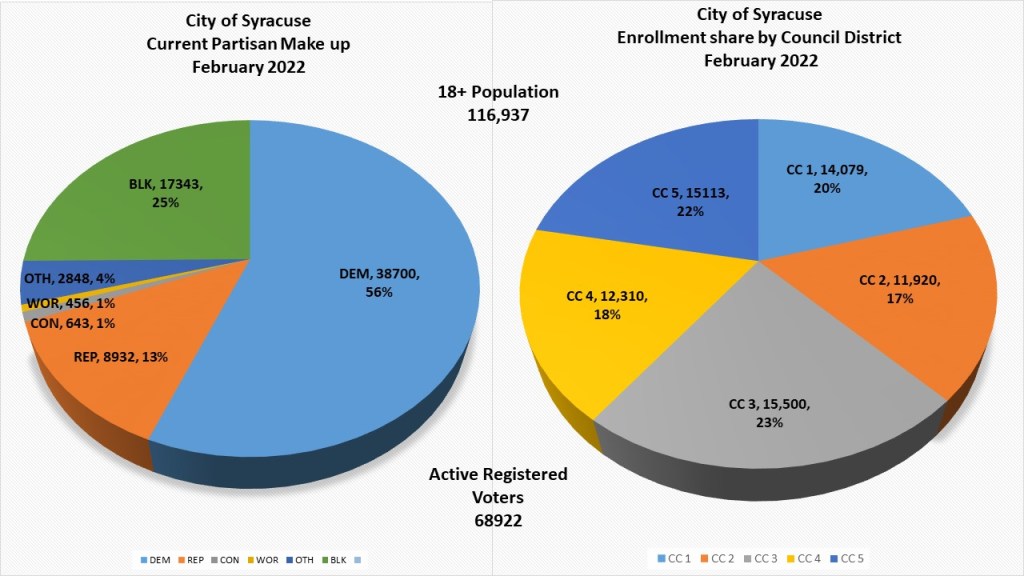
The City of Syracuse has definitive Democratic partisan lean. 56% of the City of Syracuse is Democrat followed by 25% of the City Blank or non-enrolled. The GOP actually comes in a distant 3rd with just 13% of the registered voters. As far as registered [population, the current registration only 58.9% of the 18 over population. Much of the unregistered in the city though may not be able to register with a high concentration of the non-citizen population. Also students at SU and Lemoyne who may be registered at their home address. When we look at the common council districts we see that population sometimes corresponds with registered voters. Average for 68,922 voters is 13,784. Though CC 1 is the most populous district, it is middle of the road in registered voters at 14,079. CC2 though is lagging in registered voters as it is in population at just 11,920 voters. CC 4 is of average population but under registered at 12,310 voters. CC 5 and CC3 are actually over the average for registered voters both topping 15k.
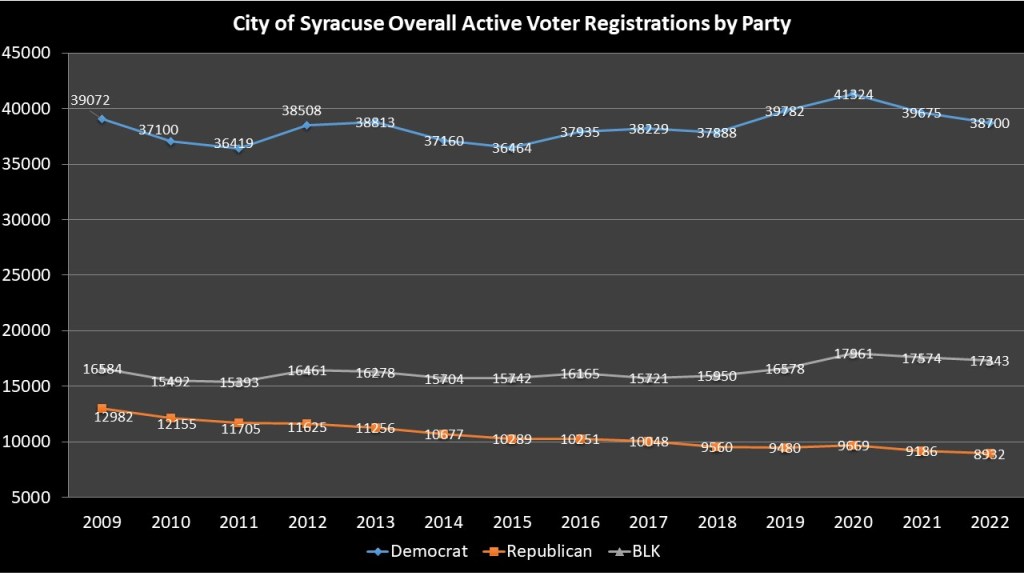
Democratic domination of the City of Syracuse in registered voters is not a new phenomenon and it is only getting worse over time. Democrats have stayed about even in raw registration numbers with a small loss of 372 voters since 2009. Republicans have lost 4050 voters since 2009. The story that seems to be told in the City of Syracuse may be the rise of non-enrolled voters. They have gained 759 voters since 2009 and well distanced themselves from the GOP cementing 2nd place. While the Non-enrolled are gaining on the Democrats it will still be a long time, if ever, they will catch up as they are less than half the current enrolled Democrat number.
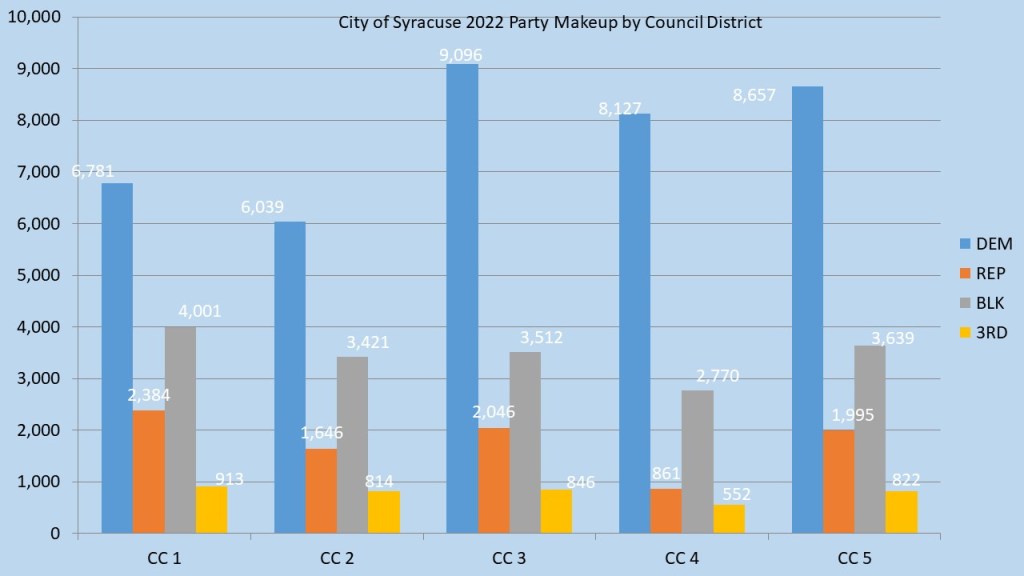
As we can see the district breakdowns reflect the city as a whole. Last year for only the second time in City history, Democrats won every district seat on the Syracuse common council. The districts vary in Democratic advantage but all are solidly blue. Even the last district that was in GOP hands, District 1, has a 3 to 1 advantage for the Democrats. In every district the non-enrolled outpace the GOP by a wide margin.
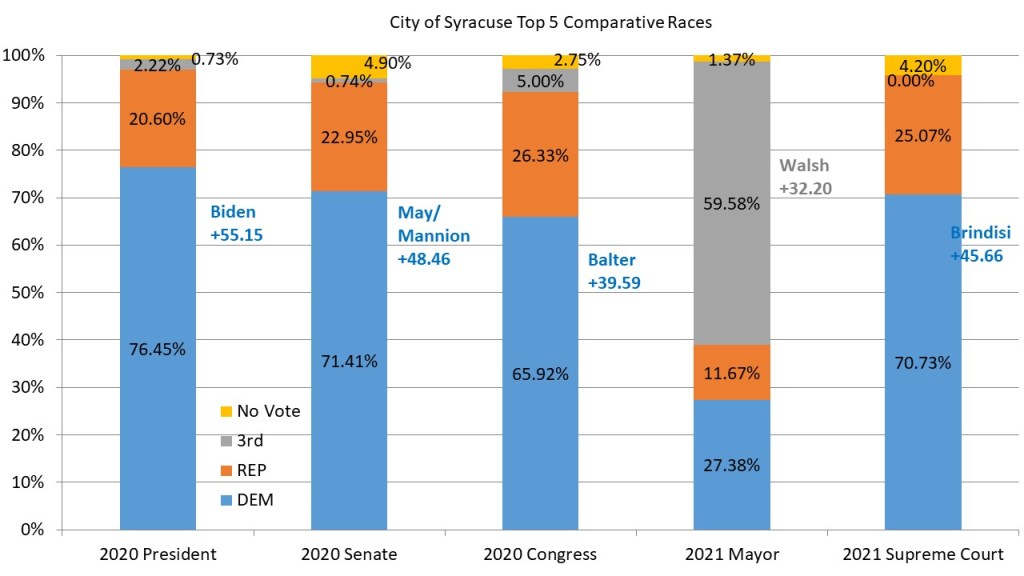
For our #wonkywednesday articles this year we will be using 5 races to compare how the subjects of our articles perform. We will be using the Presidential, State Senate, and Congressional races to see how our subject performs in a high turnout federal year. We will also use last year’s Supreme Court Race for a base on how the voters in the district react in a low turnout year. For the City of Syracuse I am including last year’s mayoral race as well. The City of Syracuse performs for the most part how you would expect the registration to perform. Biden won by over 55% in 2020 in the City of Syracuse. The NYS Senate races also did very well combining for an over 48 point margin in 2020. Dana Balter had nearly a 40 point margin out of the city, though 5 more points were wasted on the WFP line. Anthony Brindisi in a GOP friendly year still managed a 45 point victory out of the city. Given all that it makes Walsh’s victory in 2021 even more impressive. His 3rd party run had a 32 point victory in 2021 winning with well over a majority of the vote.
The City of Syracuse Independent Redistricting Commission will meet 5 times over the next seven weeks to hear from the public on what they want from their new districts. They will be holding hearings at each of the city high schools. The first redistricting hearing will be at 4pm Friday March 18th at ITC High School at 4pm. The next four meetings will be March 26 PSLA at Fowler High School 7pm, April 7 at Henniger High School at 7pm, April 24th at Corcoran High School at 4pm, and April 28th at Nottingham High School at 7pm. You can give testimony about what you would like to see in your city for the next ten years.
Over the next few weeks we will delve into each of the 5 current districts starting with Common Council district 1 next week.
Subscribe to dustinczarny.com for election information and content updates.




 Dustin M. Czarny